This article is published in Aviation Week & Space Technology and is free to read until Nov 08, 2026. If you want to read more articles from this publication, please click the link to subscribe.
Aftermarket Logistics Managers Adapt To Supply Chain Paradigm Shifts

A recent Oliver Wyman survey found that material shortages, geopolitical issues and tariffs are disrupting the MRO industry.
The MRO industry has been reeling for the past six years from the effects of the global pandemic—and more recently, tariffs and regional conflicts.
These and other unanticipated disruptions could be the new normal, according to a recent report from Oliver Wyman that analyzes shifts in the MRO supply chain. More than 150 aviation professionals surveyed in the report indicated that they do not see post-COVID-19 supply challenges subsiding anytime soon—if ever. Optimism about recovery occurring in less than three years fell to 60% from 70% in 2025 and 80% in 2024. The percentage of respondents that expect no recovery within 36 months also grew to 27% from last year’s 14%.
Nearly 90% of respondents reported experiencing tariff impacts; component purchases, repairs and engine overhauls ranked as the most vulnerable. The survey concluded that geopolitical issues and tariffs have been the second-highest disruptor to the industry after material shortages.
Today’s geopolitical situation has considerably complicated logistics planning, says Batuhan Çakirosmanaki, purchasing and sales executive at EirTrade Aviation, a Dublin-based global asset management and aviation parts trading company.
“The Middle East is the sharper case,” he says. “Conflict between the U.S., Israel and Iran since February 2026 has repeatedly closed or restricted airspace across Iran, Iraq, Kuwait and neighboring states; pressured shipping through the Strait of Hormuz; and pushed jet fuel prices higher at points. Ceasefires have proven fragile, with renewed strikes, . . . so planners now build routing, insurance and delivery assumptions around the risk of it flaring up again rather than treating any de-escalation as final.”
The Russia-Ukraine war also has had an impact. “Russia remains a major source of aerospace-grade titanium through VSMPO-Avisma, and Western manufacturers are still working through a diversification process that’s taken nearly four years and isn’t finished,” Çakirosmanaki says. “Between the two conflicts, geopolitical risk has become a standing input in planning rather than an occasional shock.”
Vallair Chief Commercial and Marketing Officer Pascal Parant cites the negative effect of temporary airspace closures in the Middle East on material supply. “Shipping parts into the region becomes extremely difficult whenever the airspace is closed,” he says. “It is obviously a challenge for MROs located in the region but also an opportunity for MROs outside the region.”
NEW PLANNING METHODOLOGIES
Logistics managers must rethink traditional approaches to material sourcing, procurement and inventory management and adjust accordingly.
“The pandemic and recent engine availability issues reinforced one key fact: Logistics has become a strategic enabler of MRO performance,” says Özgür Yesilkaya, CEO and managing director of Lufthansa Technik Logistik Services (LTLS). “We made it a priority to sit down early in the process with our colleagues from production, making sure we were anticipating challenges before they became bottlenecks.”
He adds that LTLS has put an “even stronger focus” on performance measurement, employing greater detail and transparency for management with all team members involved, to track every step from when a part comes in to when it is ready for use again.
Yesilkaya lists labor as another post-pandemic logistical change. “We’re increasingly taking logistics-related tasks off the mechanics’ hands,” he says. “By assigning more of these responsibilities to dedicated logistics specialists, we let our mechanics focus fully on their core work. Our logistics became more efficient, and our technical teams can concentrate more on what they do best.”
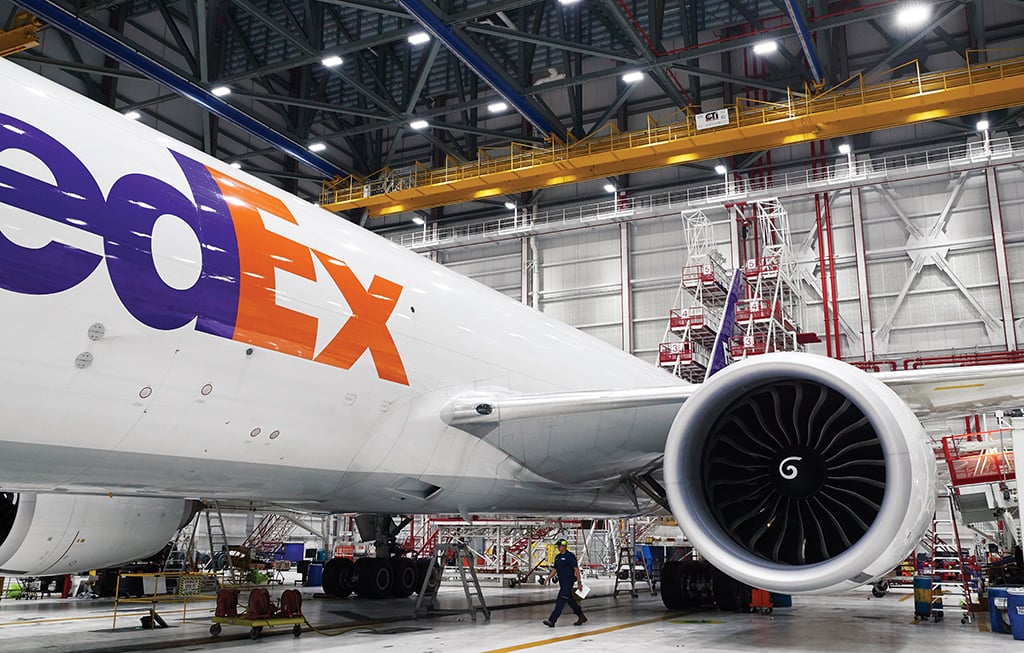
In response to the pandemic and subsequent global supply disruptions, FedEx has shifted MRO logistics and planning from a purely low-cost just-in-time (JIT) doctrine to a hybrid, risk-based approach that blends JIT with “just-in-case” measures where warranted, explains Tommy Johnston, managing director of supply chain management.
“The change is toward selective inventory buffering, smarter sourcing and increased visibility so that resilience is applied where it delivers the most operational value,” he says. “That meant bigger buffers for critical spares, faster emergency transport options, stronger supplier relationships and multisourcing, deeper use of data/predictive maintenance and tightened coordination between procurement, maintenance and operations.”
Johnston notes that FedEx has extended the service life of older airframes due to delays in new aircraft deliveries. “To support these higher-time airframes, we proactively adjusted our inventory levels and strategy to ensure a reliable supply of critical parts, maximizing fleet availability without experiencing operational bottlenecks,” he says. “Additionally, we face challenges with OEM engineering and support response times required for our internal and vendor heavy maintenance locations. To manage these delays, we plan for extended check span times and additional maintenance.”
Going forward, Johnston sees more use of data digitization such as electronic adaptive replacement cache, predictive analytics and artificial intelligence (AI) to anticipate part needs, multi-echelon inventory optimization to position the right spares at the right locations and greater supplier collaboration through vendor-managed inventory and parts pooling. “These trends help improve resilience, reduce costs and enhance fleet up-time,” he says.
Çakirosmanaki at EirTrade affirms that the industry has moved away from pure JIT to a risk-based hybrid. “You build buffer stock for high-failure, long-lead or dispatch-critical items (engines, [life-limited parts], high-value rotables) while staying lean on low-risk, readily available consumables,” he says. “This is now extending down into smaller, low-cost items, too, such as seals [and] connectors, since a $50 part being unavailable can ground an aircraft just as effectively as a missing engine.”
Çakirosmanaki adds that pooling arrangements, power-by-the-hour programs and extended vendor contracts are used alongside owned inventory to protect against stock-outs without carrying the full capital burden alone. “The hybrid model is exactly what we aim to achieve at EirTrade,” he says.
As for a trend toward high-volume purchases of parts and away from JIT, Vallair’s Parant says that will depend on the airline. “Large fleet operators are combining JIT with strategic inventory management,” he notes. “Airlines operating a hundred aircraft of the same type tend to build inventories based on the history of previous maintenance checks. In contrast, smaller operators often lack the historical data or simply do not have the cash to buy this kind of availability insurance.”
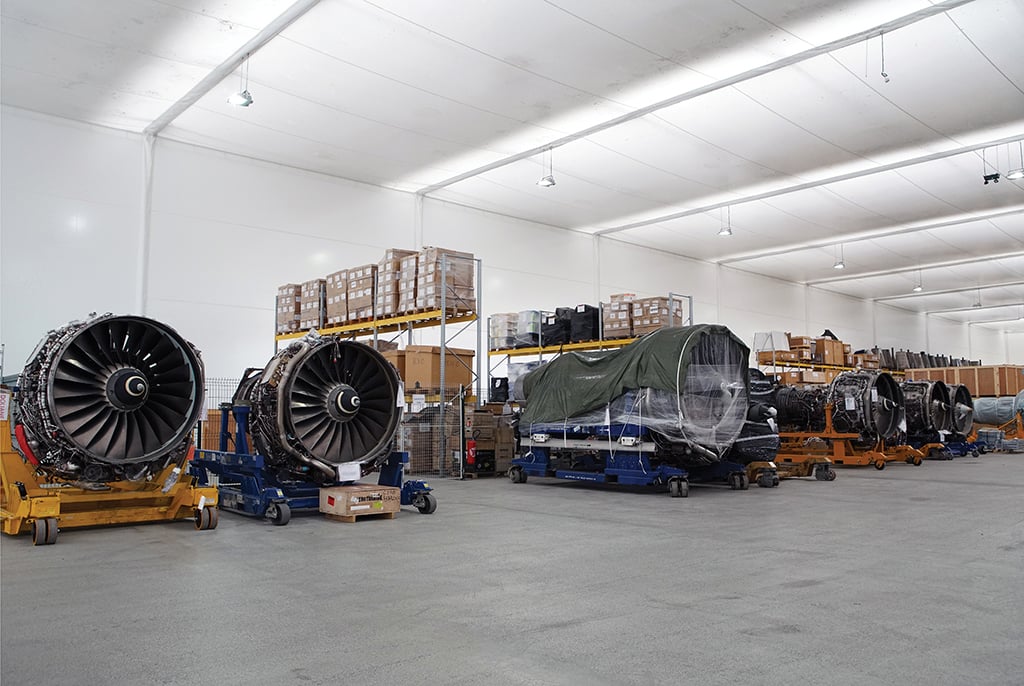
Engines remain the weakest point, given unscheduled removals and durability issues on some new-generation products, Parant notes. With “the unprecedented production ramp-up that has put thousands of engines into service in a very short time and the resulting bottlenecks in both MRO capacity and parts manufacturing, there is not much that can be done beyond optimizing [used serviceable material], using [designated engineering representative] repairs and, in some cases, [parts manufacturer approval] parts,” he says.
AI INROADS
According to Yip Hin Meng, deputy president of commercial aerospace at ST Engineering, AI is gaining traction particularly in areas such as reliability forecasting, maintenance planning and material management.
“At ST Engineering, we actively explore and apply AI-enabled tools across our MRO operations, with several already delivering better planning, improved visibility and enhanced resource deployment,” he says.
Yip cites a production planning control system that is being developed for engine MRO to help automate planning inputs and suggest more efficient use of machinery, labor and inventory. The system is designed to give planners better visibility into facility utilization, scheduling gaps and downstream coordination needs to improve planning efficiency and operational responsiveness.
MRO logistics management will likely become more predictive, connected and automated, Yip says. “AI, data analytics and other emerging technologies will support more condition-based maintenance planning, helping operators improve parts-demand forecasting, optimize inventory and reduce unscheduled removals,” he says.
At the facility level, Yip expects that next-generation MRO operations will also increasingly leverage automation, smart warehousing, robotics, digital workflows and real-time visibility to improve both planning and shop floor logistics.
“For example, our newest airframe maintenance facility in Changi Creek, Singapore, is digitalizing the part handling process end-to-end,” Yip notes. “With data being validated once parts arrive at our warehouse, the parts are then quality-inspected using AI and nondestructive testing methods, labeled and stored in high-density automated storage and retrieval systems.”
When a part, tool or consumable is requested, an autonomous mobile robot will be deployed to deliver it from the warehouse to the hangar floor, reducing repetitive logistics work and allowing engineers and technicians to focus on higher-value maintenance tasks.
Çakirosmanaki cites AAR’s Airvoyant as an example of an AI-driven procurement platform. Built on Amazon Web Services, Airvoyant connects buyers to suppliers, automatically sources quotes and integrates with enterprise resource planning (ERP) systems like Trax and Aeroxchange’s supplier marketplace. Launched in April, the platform reflects a broader pattern across the roughly $7 billion MRO software market.
“AI-driven forecasting and inventory tools are increasingly built directly into existing ERP and maintenance systems rather than sitting apart from them, so procurement, inventory and maintenance forecasting live in one connected system instead of several that have to be reconciled by hand,” Çakirosmanaki explains. EirTrade is keeping tabs on the AI-powered procurement platforms being developed as it looks forward to adapting to “this new era,” he adds.
Ian Foster, vice president of MRO and technical at APOC Aviation, a Netherlands-headquartered aircraft part-out specialist, notes that modern AI systems combine aircraft sensor data, maintenance histories, flight profiles and environmental conditions to estimate when a component is likely to require removal or overhaul.
“One of the largest benefits of predictive maintenance is more accurate forecasting of spare-part demand,” he says. “Instead of stocking components according to historical averages or fixed maintenance intervals, AI predicts which components are likely to require replacement across an entire fleet.”
“The optimization of logistics operations is one of the areas where AI and advanced analytics deliver real value,” says Yesilkaya at LTLS. “Along with building forecasting models that predict inbound material volumes and demand patterns at each station, we’re rolling out AI-driven tools for automated data capture and processing, which boosts both data quality and availability. With better data and smarter forecasts, our operational decisions are driven by actual demand—not static assumptions.”


Related Content