This article is published in Aviation Week & Space Technology and is free to read until Dec 09, 2026. If you want to read more articles from this publication, please click the link to subscribe.
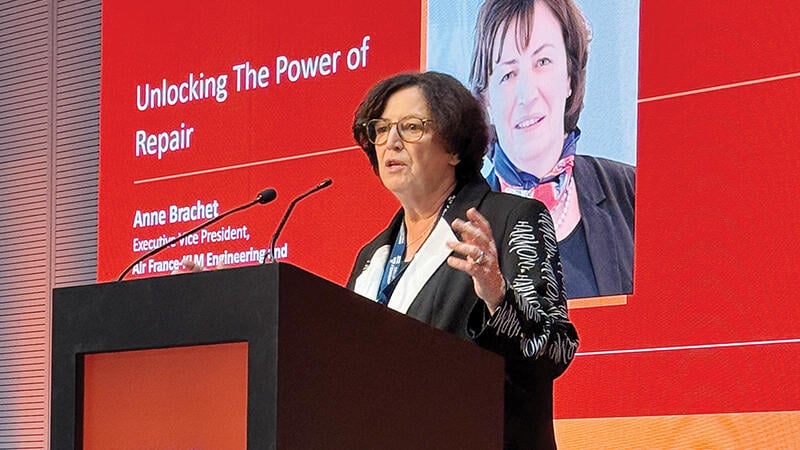
Anne Brachet, executive vice president of AFI KLM E&M
During MRO Europe in Amsterdam, I noticed a new intensity to supply chain conversations, especially when it came to repairing parts.
Accepting that the shortage of parts “is the new normal” will no longer be tolerated, said Anne Brachet, executive vice president of AFI KLM E&M. She acknowledged that OEMs and suppliers have made considerable investments to recover from the COVID-19 pandemic, but that, collectively, the industry needs to do more. “Because today, when you operate an airline, if you compare how many spare aircraft are needed, it requires more aircraft to fly the same flight hours,” which is too costly, Brachet pointed out.
Prominent engine maintenance shops around the world, including AFI KLM E&M, also have invested to ease long lead times and accommodate increased demand. “We extended the shop to have . . . more space to just park engines waiting for parts,” Brachet said. “We almost doubled the [works in progress]. That’s crazy.”
She emphasized that the supply chain is in a crisis, and noted that “we [won’t] see a clear recovery” unless systematic fundamentals change—a big one being enabling more parts repairs. AFI KLM E&M and others “have plenty of competencies, and we need to be able to use all of them in a fair and balanced business model,” she said.
Delta TechOps—which, like AFI KLM E&M, understands the airline operations viewpoint—reports that some OEMs are more willing to partner with it on legacy products, “using our extensive repair knowledge and data that we have through the years, and using alternative methods—be it repairs or additive manufacturing—to fill those gaps,” said Basil Papayoti, vice president for commercial. He also sees some OEMs approving Delta-developed repairs faster because of the critical supply chain situation.
BAE Systems has been rolling out deeper repair schemes for its products through its Horizon Solutions offerings—even for very old ones, like a 43-year-old thrust management computer on a Boeing 767. Overhaul for that part comes with a four-year warranty and “helps mitigate the risks of stretching out fleet operations,” said Josh Art, aftermarket program engineering manager. “Customers see the value quickly” of the overhaul options and often choose them over standard repairs to lower life-cycle costs, Art said.
While increased fuel costs and the prospect of intensifying conflict in the Middle East could cause some airlines to retire older aircraft, “we are industrializing new-generation and legacy product today at Delta to keep our airplanes flying,” Papayoti said. “We fly the oldest [Airbus] A320s and we fly the newest A320s, and there’s a huge spread in between. And we’ll still be flying legacy [Boeing] 747s and 767s for a long time,” as will cargo customers, he added.
Expect repair development to continue ramping up next year.

Related Content