This article is published in Aviation Week & Space Technology and is free to read until Jul 09, 2026. If you want to read more articles from this publication, please click the link to subscribe.
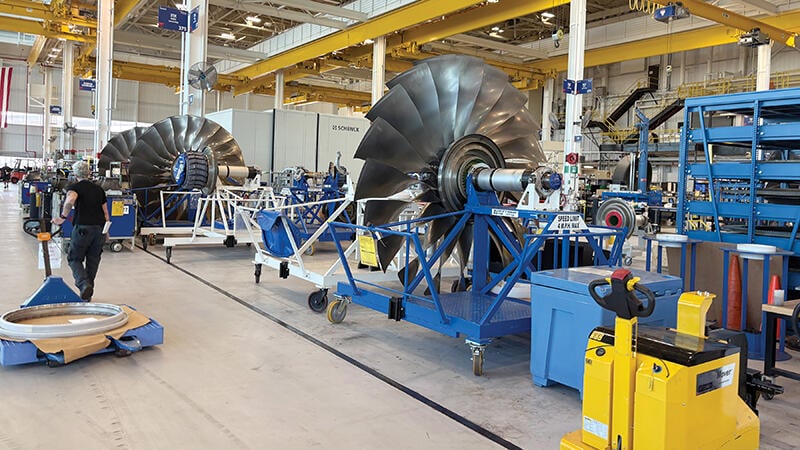
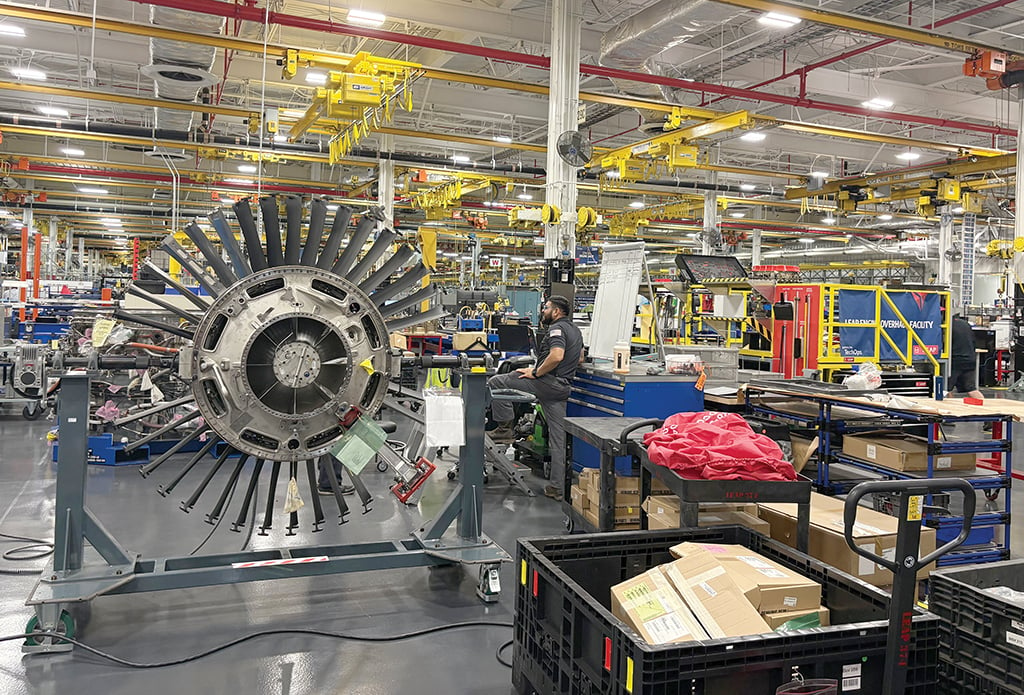
Delta TechOps’ Rolls-Royce Trent shop in Atlanta primarily focuses on third-party work.
Since coming on board at the beginning of this year, Delta TechOps’ new chief commercial officer, Marc Meredith, is on a mission to expand the company’s third-party business by billions of dollars in the next couple of years.
“This is going to be aggressive growth,” Meredith tells Inside MRO. “We’re going to go after the third-party market like we haven’t done before.” He says the company “is going to trip over” the $1 billion revenue it aims to reach this year, and he expects this to grow to $2-3 billion by the end of the decade. “Our target is to be a $5 billion business, similar to some of our bigger competitors,” such as Lufthansa, he adds.
The aftermarket provider’s portfolio is about 80% internal work for Delta Air Lines and about 20% third-party work. “Eventually, I would see a 50-50 split,” Meredith says. “Whether that could all be done in Atlanta or we’d need other footprint is something that we’re working on right now. The existing Atlanta and Minneapolis footprint would probably get us [to a] scale of about $2 billion, maybe a little bit higher. So then we’ll be looking for other inorganic kinds of solutions to get much beyond that.”
One option could be mergers or acquisitions, he says. The company is also exploring opportunities with airline alliance partners. At MRO Americas in April in Orlando, Delta TechOps announced a long-term MRO collaboration with LATAM Airlines Brasil, with an initial focus on Airbus A320 component repair. Under the partnership, select Delta A320 components are to be transitioned to LATAM’s repair facility in Sao Carlos, Brazil.
Delta TechOps has been ramping up its third-party engine and component MRO deals. In December, the company signed its first third-party CFM International Leap-1B maintenance contract with Korean Air. It signed an eight-year exclusive CFM56-5B maintenance contract with IndiGo at MRO Americas and last October signed a long-term support contract to provide component services in Atlanta for UK leisure carrier Jet2’s narrowbody fleet.
While component MRO accounts for only 10-15% of Delta TechOps’ third-party business, Meredith believes the component business could grow 6-8 times. “The component business is a little gem here that’s probably a little bit hidden, because everyone tends to talk engine maintenance, but the scale and breadth of it is huge,” he says. Delta TechOps has 26 dedicated component shops that can help support nose-to-tail services.
Engine maintenance is undoubtedly a driver in the company’s third-party work as it continues to expand capabilities in Atlanta. Delta TechOps became the first North American airline MRO provider licensed to support both the Leap-1A and -1B in March. The company has already inducted its first Leap-1B for Korean Air and expects to induct its first Leap-1A by year-end.
“We have those engines coming into our fleet, and we’re starting to offer MRO services to third parties on them prior to [induction into Delta’s] fleet,” Meredith says. “That’s not been the traditional way that we’ve worked it here.
“We’ll start to see [Leap]-1As and -1Bs coming through the shop in large numbers, and they’re all largely going to be third-party customers,” he adds.
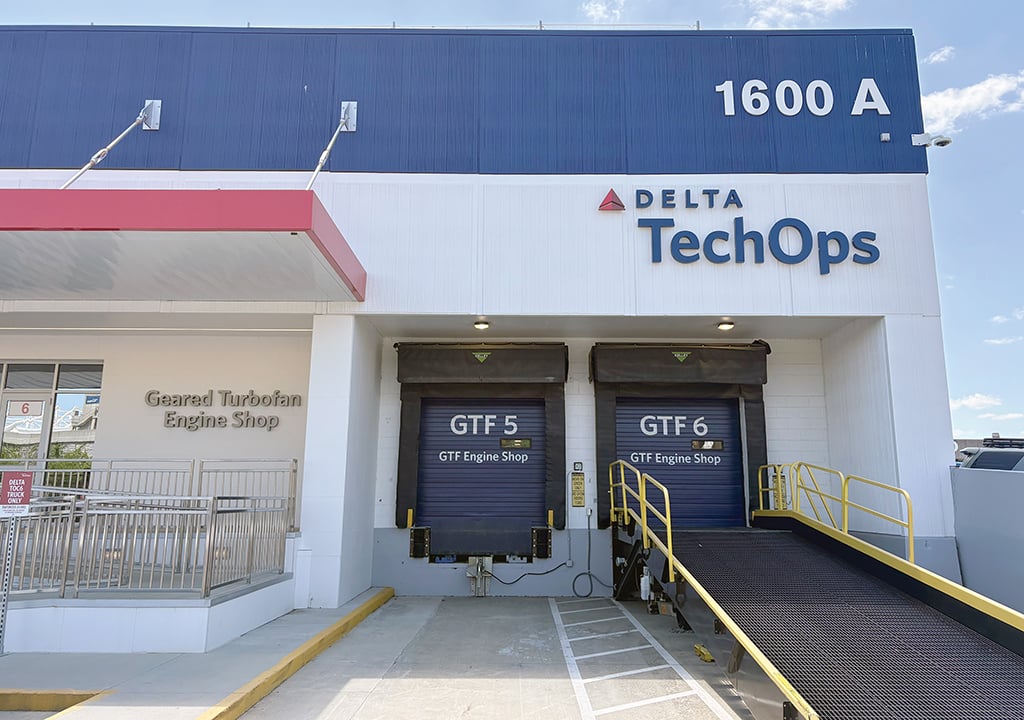
Delta TechOps opened a new Pratt & Whitney geared turbofan (GTF) shop in Atlanta in early 2023, and that has been quickly ramping up output. In 2024, the site serviced about 90 engines and last year about 150. Delta TechOps aims for the shop to reach 240 this year. “We’re growing to be a 400-a-year facility in the next couple of years,” Meredith says, projecting that this will likely happen by 2030.
As demand increases, the GTF shop is working on speeding up turnaround times (TAT). The site has been averaging about 120-day TATs. Delta TechOps aims to reduce this rate to the 70s by implementing continuous improvement within the shop’s flow and accelerating training and hiring. One GTF shop leader tells Inside MRO that Delta TechOps was able to demonstrate a TAT of only 45 days during a “pit stop” experiment with Pratt & Whitney to show what was possible with all necessary engine parts on hand—beating the 50-day record of one of Pratt’s owned GTF shops.
“There’s a lot of effort right now on continuous improvement across the business,” Meredith says. “How are we optimizing the time we’re taking in the shops and factories to improve what we can control?”
The Rolls-Royce Trent is another engine platform on which Delta Tech-Ops is securing third-party work. Business at the company’s Atlanta Trent shop—which supports the Trent 1000, 7000 and XWB—is about 75-80% third-party. While Delta has Trent 7000s and XWBs in its fleet, it does not operate Trent 1000s, so all that work is performed for customers.
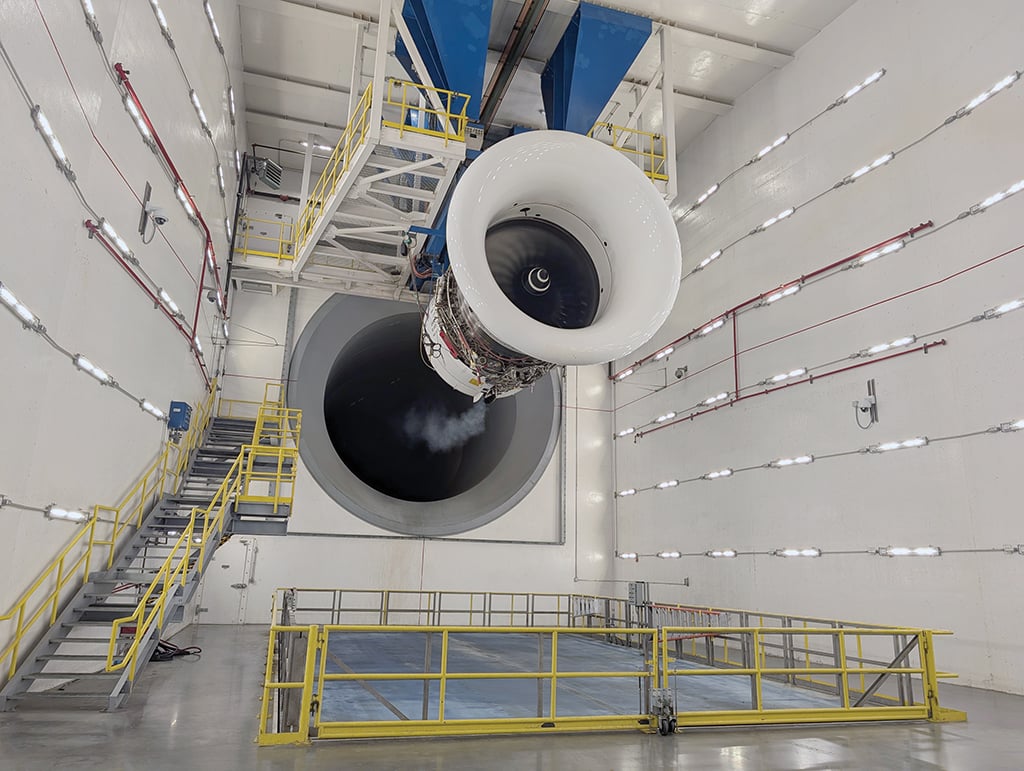
Delta TechOps is also expanding test cell capabilities in Atlanta. The company opened the world’s largest production test cell there in 2019, and it is aiming to test more than 750 engines there this year. Demand for engine tests is growing quickly, so by 2029, Delta TechOps plans to open a second test chamber at the test cell to mirror its existing one. The company has additional engine and auxiliary power unit test cells in Atlanta and Minneapolis.
Meredith is excited about growth in next-generation platforms, but he notes that legacy engine work remains an important part of Delta TechOps’ portfolio. “The [Boeing] 757 fleet for Delta is still a vibrant, highly operated fleet, so we’re becoming the Center of Excellence for Pratt & Whitney PW2000 overhauls here, and we’re able to expand that into some military applications,” he says. “You think of the PW2000 as being something that’s kind of ramping down, but here, that’s a key part of our story today, and it’s a strong growth element over the next year or two with these military applications.”
When asked what his pitch would be to potential third-party customers, Meredith points to Delta TechOps’ depth and breadth of experience across a 1,000-aircraft fleet, as well as its industry reputation and culture.
“The outlook for the business at the moment is very positive,” Meredith says. “The MRO space right now is full of demand, and companies that can step into that and scale up some solutions or scale up on the delivery side have opportunities to really develop quickly. I think we see that as a massive opportunity.”

Related Content