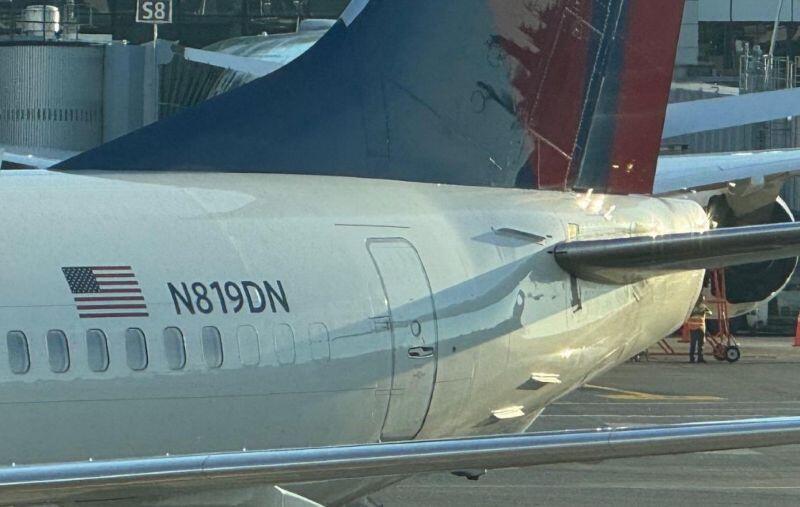
VCT's blade-like finlets smooth out the flow over the aft fuselage of the 737NG, reducing drag.
Delta Air Lines is installing drag-reducing finlets across its fleet of 240 Boeing 737-800s and -900ERs following an extensive in-service evaluation with developer Vortex Control Technologies that validated a 1.2% reduction in fuel burn from the modification.
The 25 in.-long, 2.5 in.-tall blade-like aerodynamic devices are installed on the aft fuselage of the 737NG to reshape the airflow, reduce flow separation and improve pressure recovery on the aft fuselage, lowering drag and reducing fuel consumption.
Delta committed to fleetwide installation of finlets following an in-service performance validation involving 22 aircraft. Seattle-based Vortex Control Technologies (VCT) is now working with the airline to identify other types in its fleet that could benefit from finlets.
Finlets were developed by key former members of the Lockheed Martin team who designed and tested drag-reducing microvanes for the Lockheed C-130 and Boeing C-17 airlifters. The devices were certified on the 737-700 in 2018, followed in 2023 by the -800 and -900ER.
In service since October 2018, finlets are flying on 737s operated by six airlines including Avelo, Copa, Norwegian, Southwest and SunExpress, accumulating some 1 million passenger-carrying flight hours so far, says VCT chief engineer Rick Hooker.
As its largest finlet order to date, Delta’s fleet retrofit is a milestone for VCT. “This followed successful completion of an in-service performance validation effort that was pretty extensive,” he says. “Keep in mind it’s not just about the performance. It’s about ease of installation of the devices, how they are to maintain.”
Delta plans to install the finlets during maintenance checks as well as overnight outside at its Atlanta hub and aims to complete the fleetwide retrofit in just 18 months, which is half the time it took the airline to install split scimitar winglets on its 737NGs, says Jesse Miers, director of sustainability at Delta.
Four finlets are installed asymmetrically on the 737NG’s aft fuselage, three on the left-hand side and one on the right-hand side where the “bicycle seat” vortex generator on the auxiliary power unit inlet already modifies the airflow over the aft fuselage.
Weighing 1.8 lb., each finlet is machined from a block of aluminum. “They cost the same as a 3D-printed finlet, and it’s easier to scale production when they’re machined,” Hooker says. Lightly loaded aerodynamically, the devices are bolted directly to the skin with eight standard fasteners in an unpressurized area of the fuselage.
Installing finlets enables the row of vortex generators between the 737’s horizontal and vertical stabilizers to be removed, reducing drag and eliminating a source of tailplane vibration, he adds.
For a small company, the partnership with Delta was important, Hooker says. Based in Atlanta, the VCT design team was able to get access to Delta’s aircraft and conduct scans to ensure they had accurate geometry for their computational fluid dynamics tools. VCT was also able to work with Delta mechanics to streamline the installation process. “When we needed an aircraft for FAA certification flight testing, Delta helped us out,” he says.
For the in-service validation, VCT and Delta collected data on the aircraft for three months before installation of the finlets and then three months after, looking at the performance increment. A control group of unmodified 737s went through the same process to see if there were any systemic changes over the six months, Hooker says.
“Everyone wanted to prove to themselves, what do we actually see in our operation, in the real world?” Miers says. “And we’re so happy that we already have it on those 22 aircraft, with the recent spike in oil prices.”

Related Content