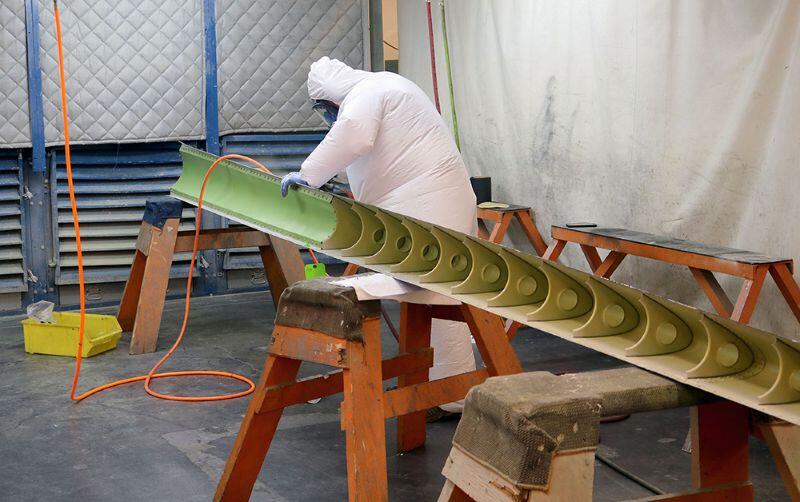
Component repair technician.
Aftermarket suppliers are warning that future sustainability-focused repair innovation will depend less on ambition and more on solid data, proven capability and tightening regulation. Industry leaders say this shift is already changing how components are repaired, recovered, tracked and kept in service for longer.
GA Telesis CEO Abdol Moabery says the industry is entering an era where sustainability claims will only stand if they can be proven. “Sustainability in the aftermarket will ultimately be defined not by our intent, but by our ability to measure, validate and act on information in real time,” he says.
For Moabery, the decisive factor is data integrity—knowing a component’s full history, condition, prior repairs and remaining life. “Without that level of immutable data integrity, sustainability claims are difficult to substantiate and even harder to scale,” he adds. GA Telesis is already leaning heavily on predictive analytics and digital platforms to optimize maintenance pathways, enabling earlier intervention and more efficient material‑recovery planning.
Simon Bayliss, AerFin’s chief operating officer, sees a broadening toolkit of repair technologies emerging as operators push to extend asset life. “Additive manufacturing is playing an increasingly important role, enabling on‑demand production of parts, tooling and material build‑up repairs for high‑value components,” he notes, pointing to reduced lead times and lower logistics‑related emissions. Digital twins and improved life-cycle tracking are also transforming maintenance planning, giving engineers clearer visibility of component history and supporting predictive maintenance that avoids unnecessary replacements.
Bayliss says composite repair capability is advancing quickly, with better bonded‑repair techniques, curing control and inspection processes extending the life of increasingly complex structures. Teardown strategies are becoming more data‑driven, too, with smarter harvesting focused on recovering the highest‑value components earlier and more efficiently. Meanwhile, parts manufacturer approval solutions and alternative material pathways are expanding certified repair options and reducing dependence on OEM supply chains.
Pascal Parant, Vallair’s chief commercial and marketing officer, stresses that sustainability pressures are now influencing aircraft design itself. “New aircraft are increasingly being designed from the outset with end‑of‑life and recyclability in mind,” he says. However, he cautions that many emerging repair technologies, including advanced ceramics and next‑generation composites, are still maturing and not yet fully industrialized.
Parant asserts that sustainability‑related costs and regulatory pressures will intensify once current economic tensions ease. Climate risk, he says, is now a structural reality. “The aviation industry must find a balance between sustainability, growth and maintaining acceptable living standards,” he says. “This is not optional; it is essential.”

Related Content