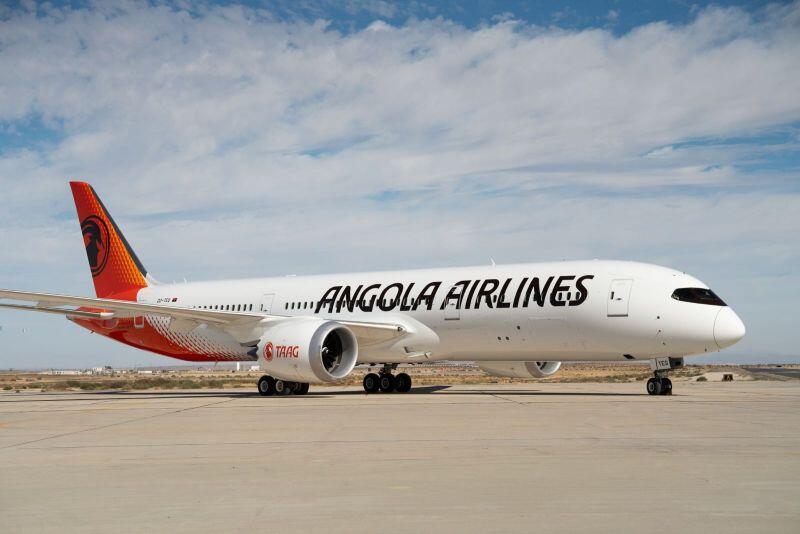
TAAG Angola Airlines’ first Boeing 787-9 operations to Europe mark more than a fleet upgrade, with the carrier strengthening its maintenance infrastructure, digital capabilities and engineering workforce to support the new-generation aircraft.
The airline recently received European Union Aviation Safety Agency (EASA) authorization for the 787-9 under the Third Country Operator (TCO) framework, enabling the aircraft to begin commercial services on the Luanda–Lisbon route, which is currently operated by older 777s.
For TAAG, the approval followed a series of technical and operational milestones designed to demonstrate that the airline’s maintenance and airworthiness systems could support the aircraft to the required standard.
“EASA’s authorization is essentially a full technical and safety assessment of how an airline is run, not a formality,” Misayely Abias, TAAG’s chief maintenance and engineering officer, explains to Aviation Week. “Adding the 787-9 to our TCO scope meant demonstrating, with evidence, that the aircraft could be operated and maintained to the same standard EASA expects of any European carrier.”
The assessment required TAAG to establish a 787-specific maintenance program, supported by reliability monitoring, controlled technical records, minimum equipment list management and extended-range twin-engine operational performance standards capability. Demonstrating a working safety management system, competencies and oversight to support a new type was also essential.
The approval also forms part of TAAG’s broader Aviation Excellence and Sustainable Transformation program, aimed at strengthening operational maturity with support from Lufthansa Consulting. As Abias notes, the program has helped create a stronger technical foundation across the airline rather than focusing solely on introducing a single aircraft type.
To support the 787 operation, TAAG has developed a maintenance support model combining internal capability in Angola with specialized partners across its international network. In Luanda, the airline retains responsibility for continuing airworthiness management, engineering, planning and materials control, while European operations are supported through contracted line maintenance coverage from Nayak in Portugal.
The support structure is also underpinned by OEM and supplier agreements, including Boeing fleet support, GE Aerospace GEnx engine support, and component pooling and repair arrangements designed to strengthen spare availability and AOG response capability.
“The philosophy is simple: Control and accountability stay in Angola, while world-class technical presence is guaranteed wherever the aircraft flies,” Abias says.
TAAG took delivery of its first 787-9 in January 2025 and currently operates two of the aircraft type.
TAAG also began flying the 787-10 on its Luanda-Lisbon route on July 17. It took delivery of its first 787-10 in November 2025 and now operates two of the aircraft type.
According to TAAG, the 787 introduction required investment in new technical capabilities, particularly around the aircraft’s composite structure, more-electric systems architecture and digital maintenance environment.
Abias says TAAG viewed the aircraft introduction as an opportunity to raise the airline’s engineering standards across the organization.
“The 787 is a generational step from our previous widebodies, and we treated its introduction as an opportunity to raise the whole engineering standard of the airline rather than simply ‘add a type,’” he stresses.
The preparation included investment in specialized tooling, ground support equipment, calibration standards and digital systems. TAAG has strengthened electronic technical records, maintenance data processes and aircraft health-monitoring capabilities to improve reliability tracking and enable engineers to identify potential issues before they develop into operational disruptions.
Workforce development has been another central element of the 787 program. The aircraft introduces technologies that require new skill sets, including composite structures, electrical power systems, battery technology and the analysis of aircraft health-monitoring data.
TAAG’s engineers and technicians have completed 787 type training alongside structured on-the-job experience supported by OEMs and specialist training providers. “The 787 introduces technologies our teams had not worked with at this scale, so competency development was central to entry into service,” he adds.
The objective is to develop sustainable local expertise rather than rely indefinitely on external support, Abias says.

Related Content