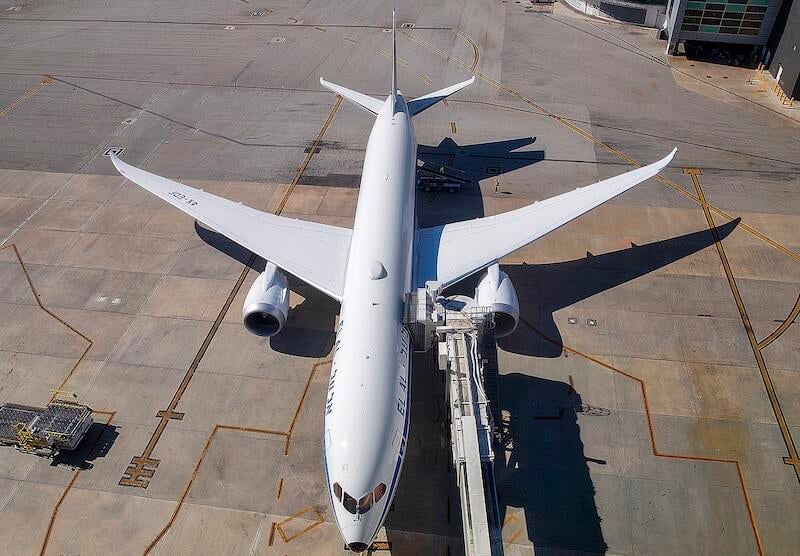
Passenger-to-freighter (P2F) conversion specialist Israel Aerospace Industries (IAI) is looking to add the Boeing 787 to its portfolio in the future.
“When you are considering any conversions, you see the aircraft in the age of 15 years,” says Yaacov Berkovitz, IAI's aviation group executive vice president and general manager. “The Boeing 787 is reaching this time. Instead of scrapping them, you give them a new life, a new purpose.
“The 787 can be a candidate of course for conversion,” Berkovitz says. He adds that there are a lot of challenges with the structure of this aircraft, saying that the 787 consists of approximately 80% composite materials by volume. “But I would say that the engineering that I have here at IAI is more than capable to grow and dive in this,” he adds.
“When we convert an aircraft, we need to have the basis to do the full maintenance checks of this aircraft. It is like a one-stop shop for the customers which are coming for converting,” Berkovitz adds. “The 787 we don't have now [in IAI's maintenance, repair and overhaul portfolio], but [we will] in the future,” he says.
IAI has been involved in the P2F business for more than 50 years. As the holder of several supplemental type certificates for P2F conversions, IAI holds a leading position in the used freighter business.
Talking about new-generation aircraft, Berkovitz describes the Airbus A350F as a “wonderful aircraft, a masterpiece.” Berkovitz believes that there is enough business for everybody—for newbuild freighters as well as converted ones.
Some aircraft will disappear over time. “The Boeing 767 is in its sunset of its conversion, but there are still more than a hundred aircraft around the world,” he says, adding that it is still a good aircraft, offering a payload of 55 tons. IAI offers B767-200/300BDSF conversions.
Berkovitz sees more international e-commerce and merchandise business for cargo operations. “This will have a big influence. Because chips, they don't go in ships,” he says. “It all depends on how the lessors and airlines would like to go. I think that every airline that understands the volatility of the market should have some kind of vertical that is cargo.”

Related Content