This article is published in Aviation Week MRO part of Aviation Week Intelligence Network (AWIN), and is complimentary through May 30, 2026. For information on becoming an AWIN Member to access more content like this, click here.

MTU Sees No Signs Of Aftermarket Demand Decline

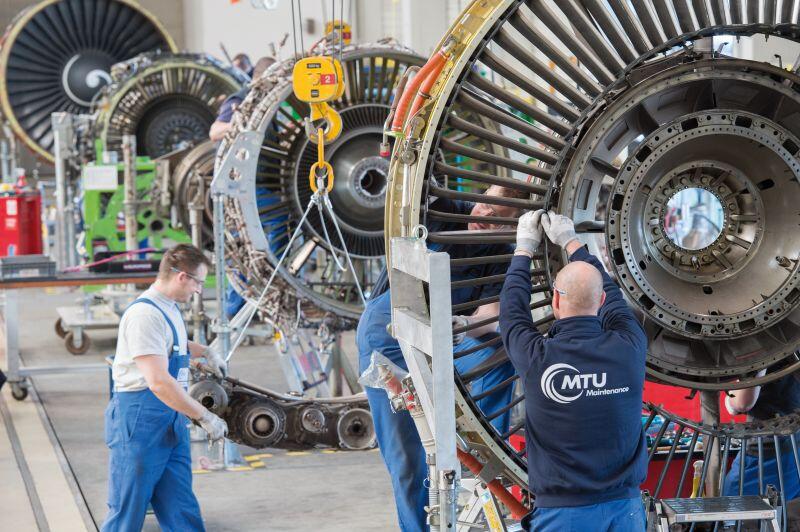
MTU Aero Engines employees
Credit: MTU Aero Engines

MTU Aero Engines sees no signs of weakening aftermarket services demand amid higher fuel prices that are triggering some capacity reductions, the company’s top executive said.

“In our shops, we have not received a single cancellation or meaningful deferral as of now,” CEO Johannes Bussmann said on the supplier’s first-quarter earnings call April 30. “We still have a backlog” of engines waiting for overhaul shop slots. “That means even if something comes up, we are able to compensate the work with other engines waiting,” he added.

Bussmann said MTU has taken steps to mitigate against supply-chain disruptions triggered by the Middle East conflict and closure of the Strait of Hormuz.

“For the limited number of MTU suppliers located in the Middle East, appropriate measures have been implemented to ensure continued availability,” he said.

MTU saw commercial MRO revenues climb 8% to €1.6 billion ($1.9 billion) in the first quarter. Total commercial engine OEM revenues declined 5% due to “U.S. dollar exchange rate effects,” CFO Katja Garcia Vila said. Total adjusted revenues climbed 7% to €2.2 billion on solid defense business and commercial aftermarket results.

Work on the Pratt & Whitney PW1000G geared turbofan accounted for 44% of MTU’s commercial MRO revenue. MTU, a risk-sharing partner on the program, is also a major provider of both scheduled overhauls and durability-related modifications that has driven GTF work in recent years.

MTU’s guidance sees full-year adjusted revenue of €9.2 billion-€9.7 billion, up from €8.7 billion in 2025, with growth in all business areas.

Its commercial businesses are expected to combine for organic revenue growth in the mid-to high-teens as new-engine deliveries ramp up to support Airbus A320neo and A220 production, and aftermarket demand remains strong. Spare parts sales are projected to climb in the low- to mid-teens.

GTF work will continue to drive aftermarket growth, while V2500 demand will remain solid and contribute to the expected uptick in spares sales.

Sean Broderick

Senior Air Transport & Safety Editor Sean Broderick covers aviation safety, MRO, and the airline business from Aviation Week Network's Washington, D.C. office.