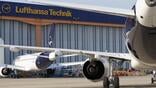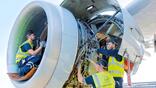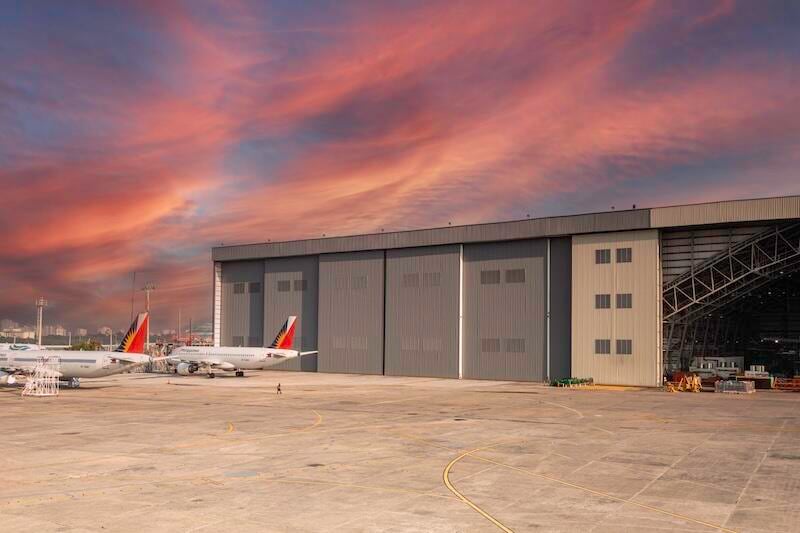
A Lufthansa Technik Philippines’ hangar in Manila specializes in widebody aircraft maintenance.
Lufthansa Technik Philippines evaluated several areas in Southeast Asia for its second widebody aircraft facility before selecting Clark International Airport, which is about 80 km, or a 1.5-hr. drive, from its Manila facility at Nino Aquino International Airport.
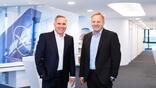
Finding a site in Southeast Asia “was never a doubt” because of the region’s growth and strategic location—it was just a matter of where, says Holger Beck, Lufthansa Technik Philippines CEO.
After evaluating “all the options,” it decided to add a second facility in the Philippines, where it has been operating for 25 years and knows the business environment. The proximity between the sites also is advantageous because the MRO can leverage its mature Manila location to help launch the new one at Clark, which is scheduled to open the first half of 2028.
Operating two mid-sized facilities instead of one mega one minimizes risk in case something like a typhoon occurs. The Philippines is also geopolitically neutral, which was another selling point.
The dual widebody base maintenance facilities in the Philippines will broaden Lufthansa Technik’s capacity and capabilities to service customers in Asia, Australia, Europe and the Middle East. The Clark facility will add Boeing 787 heavy check capability, the timing of which is good because the fleet is approaching “the heavy, heavy checks,” Beck says. It also is investing more in Airbus A350 maintenance capabilities so it will have the full scope of Boeing 777, 787, A330, A340, A350 and A380 heavy maintenance services. Lufthansa Technik Philippines maintains A320 narrowbodies, but widebodies are its main focus.
The new 157,000-m2 (1,689,930-ft.2) site at Clark will accommodate up to nine widebody aircraft and will complement Manila’s 226,000-m2 facility that holds up to six widebodies and three narrowbodies.
Clark, a former U.S. military base, serves several Asian and Middle East airlines, and it also is a big logistics hub, which was a major selling point for Lufthansa Technik. UPS, for instance, already operates there and plans to open a new hub at the airport later this year. Southeast Asian Airlines is an all-cargo carrier based at Clark, and several other Asian carriers provide regional freight service. FedEx has been operating at Clark since 1984.
Clark Airport also is about an hour's drive to the seaport in Subic Bay, which is one of the largest ports in the Philippines.
Perhaps even more appealing than the infrastructure elements are the Filipino people, who often speak English and are very dedicated, Beck says. About 20 million people live in and around Manila, so the catchment area for potential employees is vast.
The area includes colleges that offer aviation programs and aviation maintenance technician schools.
Lufthansa Technik Philippines, a joint venture with MacroAsia Corp., itself has “a really strong track record of training people in Manila,” because it has trained more than 10,000 Filipinos since operating in the country, Beck says. It inputs about 400 students annually in its 18-month maintenance training program, which is followed by two to three years of gaining experience on the production floor.
“We have known for quite some time that we would like to expand, so two years ago” it started to source new students from the Clark area. “We already have roughly 500 people from the Clark area that have been trained and are building up their competence,” Beck says.
When the new facility at Clark opens in 2028, it expects to have a full staff from the area already trained, experienced and ready to go.
The two facilities will operate in parallel—each with their respective staffs, but at least initially some specialists will be exchanged, Beck says.
Lufthansa Technik is investing at least $100 million in the Clark facility. In addition to the hangars, it will include a paint shop and workshops for nondestructive testing, tool calibration, structures, components, composites, machining, panels, upholstery and “a large shop for seats, galleys and lavatories,” Beck says. “The goal is that we can maintain or repair all parts that are touched at a base maintenance event in-house to reduce the downtime and smooth the logistics,” he says.
Given all of the advantages of Clark, “we are very confident that this is exactly the place to be,” Beck says.

Related Content