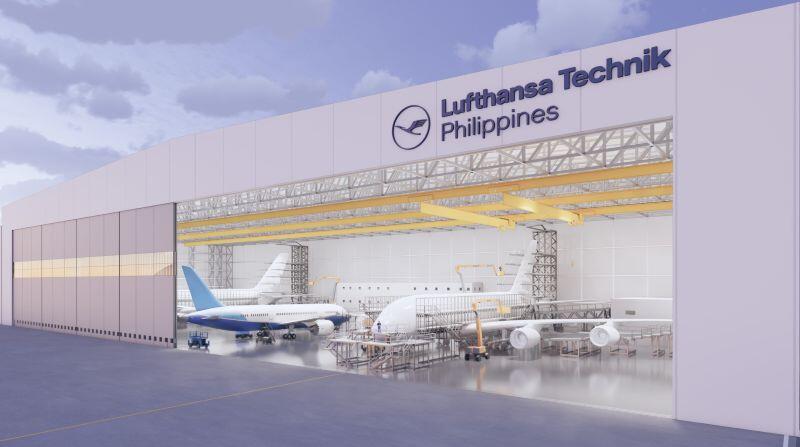
Rendering of the new Lufthansa Technik Philippines facility at Clark International Airport.
Lufthansa Technik Philippines broke ground Aug. 6 for its second widebody aircraft MRO location in the country to accommodate growing demand for heavy checks in the region and beyond. The new 157,000-m2 (1,689,930-ft.2) MRO facility at Clark International Airport will complement its existing 226,000-m2 facility in Manila at Ninoy Aquino International Airport, which is less than 100 km away.
The facility at Clark is scheduled to begin operating in 2028.
Once the second facility opens, Lufthansa Technik Philippines will be able to accommodate up to nine widebody aircraft at Clark and up to six widebodies and three narrowbodies in Manila.
The new facility will add Boeing 787 heavy check services, the timing of which is good because the fleet should double over the next decade and the number of C and D checks forecasted by Aviation Week is climbing. That data also reveals the highest demand for 787 MRO over the next decade is in Asia-Pacific—projected at $40 billion.
Lufthansa Technik Philippines, a joint venture between Lufthansa Technik and MacroAsia Corp., also is investing in Airbus A350 maintenance capabilities for the Clark facility. Aviation Week data also shows the A350 in-service fleet also should more than double over the next decade, and MRO demand will be highest in Asia-Pacific—$28.7 billion over the decade. By adding 787 and A350 heavy maintenance capabilities, the MRO will be capable of servicing the full plate of Airbus and Boeing widebodies.
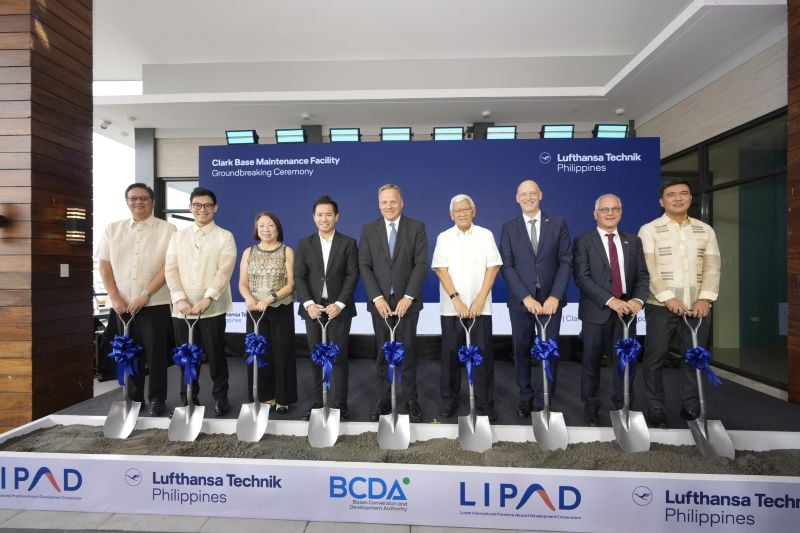
An advantage of having the two facilities close—about a 1.5-hr. drive—enables the MRO to draw on its technical expertise, proven processes and staff during the ramp-up.
Holger Beck, Lufthansa Technik Philippines CEO, expects that the new facility at Clark Airport will be fully trained and staffed when it opens in 2028. More than 500 people from the Clark area already have been trained and are building experience, he says. That number will grow to 1,200, he said.
The two facilities will operate in parallel initially—each with their own staff—although a few specialists could be shared in the early stages.
Lufthansa Technik is investing at least $100 million in the Clark facility. In addition to the hangars, it will include a paint shop and workshops for nondestructive testing, tool calibration, structures, components, composites, machining, panels, upholstery and “a large shop for seats, galleys and lavatories,” Beck says. “The goal is that we can maintain or repair all parts that are touched at a base maintenance event in-house to reduce the downtime and smooth the logistics,” he says.

Related Content