This article is published in Aviation Week & Space Technology and is free to read until Nov 20, 2026. If you want to read more articles from this publication, please click the link to subscribe.
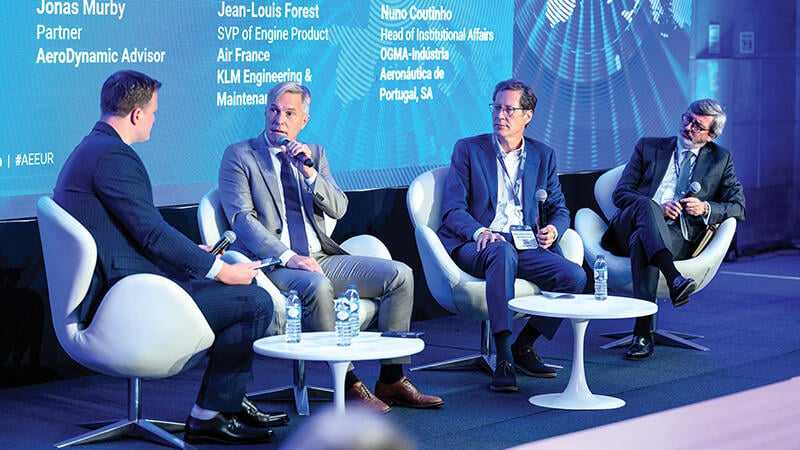
MRO Editor for Europe, the Middle East and Africa James Pozzi (far left) moderated the geopolitics-focused panel at Aviation Week’s AeroEngines Europe conference with (from left of Pozzi) Jonas Murby, Jean-Louis Forest and Nuno da Penha Coutinho.
Rising shop visit demand, persistent material constraints and uneven next-generation engine durability are changing the commercial engine aftermarket in Europe. Discussions at Aviation Week’s AeroEngines Europe conference in Lisbon, Portugal in September highlighted how those pressures are influencing capacity investment and repair development across mature and new technology platforms.
Geopolitics and Engines
Geopolitical fragmentation is adding cost and complexity to engine maintenance in Europe, but speakers at AeroEngines Europe said that could strengthen the continent’s long-term investment plans.
Speaking during a geopolitics-focused session in Lisbon, Jonas Murby, partner at aerospace consultancy AeroDynamic Advisory, noted that since the global engine MRO model has long relied on relatively free movement of materials, technology and assets, export controls are “chipping away at these pillars.” Companies are holding more inventory across regions and managing more complex supply chains as a consequence.
One vulnerability Murby identified is in Europe’s forging capacity limitations. Citing AeroDynamic Advisory analysis, he said China and Russia account for about 45% of global medium- to large-press forging capacity, although China produces relatively few critical engine forgings. Murby estimated that only 10-20% of global capacity remains available as headroom. “Even with Chinese capacity, we may be hitting a ceiling in the coming year or two,” he said. “Without Chinese capacity, we’ll be in a real crunch.”
Competition for scarce resources could intensify as European defense spending increases. Speaking on the same panel, Jean-Louis Forest, senior vice president of engine product at Air France Industries KLM Engineering & Maintenance (AFI KLM E&M), warned that military demand could take priority over civil aerospace, which in turn could add further pressure to balance new engine production against rising aftermarket demand. While suppliers often predict improvement the following year, Forest said recovery would take “at least two or three years.”
For MRO providers, resilience is increasingly shaping investment decisions. Forest noted AFI KLM E&M’s multiproduct strategy across narrowbody and widebody models to mitigate geopolitical risks. The company has also focused on stronger forecasting and in-house repairs to manage potential geopolitical disruptions. “Vertical integration and repair—that’s very important to monitor and keep control of costs and turnaround times, especially in today’s world,” he said.
Another MRO provider, Portugal-based OGMA, which has civil and defense aftermarket capabilities, is also making long-term investments in its MRO shops. Nuno da Penha Coutinho, head of institutional affairs at the Embraer subsidiary, said long-term partnerships underpin the company’s investment in programs such as the Pratt & Whitney geared turbofan (GTF), including repairs of the PW1100G variant for the Airbus A320neo and the PW1900G variant that powers the Embraer 190-E2 and 195-E2 aircraft. OGMA joined the GTF network in 2020 and inducted its first engine in the summer of 2024. Coutinho said the company plans civil and defense capacity separately and has different teams and test cells for its Pratt & Whitney and Rolls-Royce engine programs. “We don’t share even the test cell, so we built a brand-new test cell for Pratt & Whitney engines,” he said.
The panelists said they expect more regional engine MRO activity, although Forest cautioned against duplicating every capability in every market. Customers need localized spare parts, rapid response and light maintenance, he said, while major engine work still requires concentrated investment and specialist skills. Forest added that AFI KLM E&M, which operates engine shops in Paris and Amsterdam, is targeting a combination of “deep centers of excellence and expertise” with a regional presence for lighter work.
Meanwhile, Coutinho said OGMA already looks first to Portugal, then elsewhere in Europe, when seeking additional sources of supply. While these shifts could help keep more aftermarket work on the continent in the medium term, Murby raised a longer-term concern: investment in the industrial processes supporting European shops. “We’re [reducing] our industrial capability in Europe, outsourcing that to somewhere else, and I think long term, that erodes the entire basis for the competitive advantage,” he said.
However, Murby sees signs of a reversal. “We may have turned a corner now in Europe and decided to focus more on our competitiveness,” he added. “The defense requirements are for sure a driver of that.”
Tight USM Supply
Low retirement rates are set to constrain used serviceable material (USM) supply, given that a gradual uplift in engine availability is anticipated rather than a sudden wave of teardowns.
Richard Brown, managing director of NAVEO Consultancy and moderator of a discussion on the impact of engine retirements on the USM market, said annual aircraft retirements have recently represented about 1.5-1.6% of the fleet, compared with a traditional benchmark of approximately 2.5%. Delivery delays and durability issues on newer engines are keeping mature aircraft flying. While this sustains maintenance demand, it also limits the volume of assets available for dismantling.
Reflecting this reality, Rodolfo Bryce, president and CEO of CFM Materials, said he expects about 200 CFM International CFM56-5B and -7B engine teardowns this year, broadly unchanged from 2025. Activity has picked up in the second half of the year, however, with larger asset packages emerging for delivery in 2027-28 as owners seek to capture high residual values. “The demand is still sky-high,” Bryce said. He expects shop visit demand for those CFM56 variants to peak in 2027 or potentially 2028 before gradually declining.
Julius Bogusevicius, head of engine, airframe and materials services at Lithuanian MRO provider FL Technics, cautioned that aircraft retirement figures do not necessarily indicate engine retirements. “[The engines] have totally different lives,” Bogusevicius said. “You buy an engine, and it’s not known what will happen with it.”
For airlines, constrained material supply is increasing the importance of advance shop visit planning and module exchanges. Bogusevicius said customers increasingly favor exchanging an expired module rather than waiting for an overhaul, while engine builds are being tailored to the most economical operating horizon. “The engine itself typically dictates the build of the engines,” he said.
Cliff Topham, senior vice president of engine and business development at Werner Aero, emphasized how strongly engines now determine aircraft acquisition economics. “Engines drive everything,” he said, adding that optimism over the value of some A320neo airframe material has moderated because many components are common with later A320ceo aircraft.
Paul Richardson, senior vice president of sales and marketing for Europe, the Middle East and Africa at AAR, pointed out the similarly tight availability on mature widebody platforms, including GE CF6-80C2 and PW4000 engine platforms. He said that lower recoverable material yields also complicate acquisition pricing.
Maintenance Cost Pressure
Rising maintenance costs and uncertain shop visit turnaround times are sustaining demand for leased engines, but operators and investors face different risks as pricing remains elevated.
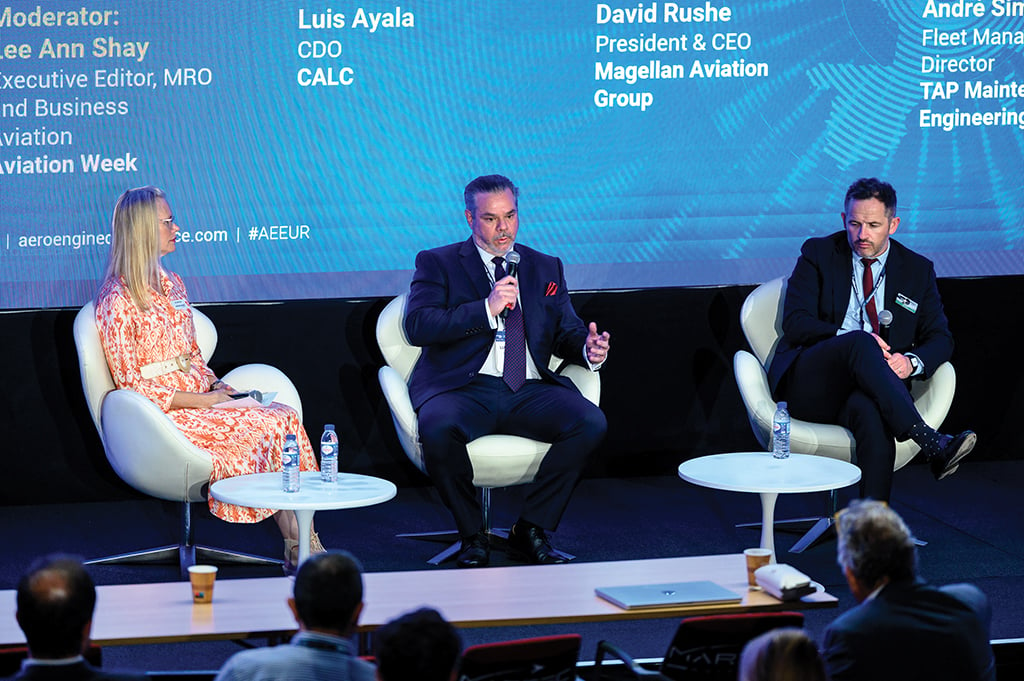
China Aircraft Leasing Group Chief Development Officer Luis Ayala identified material availability as the biggest constraint in engine maintenance and said the group has acquired teardown feedstock to supply components for engines entering the shop. Ayala argued that heightened engine lease rates reflect rising maintenance expenditure as much as the financial cost of owning the asset. “If we continue to have an increase in maintenance, we will have an increase in the lease rate,” Ayala said.
Short-term leasing is typically used to avoid unpredictable maintenance costs and downtime. David Rushe, president and CEO of Magellan Aviation Group, said the business typically leases engine assets for up to three years, giving operators a contracted rental and reserve payment profile instead of exposure to uncertain shop visit outcomes.
“We are seeing a lot of extension requests,” Rushe said, adding that this reflects airlines’ need to react to changing fleet plans. Demand for CFM56-5B and -7B life-limited part shipsets with 8,000-10,000 remaining cycles also suggests operators continue to value another five or six years of engine utility. In the widebody segment, Rushe also highlighted strong demand for PW4000 engines and increasingly restricted CF6-80E1 availability.
Airlines are seeing a distinction between narrowbody and widebody markets. André Simões, fleet management director at TAP Maintenance & Engineering, said increasing narrowbody availability could bring pricing corrections within roughly a year, while widebody aircraft delivery delays could sustain pressure for another 3-5 years.
For TAP, balancing short- and long-term leases provides operational flexibility, but new-technology engine servicing issues have made maintenance planning more reactive, Simões said. He noted that the airline’s spare ratio for new-technology narrowbody engines is about 12%, with an ambition to reduce it to 7-8% within three years as asset reliability improves.
Engine economics are also assuming greater importance in aircraft selection, a trend several other operators noted this year. Simões stressed that airlines need to negotiate satisfactory engine maintenance agreements before committing to aircraft, warning that adding aircraft to existing agreements can attract much higher pricing.

Related Content