
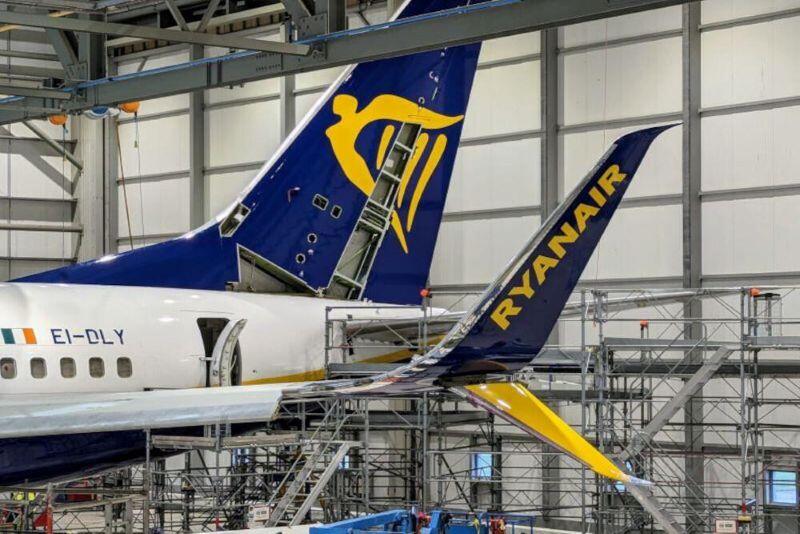
ISTANBUL—European airlines are looking to further grow their in-house maintenance capabilities while retaining third-party providers to supply flexibility over periods of peak demand, executives said during Aviation Week’s MRO BEER conference.
In a June 18 panel discussing airline maintenance strategies, representatives from Europe-based carriers Ryanair, LOT Polish Airlines, TAP Air Portugal and ACMI carrier GetJet Airlines said constrained MRO capacity, increasing material prices and less predictable turnaround times (TATs) have led to airlines seeking greater control over certain maintenance activities.
For Irish LCC Ryanair, which operates more than 650 aircraft, mostly Boeing 737NG and MAX aircraft with a few Airbus A320 aircraft, its gradually aging aircraft fleet is influencing both internal investment and the allocation of work to external MRO providers.
“At the moment, I would say our aging fleet is really driving the strategy,” said Eoin Curtis, Ryanair’s head of heavy maintenance. “Our strategy is to do as much as we can in-house, and working with third-party providers gives us the flexibility that we need.”
Given the size of its fleet, Ryanair’s scale and fleet commonality continue to give the airline leverage when negotiating with maintenance providers, Curtis said. Rather than placing isolated aircraft slots, the airline can commit entire maintenance lines to providers over its September-to-May heavy maintenance season. “We don’t deliver little slots here and there,” he said. “We are asking for one maintenance line, two maintenance lines or five maintenance lines. Providers know they are always going to have aircraft there.”
While leaning on its external partners, the carrier continues to expand its internal airframe and component capabilities. Ryanair intends to keep early heavy checks on its newer 737-8-200 fleet, a high-capacity variant of the 737 MAX 8, in-house to build expertise on the aircraft, following the approach it previously took with its 737-800 fleet.
It will also retain work on its oldest aircraft internally, while using external providers for more mature aircraft and to absorb capacity peaks. “When a partner is struggling with a TAT or a defect they have not seen before, the chances are that we have seen it 100 times,” Curtis said. “We can bring in technical assistance and give tailored advice.”
Ryanair is adding hangar capacity at several European locations, including a previously announced four-bay facility at Prestwick, Scotland, at a cost of £40 million ($53 million), and has recently expanded its MRO operation in Madrid following a €25 million investment. Ryanair also operates maintenance centers in Dublin, Ireland; Kaunas, Lithuania; London Stansted; Seville, Spain; and Wroclaw, Poland.
Ryanair is exploring greater engine maintenance capability for its CFM56 and CFM Leap engine fleet, with the locations of two in-house engine facilities expected to be announced soon, and Ryanair expects them to come online by around 2029. Curtis said the airline is doing this partly because it cannot rely solely on its existing external network to support its future engine requirements, which will number around 2,000 engine units in three years.
GetJet Airlines CEO Inga Duglas said the ACMI carrier, which operates A320-200, A321-200 and 737-800 aircraft, has placed maintenance and supply chain functions within its wider group, as the level of flexibility required by its business model was difficult to obtain consistently from the wider market.
Duglas said that an ACMI operator, using the wet leasing model, must be capable of deploying aircraft and crew at short notice when another airline experiences a disruption, and that requires the carrier’s maintenance organization to share the same operational targets as the airline.
“Flexibility is the key element for us,” she said. “We had been looking in the market for the level of flexibility that an ACMI operator requires, and we struggled to find it.”
GetJet’s internal maintenance covers base and line maintenance, procurement, repair management, logistics and engineering. The Lithuania-based airline still relies on third parties for specific component and material services but oversees the overall process within the group.
“There is no silver bullet to solve the problem,” Duglas said. “Good cooperation inside the organization and close work every single day pays off when it comes to controlling cost and TAT.”
Flag carrier LOT Polish Airlines operates a more diversified aircraft fleet, comprising nearly 50 Boeing aircraft, including 737-800, 737-8, 787 and more than 40 Embraer aircraft, including E170, E175, E190, E195 and E195-E2 models. The airline has an order in place for more than 40 AA220 aircraft, with the first delivery expected in 2027. Because of this fleet diversification, Wiktor Radon, LOT’s technical operations managing director, said standardization and long-term supplier relationships are especially important for the airline.
Radon said that for its maintenance strategies, the Warsaw-headquartered airline is seeking common approaches across fleets, including standardized procedures and maintenance planning practices, while securing access to capacity through longer-term agreements.
The carrier utilizes internal and group capability as an effective means of protecting access to maintenance and control costs, while using external MRO providers for overflow work and activities that LOT cannot handle through grouping partnership.
Radon said contracts alone are insufficient in a market where requirements and operating conditions can change quickly. “Airlines and MRO providers must understand each other’s operational constraints and treat the arrangement as a partnership,” he said.
TAP Air Portugal is also expanding its internal maintenance footprint after its fleet has roughly doubled over the past two decades, while much of its hangar infrastructure has remained unchanged in Lisbon. TAP operates an all-Airbus fleet of nearly 100 aircraft, comprising A320ceo and A320neo family narrowbodies and A330ceo and neo widebodies.
Nelson Vaz, TAP’s director of business development, said the airline’s network requirements directly shape the strategy of its MRO arm, TAP Maintenance & Engineering. The company is adding hangar capacity in Porto to gain greater control over maintenance checks and aircraft availability and work for third parties.
TAP intends to keep base maintenance functions in-house, along with work covered by its existing engine certifications and selected component capabilities. Vaz said it will continue outsourcing services where it lacks certification, capacity or sufficient scale, while using a mix of internal and third-party line maintenance at its overseas stations.
The airline is also incorporating higher labor, material and repair costs into its budgeting rather than expecting prices to return quickly to earlier levels. Vaz said inflation and cost-escalation assumptions have been included in TAP’s long-term strategic planning.
Airlines may sometimes need to pay more to secure material or repair capacity and avoid much larger disruption costs, Vaz acknowledged. However, he cautioned against treating premium pricing—identified by the panel as a key trend of recent years—as a permanent solution. “Saying that paying a premium will be the new normal, I don’t think that is the right way to go, because we have to act on the root cause,” he said.

Related Content




Comments