This article is published in Aerospace Daily & Defense Report part of Aviation Week Intelligence Network (AWIN), and is complimentary through Jul 18, 2026. For information on becoming an AWIN Member to access more content like this, click here.

Elbit Eyes Airborne High-Power Laser Demo

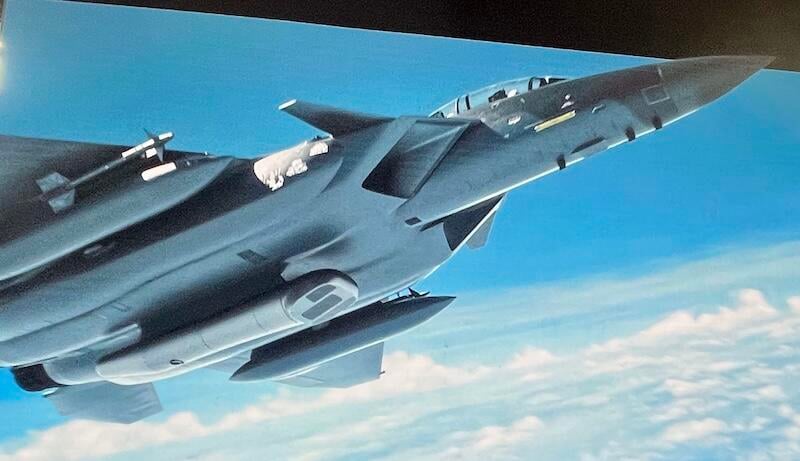
elbit high-power laser pic at eurosatory

An image displayed by Elbit Systems at Eurosatory in Paris.

Credit: Aviation Week Staff

PARIS—Elbit Systems’ plan to equip the Israeli Air Force and potentially others with airborne high-power lasers is starting to take shape.

The company used the ILA Berlin air show and now Eurosatory to drive interest into both a helicopter-based effort called Sting and a fighter-based application called Xcalibur. The program details emerge after a year during which Elbit CEO Bezhalel Machlis has variously teased elements of the company’s work.

The airborne application would augment Israel's ground-based air defenses to engage drones and some missile systems before they reach the country's borders.

Elbit, which several years ago demonstrated a 3-kW airborne laser on a Cessna 208B Grand Caravan to validate the concept’s feasibility, is now looking at using a near-10-kW-power laser in a demonstration on a helicopter.

The key to the system is not just the coherent beam combining laser technology, but the ability to spot and identify a threat and then point the beam to keep the silver-dollar-sized beam spot on the same location of the target to destroy it, a program official said. For the laser pointing, Elbit is drawing on its decades of work in directed infrared countermeasures systems.

The helicopter demonstration would involve a UH-60 Black Hawk with the beam controller and energy source in the cabin.

The fighter application, which requires more dense packaging, would follow somewhat later.

The high-power podded fighter application would come with the energy source packed into the system that could be quickly reloaded on the ground without the need to swap pods. The laser could potentially be used to also engage enemy air defense missiles, though more traditional countermeasures providing the host aircraft with 360-deg. coverage may still be better for those roles.

Elbit's airborne laser work builds on the company's role as the laser supplier for the Rafael ground-based Iron Beam. Rafael delivered the first operational Iron Beam laser last December to the Israel Defense Forces, which are still working on integrating the optical weapon into the country's overall command and control structure for air and missile defense. Fielding a solid-state laser that is powerful, accurate and light enough to work on a moving airborne platform is harder than a ground-based system.

Robert Wall

Robert Wall is Executive Editor for Defense and Space. Based in London, he directs a team of military and space journalists across the U.S., Europe and Asia-Pacific.

Steve Trimble

Steve covers military aviation, missiles and space for the Aviation Week Network, based in Washington, DC.