This article is published in Aerospace Daily & Defense Report part of Aviation Week Intelligence Network (AWIN), and is complimentary through Mar 14, 2026. For information on becoming an AWIN Member to access more content like this, click here.
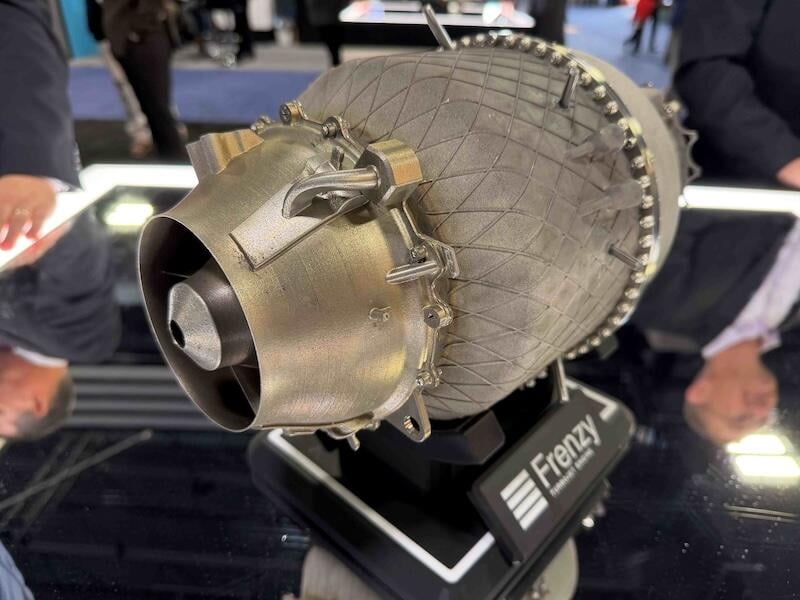
Beehive Industries' Frenzy engine.
AURORA, Colo.—The U.S. Air Force has confirmed that four engine-makers have been granted initial conceptual design awards for the second increment of collaborative combat aircraft (CCA) and other types of autonomous collaborative platforms (ACP).
In addition to awards already acknowledged by GE Aerospace-Kratos and Honeywell, the Air Force says contracts have also been issued to Beehive Industries and Pratt & Whitney. The awards are part of the Air Force Life Cycle Management Center Propulsion Directorate’s initiative to mature engine designs in support of conceptual designs for CCA Increment 2 and other types of ACP, the Air Force says.
The Air Force adds the awards “are for the early stages of engine development, the initial design, with an option award and to complete the preliminary design review of new, next-generation engines in support of future ACP and CCA increments.”
The GE Aerospace and Kratos Defense & Security Solutions engine partnership, announced on Feb. 23, said it had won a $12.4 million contract to complete preliminary design of the jointly developed GEK1500 engine targeting missile and reusable uncrewed aircraft. The fast-paced GEK1500 development effort was announced in mid-2025 and builds on experience gained with the GEK800, an 800-lb.-thrust engine designed to power expendable vehicles, such as cruise missiles.
Honeywell also revealed it has received a prototype design contract from the U.S. Air Force’s Propulsion Directorate for its SkyShot 1600, a new small engine targeting the CCA market. Launched in September and originally called the HON1600, the new engine “supports thrust levels from 800-2,800 lb.,” says Honeywell, which adds the design can be configured as either a turbojet or turbofan, “with scalability for additional thrust as required.”
Beehive Industries is not commenting directly on the Air Force award but says in January it completed a “run-at-rate” production exercise to make 30 of its 200-lb.-thrust additively manufactured Frenzy engines to validate large-scale manufacturing capability. The Denver-based company says, however, it is “working on the same timeline to support CCA vehicles for Increment 2.” Beehive is also working with “vehicle partners” for flight tests in the second quarter. The ramp-up in production and test activity follows the successful conclusion of an altitude test campaign at the Air Force Research Laboratory in Dayton, Ohio.
Pratt & Whitney has also yet to comment on the CCA award. The company plans to begin tests in 2026 of the first of a new family of scalable engines targeting CCAs and cruise missiles. Ranging from 500 lb. to 1,800 lb.-thrust, the engine series is derived from the additively manufactured TJ150 and builds on lessons learned from development of the GatorWorks FJ700 small turbofan.
“This design phase is crucial to evaluate what is in the 'art of the possible' before committing to the more expensive and complex phases of building and testing prototypes,” the Air Force says. “The ultimate goal is to develop engines that are affordable, high-performing and can be produced rapidly and at a large scale,” it adds.
The two larger CCA Increment 1 prototype aircraft, Anduril’s YFQ-44A and the General Atomics Aeronautical Systems YFA-42A, are powered by versions of the 3,600-lb.-thrust Williams FJ44-4.