This article is published in Aviation Week & Space Technology and is free to read until Oct 10, 2026. If you want to read more articles from this publication, please click the link to subscribe.
GE is transitioning to a mixed F404/414 production line as F404-powered advanced trainer work increases.
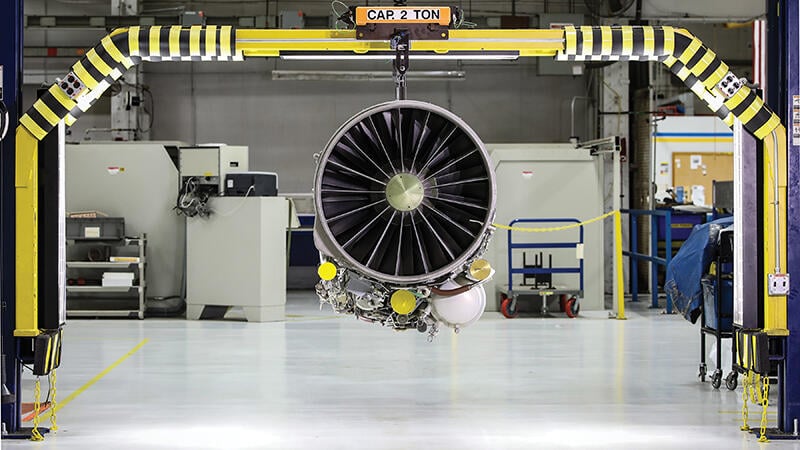
Times are changing at Turbo Town, GE Aerospace’s storied facility in Lynn, Massachusetts, which is primarily responsible for production of most of the company’s military turbofan and turboshaft engines.
Driven by a resurgence in demand for GE-powered advanced fourth- and fifth-generation fighters, as well as a new wave of fighter trainers, the company is undergoing a production system transformation. In addition to Lynn, the makeover is underway throughout its supply chain and facilities like StandardAero’s facility in San Antonio, which is the focus for F110 combat engine assembly.
- F110 production will increase 50% year over year in the second quarter
- The Flight Deck operating system is playing a growing role in the ramp-up
GE, which aims to more than double deliveries of F110 and F404/414 engines between now and 2032, is implementing the ramp-up through a host of improvement initiatives, ranging from streamlined production flows and increased automation to greater use of additive manufacturing and supply chain support investments.
“How do we ramp the rate?” says Paul Ferraro, vice president and general manager of GE Aerospace’s Defense Engines and Services business. “How do we respond to this increase in demand? It’s been challenging, to be honest with you.”
Issues with the supply of key forgings and castings have been among the main culprits behind slower-than-planned deliveries of the F110 and F404 engines, among others, in recent years for both U.S. and international programs. The U.S. Air Force highlighted concerns about the delivery shortfall and supply chain constraints on Aug. 3, when the service announced that it is “embarking on a multiyear procurement of engines for its fighter fleet, with a projected peak demand of over 180 engines per year by [fiscal] 2034.”
The business notice—which affects GE, as the exclusive Boeing F-15EX engine provider and the dominant supplier on the Lockheed Martin F-16—stressed that the “current industrial base has demonstrated significant challenges, including production delays, quality control issues and critical obsolescence (i.e. diminishing manufacturing sources and material shortages) across key engine components.”
But GE says work to accelerate production is gaining pace and set to speed up over the next year, following the company’s Sept. 8 announcement that it plans to acquire key castings supplier Consolidated Precision Products (CPP) for $11.75 billion (page 26). Expected to close in the second half of 2027, the CPP deal comes on top of $600 million in recent production system investments, $100 million of which was focused on the Lynn facility.
The implementation of GE’s Flight Deck operating system has aided the transformation. Flight Deck is a companywide initiative that the company says has resulted in quality and delivery improvements at Lynn. The time taken to resolve material defect issues, for example, dropped 40%, and engine output increased 30% between 2024 and 2025.
The company says it has made improvements across the product lines. Post-test time for the T700 turboshaft is 70% lower, while combustor lead time for the same engine is 90% shorter, GE says. Other Flight Deck impacts include a 56% reduction in the manufacturing lead time of F110 high-pressure (HP) compressor shafts and a 75% cut in lead time for the F404 HP turbine rotor.
Ferraro says the company is well placed to tackle the multiyear engine procurement challenge, given its production investments and growing use of artificial intelligence to manage supply chain issues and new streamlined processes through Flight Deck. “It is well within the right and purview of the Air Force, and we look forward to the opportunity,” he says. “I think we have a great solution.”
Overall engine deliveries increased 30% from 2024 to 2025, and another 15% will be added by the end of the second quarter. “The production ramp that you see here—that’s real,” Ferraro says. “We anticipate that to continue at that rate throughout the year and then continue into subsequent years.”
Higher rates are attainable on the F110, particularly with a predictable orderbook, GE Aerospace Defense & Systems President and CEO Amy Gowder says. “If you go back to 2009-16, we had a very stable demand signal, and we were producing 120 a year,” she notes. “At a peak, I think we got up to 136, and that’s with the investment that’s in the supply base today. So we think it’s very easy to get back there.”
Challenges came when F110 demand decreased amid uncertainty about the future of the F-15 and F-16, the two major platforms powered by the engine. “When I first joined in 2022, we went to a supplier and they said, ‘Oh, the F110 is going out of business,’” Gowder says. “I’m like, ‘No, I’m doubling and tripling the production back to where we used to be.’”
As a result, GE has been working more closely with suppliers on market awareness. “If you’re not paying attention, if you don’t live and breathe the F-16 orderbook or the F-15EX production schedule, you might miss it,” Gowder adds. “So demand certainty is helpful in flowing that out to the supply base and saying, ‘Here’s the rate we’re going to be at for the next two years.’”
The supply base has also improved but still has ground to make up. “Is it where we want it to be to fully meet all the demand we have tomorrow? No,” Gowder says. “There’s still a lot of work to do. There’s still a lot of investments that just haven’t come online yet.
“Furnaces don’t come online in three months,” she continues. “They take, like, 18 months to come online, so I think even in the raw material castings and forgings world, there’s a lot of purchase orders we placed last year that are going to hit in fourth quarter or first quarter next year. And so you’re going to continue to see some supply improve.”
Lessons learned on the F110 ramp-up, supply base, assembly, integration and test are being applied to the F404/414, which is seeing a similar boost in demand, particularly from the growth in advanced trainer programs like the Air Force’s Boeing T-7A, Korea Aerospace Industries (KAI) T-50 and Turkish Aerospace Industries Hurjet—all of which are F404-powered.
GE is “heads down and working hard to turn those engines out as quickly as we can,” Ferraro says. “We see that demand very substantially now and growing as well.” Although F414 production for F/A-18s is winding down with production of the aircraft due to conclude in 2027, the engine will continue to be assembled for the Swedish Saab Gripen, South Korean KAI KF-21 and Indian HAL Tejas Mk. 2.
F414s make up around 50% of the expected F404/414-family engine deliveries but are forecast to make up proportionately less as F404 volumes grow. By 2032, GE forecasts that F414 deliveries—while slightly higher than today—will account for only around a third of overall F404/414-family shipments. The company did not provide specific delivery numbers for the F110 or F404/414. GE is transitioning from a high-volume F414 line to a mixed F404/414 assembly line to reflect the changing production balance.
Automated production of some components, initially developed for T700 rotating seals, is also being extended to other engine families. First introduced in 2022, robots now operate automated processes in six machines. GE plans to automate another six machines over the next few years.
With more than 25,000 T700/CT7 turboshafts delivered to date, the company continues to focus on production improvements for the venerable helicopter engine family and to prepare for its replacement—the T901. Despite continuing budget uncertainty over the engine’s future, GE says it is on track to complete T901 airworthiness qualification tests in late 2027 and is in preliminary discussions with the U.S. Army about a potential procurement program in 2028.
Developed under the Army’s Improved Turbine Engine Program (ITEP), the 3,000-shp T901 was designed for the now-canceled Future Attack Reconnaissance Aircraft and as a drop-in replacement for the ubiquitous T700 powering the Sikorsky UH-60 and Boeing AH-64 fleets.
Due to ceramic matrix composite parts and other design changes, the T901 generates 50% more power than the T700 with 25% better fuel efficiency and has improved hot-and-high performance with full mission payloads.
However, facing broader budget shortfalls, the Army announced last year that it would not move the program into procurement. Congress stepped in with $175 million in the fiscal 2026 defense spending bill and another $63 million in the One Big Beautiful Bill Act to keep ITEP moving.
Following its first flight in a UH-60 in May 2025, the T901 completed preliminary flight rating tests at the end of June 2026, during which the helicopter was flown up to 17,000 ft. and as fast as 160 kt. A follow-on operational assessment planned for fiscal 2028 will evaluate the hot-and-high rating with tests of full mission performance at 6,000 ft. in 95F conditions.
ITEP is “fully funded through qualification,” Gowder says. “So we’re good through fiscal 2027 based on the strong bipartisan support we have for the program. The Army is pretty happy about it, actually—they want to keep it going.”
However, Gowder concedes that constrained Army budgets have affected T901 procurement. “But it’s not something they don’t want,” she says. “It’s something they struggle to fund. So the bipartisan support has got us the money we need to finish in the fall of 2027.” Gowder also notes that GE has invested $300 million in the T901. “If you add in the capacity investments we’ve done, we’re close to $500 million,” she says.
International interest in the T901 is also growing, Gowder says. The Army is “talking about could they do a first long-lead order in 2028 and then ramp up to full production later, and then that’s also where some of these foreign military sales customers might come into play,” she adds.