This article is published in Aerospace Daily & Defense Report part of Aviation Week Intelligence Network (AWIN), and is complimentary through Aug 24, 2026. For information on becoming an AWIN Member to access more content like this, click here.

Boeing Examines AESA Installation Options For Apache Helicopter

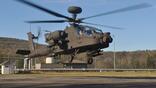
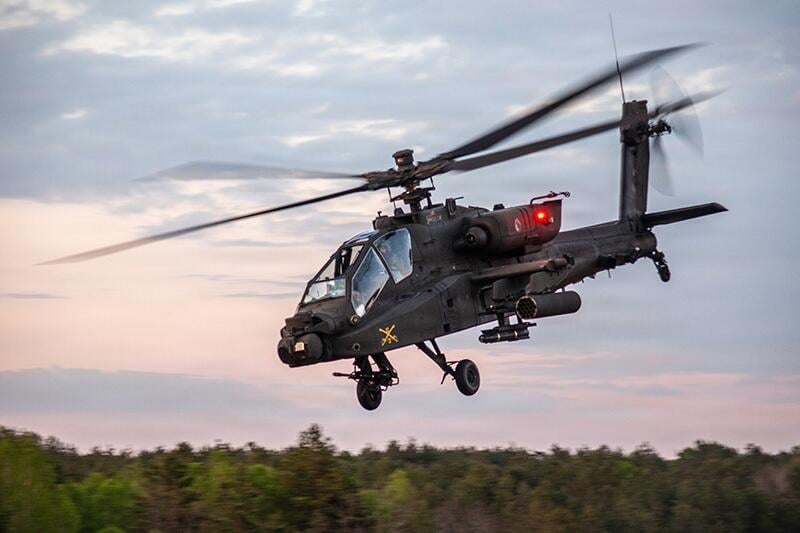
apache in poland
Credit: Staff Sgt. Dean Johnson/U.S. Army

LONDON—Boeing is looking to advance the installation of an active, electronically-scanned array (AESA) radar onto the Apache attack helicopter, as the airframer and the U.S. Army seek to expand the rotorcraft’s situational awareness.

The U.S. Army has been evaluating the potential installation of an AESA radar on the helicopter for around 18 months and will be the ultimate arbiter of whether the sensor is installed.

Boeing said there is a strong case for such an integration, however, as it would boost the rotorcraft’s target detection range several times over compared to the existing Lockheed Martin/Northrop Grumman-made Longbow millimetric radar and improve survivability, allowing it to stand off further from targets to engage them, especially when combined with longer-range weapons such as the Rafael Spike.

“AESA would take that fire control radar that [the Apache] has today to the very next level,” said Terry Jamison, Boeing’s director of attack helicopter programs, speaking ahead of the Farnborough Airshow. He also said that the additional range and power of such a sensor would benefit the aircraft’s newfound anti-uncrewed air system (UAS) role, which the Apache has been pressed into in recent months in the Middle East.

Boeing is looking at potentially mounting an AESA on the fuselage of the helicopter, negating the need for the rotor-mast-mounted Longbow. That radar was placed on the rotor mast so that Apache crews could leverage the terrain and protect themselves, but with an AESA radar, this may no longer be necessary because of the increased detection ranges.

“Hiding [the Apache] behind a hill or a tree or a building is not quite as critical as it was when we had that shorter range of the fire control radar,” Jamison said.

Fitting the AESA radar to the fuselage and removing the Longbow would also improve aerodynamics, company officials said.

Several AESA radars are in the product lines of numerous Team Apache suppliers that are being examined for potential integration.

“It is up to the U.S. Army as they establish their requirements as to which AESA would go on it, or if an AESA goes on it at all,” Jamison said.

Boeing would not be drawn on whether it is trying to deliberately move away from rotor-mast-mounted sensors and systems entirely. The company has also developed a crewed-uncrewed teaming receiver on the rotor mast to communicate with UAS.

Meanwhile the company is moving forward with the next iteration of the Apache’s mission system software, called v6.5, which moves the helicopter into a more open systems integration allowing a speedier incorporation of new sensors and weapons. The company has demonstrated this with launched effect manufacturers to integrate their payloads, before testing in a lab and later in live firing experiments at the Yuma Proving Grounds. Boeing is also working on the integration of a new ammunition for the Apache’s 30mm gun. The XM1225 Aviation Proximity Explosive, or APEX round, features a proximity fuse, making it more effective in the anti-drone mission.

Boeing is also seeking to expand the Apache’s electrical power output, partly driven by the introduction of new sensors and efforts to put directed energy weapons on the platform.

Although currently shelved by the Army, Boeing is continuing to work on the potential installation of the new GE Aerospace Improved Turbine Engine, should the service want to press forward with a re-engining effort. The company is also working on an oil-cooled generator.

“Adapting to change is nothing new for the Apache,” Jamison said. “It's been doing it since its inception.”

Tony Osborne

Based in London, Tony covers European defense programs. Prior to joining Aviation Week in November 2012, Tony was at Shephard Media Group where he was deputy editor for Rotorhub and Defence Helicopter magazines.