This article is published in Business Aviation & AAM Report part of Aviation Week Intelligence Network (AWIN), and is complimentary through Jun 10, 2026. For information on becoming an AWIN Member to access more content like this, click here.

Waypoint: Bizav Survives Trump’s Tariff Policies

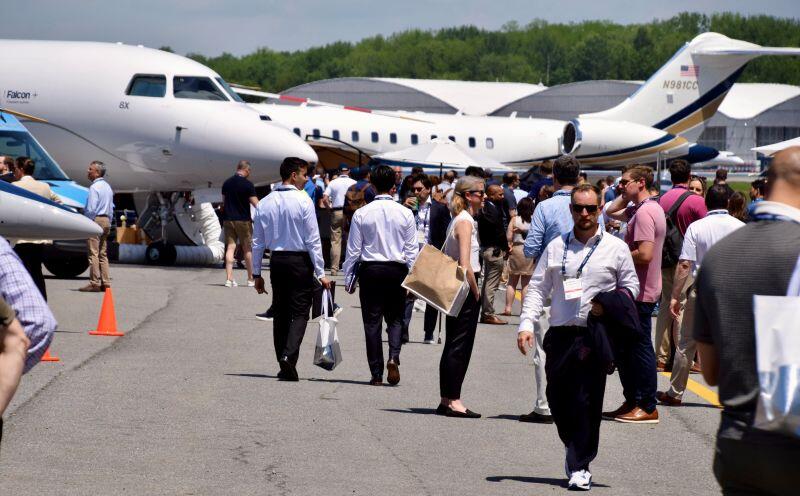
the static display at the NBAA White Plains Regional Forum

Trade visitors view the static display at the NBAA White Plains Regional Forum, held May 20 at Westchester County Airport in New York. The NBAA reported 3,400 registered attendees. 

Credit: Bill Carey

A year after President Donald Trump announced his “Liberation Day” tariff levies against U.S. trading partners in April 2025, business aviation has been liberated from Trump’s trade war.

In February, the U.S. Supreme Court dealt a death blow to Trump’s original argument that a supposed foreign trade emergency empowered him to impose widespread tariffs under the International Emergency Economic Powers Act (IEEPA). Trump reacted to the high court’s ruling by invoking a separate statutory authority to replace the IEEPA tariffs with a temporary tariff on most imports and threatened to impose further levies over alleged unfair trade practices.

Washington’s preemptive trade war rocked an international aviation industry that for more than four decades had enjoyed duty-free trade. The 1979 Agreement on Trade in Civil Aircraft eliminated tariffs on civil aircraft, engines, flight simulators, and components between 33 signatories, including Canada, member states of the European Union, Switzerland, the U.S., and as of 2023, Brazil.

Switzerland’s Pilatus suspended deliveries of its PC-12 turboprop and PC-24 light jet to the U.S. in August 2025 when Trump imposed 39% tariffs on Swiss goods. The countries subsequently negotiated an agreement that exempted aircraft.

Jarring U.S. tariff policy changes sowed uncertainty in business aircraft transactions as buyers and sellers struggled to comprehend the cost implications of moving aircraft between countries.

In the aftermath of Trump’s Liberation Day declaration on April 2, 2025, the industry has clawed back its favored trade status incrementally through bilateral agreements the U.S. negotiated with individual countries and trading blocs, NBAA President and CEO Ed Bolen said.

“When the president announced the tariffs, they applied everywhere and that was a shock for business aviation,” said Bolen, addressing the NBAA White Plains Regional Forum on May 20. “Business aviation has always operated in an environment where there are no tariffs between countries. Business aviation has always operated in a flat, fair, reciprocal, zero-for-zero [framework] for tariffs,” he said.

“Working with Congress and the administration, we learned the administration didn’t like huge [trade] deals—they liked bilaterals,” Bolen said. “We started to work. We got the bilateral with the UK to include zero-for-zero. We got the bilateral with the European Union to be zero-for-zero, and we just kept marching.”

Though Trump has sought a workaround to the Supreme Court’s ruling in February, the aviation industry should be insulated from further trade upheaval, Bolen said.

“When we saw that the Supreme Court disallowed the tariffs, the president said he was going to find another way to do it,” Bolen said. “But he’s not looking to add tariffs for civil aviation. We’ve had that discussion. We won.”

Bill Carey

Bill covers business aviation and advanced air mobility for Aviation Week Network. A former newspaper reporter, he has also covered the airline industry, military aviation, commercial space and uncrewed aircraft systems. He is the author of 'Enter The Drones, The FAA and UAVs in America,' published in 2016.