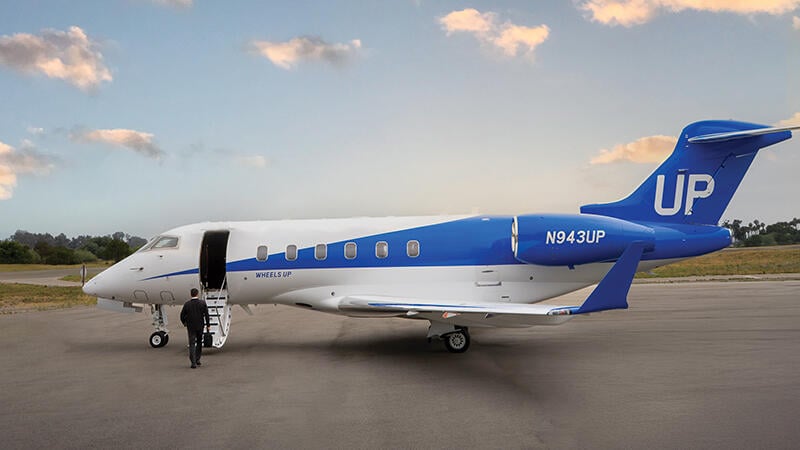
The Bombardier Challenger 300 is one of two jet types in Wheels Up’s fleet.
Eric Martel and George Mattson—CEOs of Bombardier and Wheels Up, respectively—would likely find much common ground in conversation.
Despite operating in different segments—one manufacturing business jets and the other providing on-demand charter services—their companies share striking parallels. Both assumed command of debt-laden organizations in crisis and were tasked with executing corporate turnarounds.
Each company had expanded through acquisitions and needed streamlined structures. Martel and Mattson both recognized the need to refocus on customers more than product lines. Martel prioritized building a customer-centric culture, emphasizing employee collaboration. Mattson restructured his company’s sales and service organization around customer needs instead of its two primary business lines—Signature membership and global charter.
Both CEOs introduced transparency as a competitive differentiator. In 2020, Bombardier introduced Environmental Product Declarations for the Global 7500 and subsequently published them for its portfolio. The company remains the only business jet OEM providing third-party-verified data about each jet’s environmental footprint across its life cycle.
Wheels Up began publishing operational metrics about 2.5 years ago to share its progress internally and externally. “We’ve invited our peers in the industry to do the same, but no one seems to have taken us up on it yet, so we’re on a journey of competing against ourselves,” Mattson tells BCA. “But that’s fine, too.”
Both companies have simplified their fleets. Bombardier shuttered Learjet production and now exclusively produces Challenger and Global aircraft. Wheels Up announced in April that it had finished transitioning its fleet from five models to two—the Embraer Phenom 300 and Challenger 300 series.
Revenue diversification became another shared priority. Bombardier expanded into aftermarket services and defense. Wheels Up created integrated travel options spanning membership, charter or flying on Delta Air Lines, the company’s majority shareholder.
Bombardier completed its five-year transformation under Martel and Chief Financial Officer Bart Demosky in 2025, when it became profitable.
Wheels Up’s trajectory remains in progress. “We haven’t given guidance for 2026, and I’m not going to do it right here,” George Mattson says, “but what I will tell you is we’ve now built a business model that can be sustainably profitable going forward.”
Whether 2026 or 2027 marks Wheels Up’s profitability milestone remains to be seen.
Harvard Business School’s recently published case study, “Bombardier: The Rise of the Phoenix,” documents the OEM’s transformation. Perhaps Wheels Up will be the next phoenix narrative.
Best wishes,
Lee Ann

Related Content