Pilot Warned Of Fatigue Before Fatal Accident
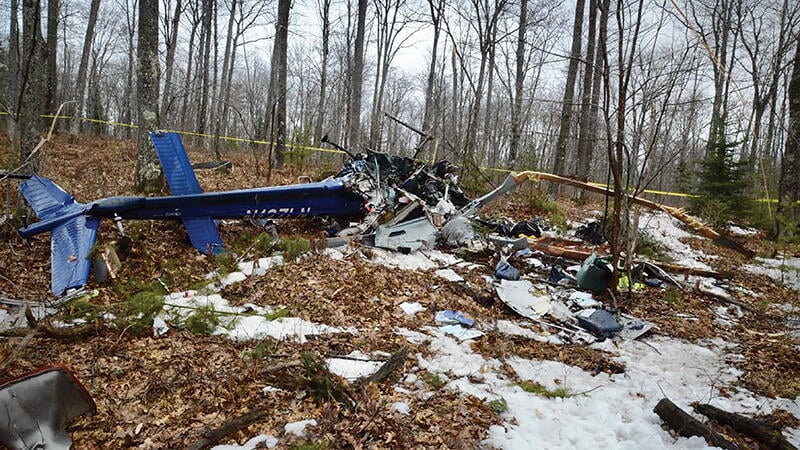
The air medical helicopter crashed in a densely wooded area in Hazelhurst, Wisconsin.
They were flying the night shift on Spirit 2. Based on the conversation and accompanying video images from the flight recorder, one thing was obvious: They were all tired.
The two medical crew in the back of the helicopter air ambulance discussed company policy and perceived retributions for excusing oneself from duty too many times. One of them had been up since 3:30 a.m.
The pilot had returned the night before from a week’s vacation in Florida with his family. The last part of that trip involved a 4-hr. drive home from the Milwaukee airport. On the morning of the accident, he got up early to take his children to day care and run errands. It is unclear if he obtained any meaningful sleep during the day, but an analysis of the pilot’s cell phone indicated several 1-2-hr. periods of inactivity during the day that could have offered nap opportunities.
In the helicopter, the pilot made repetitive hand motions to his helmet, fidgeted in his seat and was uncharacteristically quiet. That prompted one of the medical crew to ask, “Question is, are you all right up there?”
The pilot’s answer was less than convincing: “Uhh, think so. Good enough to get us home, at least.” He got close.
On April 26, 2018, the Ascension Wisconsin Spirit helicopter, an Air Methods-operated Airbus AS350 B2, lifted off from Madison, Wisconsin, at 9:07 p.m. for a Part 91 repositioning flight en route back to its home base in Woodruff, Wisconsin, 170 nm north. Shortly after takeoff, the pilot needed to make a minor westerly deviation for weather, adding about 15 min. to what otherwise would have been about a 1-hr., 45-min. flight.
Initially, there was a headwind and light chop. Groundspeed fluxed between 90 and 115 kt. It was to be the last leg in a multistop journey that began at 5:59 p.m. on the 12-hr., seven-days-on, seven-days-off night shift. By the time the crew lifted off from Madison, they had flown 94 min. and been on mission for 2.5 hr.
At 10 p.m., 53 min. into the flight, a med crew member commented, “I could go to sleep.” The pilot responded, “Yeah, that would be nice, huh?” At 10:43 p.m., he did.
About 1 hr. 36 min. into the flight, cruising at 126 kts and 2,280 ft. MSL, 1,300 ft. AGL, the crew was just 12 mi. from home. The helicopter began an uncommanded right bank.
The flight recorder images show the pilot’s head moving left. The medics began shouting. The pilot was unresponsive. Airspeed bled off to 70 kts. The aircraft continued rolling past 270 deg. and went nose-down as vertical speed approached 5,000 fpm. Torque red-lined. The high-rotor RPM horn sounded.
First responders found the wreckage at about 2:15 a.m. the next morning in a densely wooded area in Hazelhurst, Wisconsin. The Air Methods pilot and two medical crew had died on impact from blunt force trauma. The NTSB would later conclude that the accident’s probable cause was “the pilot’s loss of helicopter control as a result of fatigue during cruise flight at night.”
At the time of the accident, Air Methods had a safety management system (SMS), but not a separate fatigue risk management system. The SMS did contain an extensive section on pilot fitness to fly and employed a preflight risk analysis tool that includes consideration of human factors.
In 2018, the company’s General Operations Manual (GOM) specified 10 hr. of continuous rest that are “consecutive, known in advance and free from all restraint” between shifts. Key to fulfilling this requirement was honest self-reporting.
“Pilots and certificate managers are responsible for ensuring compliance with the flight time limitations and rest requirements,” the GOM stated. “Pilots will report for duty with the appropriate rest and be capable of performing their assigned flight crewmember duties. At any time a flight crewmember becomes medically or physically unfit for duty, they shall vocally notify the appropriate aviation manager, self-ground and comply with the requirements of CFR 61.53.”
Air Methods had also addressed fatigue in the winter 2017 edition of its in-house Safety Connect publication, listing contributing factors such as low lighting, noise, temperature, high comfort and repetitive tasks over long time periods. The publication drew liberally from FAA Advisory Circular (AC) 120-115, “Maintainer Fatigue Risk Management,” which incorporates elements of AC 117-3, “Fitness for Duty.”
Types of Fatigue
AC 117-3 notes that each flight crewmember is responsible for ensuring they are “physiologically and mentally prepared and capable of performing assigned duties at the highest degree of safety.” It further classifies fatigue into three main types: transient, cumulative and circadian.
Transient fatigue occurs due to extreme sleep restriction or extended waking over 1-2 days. Cumulative is caused by repeated mild sleep restriction or extended hours awake over a series of days. Circadian speaks to the phenomenon of reduced performance during nighttime hours.
The International Civil Aviation Organization (ICAO) noted in its 2016 second-edition Manual for the Oversight of Fatigue Management Approaches that “sleepiness can become uncontrollable,” especially across successive days of sleep restriction.
“Eventually, it becomes overwhelming, and people begin falling asleep for brief periods known as microsleeps,” ICAO stated. “During a microsleep, the brain disengages from the environment (it stops processing visual information and sounds). In the laboratory, this can result in missing a stimulus in a performance test. Driving a motor vehicle, it can result in failing to take a corner. Similar events have been recorded on the flight deck during descent into major airports and in air traffic controllers at the end of a night shift.”
ICAO determined that “at least two consecutive nights of unrestrictive sleep are required for the non-REM [(rapid eye movement)]/REM sleep cycle to return to normal.”
The situation is further compounded by interruptions in circadian rhythm, such as in the case of the Air Methods pilot, who transitioned from a week of waking daytime activity to the night shift on April 26, the day of the accident.
“The downside of rapidly rotating shift schedules is that at certain times, such as on the night shift, an individual will be working when their circadian drive for sleepiness is high and their performance is at its poorest,” according to ICAO.
In 1994, the NTSB examined the relationship of time awake to flight crew errors in 37 aviation accidents in 1978-90. The median waking time for accidents was 12 hr. for captains and 11 for first officers. For crews in which both captain and first officer scored below the median, the time awake-to-error was 5.3 hr. for captains and 5.2 for first officers.
Aboard Spirit 2 that night, there were multiple warnings—as articulated by the medical crew on board—of a possible issue with the pilot. These occurred while the crew was en route to the helipad at University of Wisconsin hospital, lifting off after refueling at nearby Madison Airport and passing over Central Wisconsin Airport near Wausau. In Madison, one medical crew member questioned if the pilot was OK to continue the flight. He responded: “I think so.”
Most helicopter air ambulance operations rely on the principle of “three to go, one to say no.” Any one of the crew members could have exercised their crew resource management agency to ground the flight for safety concerns, and a tired pilot would certainly pose such a concern.
Historically, medical crew have been reluctant to exercise this option, deferring to the pilot. That has changed in recent years, but not on that night in April 2018. That might have been the time for “one to say no.”