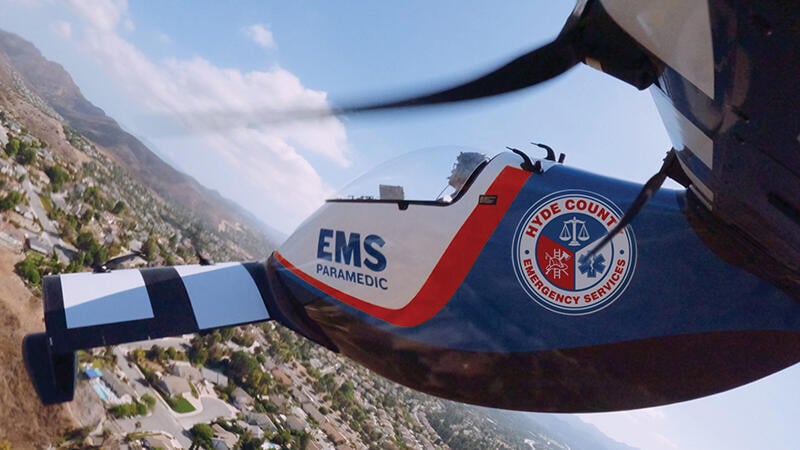
Flight-trained paramedics will fly Pivotal’s BackFly eVTOL in a Hyde County emergency response trial.
There has been talk of using electric vertical-takeoff-and-landing (eVTOL) aircraft for public good ever since the technology was first developed, but little progress has been made as manufacturers have focused on developing their aircraft.
The promise of a quick-to-launch, easy-to-fly aircraft carrying a first responder to an accident site in minutes for a fraction of the cost of a helicopter is a powerful one. However, it has yet to be demonstrated that such an asset can be integrated effectively into emergency services.
As it prepares to begin customer deliveries of its Helix ultralight personal eVTOL, U.S. startup Pivotal has launched a proof-of-concept project with Hyde County, North Carolina, to demonstrate that lives can be saved if first responders fly themselves to an emergency rather than travel by ambulance.
“There are on the order of 5,000 ‘ambulance deserts’ in the contiguous 48 states,” Pivotal CEO Ken Karklin said. “These are places that are underserved by emergency medical services to the extent that it takes a while to get an ambulance to them, because of traffic or geography.”
Pivotal’s single-seat Helix is designed to comply with FAA Part 103 ultralight rules that do not require type certification or a pilot’s license, opening up the potential for new types of missions. The company is taking a deliberate, crawl, walk, run approach to this first pilot project “because, from my perspective, success is the only option or you kill the use case,” Karklin said.
The company began by analyzing 911 call data, looking at various localities, potential takeoff and landing points, and the distribution of emergency calls that were time sensitive and occurred when an aircraft could fly, “which is not in the middle of the night in a thunderstorm,” he said.
Operations will start under day visual flight rules. “But there’s a fairly large underserved population out there and a subset of those calls that can be addressed by an EMT [emergency medical technician], paramedic or emergency room physician who boards an aircraft such as the Helix, flies directly point to point, and beats the ambulance by 5-50 min.”
This mission is not about transporting patients or victims, Karklin underlines, it is about getting the first responder with a life-saving kit to the emergency as quickly and safely as possible. Success for the proof-of-concept project will be measured by multiple lives saved.
The next step was to find a partner. On the coast of North Carolina, Hyde County is flat, temperate and has a low population density. Its aging population of about 5,000 people makes 1,000 911 calls a year. Average ambulance response time can be over 1 hr.—2 hr. if it involves a ferry trip to the barrier islands.
Pivotal has leased two BlackFly eVTOLs, precursors to the production Helix, to Hyde County Emergency Services. Three paramedics, already pilots, have been through training at Pivotal’s Palo Alto, California, headquarter and begun training in Hyde County specific to the concept of operations for the project.
This walk phase involves duplicating flights that would have been driven by past time-sensitive 911 calls, measuring how long it takes to get airborne and reach the point of patient care. “The early data suggests, yes, there is a problem we’re solving,” Karklin said. “We do see some sources of variation and we’re working on those before we go live.”
Unlike the out-and-back recreational flying for which Helix is designed, the Hyde County project requires rapid startup and point-to-point flights. “It’s all landing where you haven’t landed before,” he says. This phase is about mapping out potential safe landing sites and practicing navigation skills. Hyde County is in uncontrolled Class G airspace with power lines and cropdusters as the main hazards.
The next step before the project can go live is a declaration by Hyde County that the BlackFlys will be operated as public rather than civil aircraft. “Responding to 911 calls is unmistakably a governmental function and can only be performed when those aircraft have been committed to a public aircraft operation,” Karklin says, describing FAA approval of the declaration as the “long pole” in the project.
Once the aircraft have their N-numbers, the Hyde County proof-of-concept can begin. Pivotal and its partners, which include Code Blue Resources on the medical side, have designed the project to create a reproducible template “so we can partner with any number of organizations who can set up their own operations and use this asset to go save some lives,” he said.

Related Content