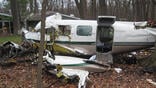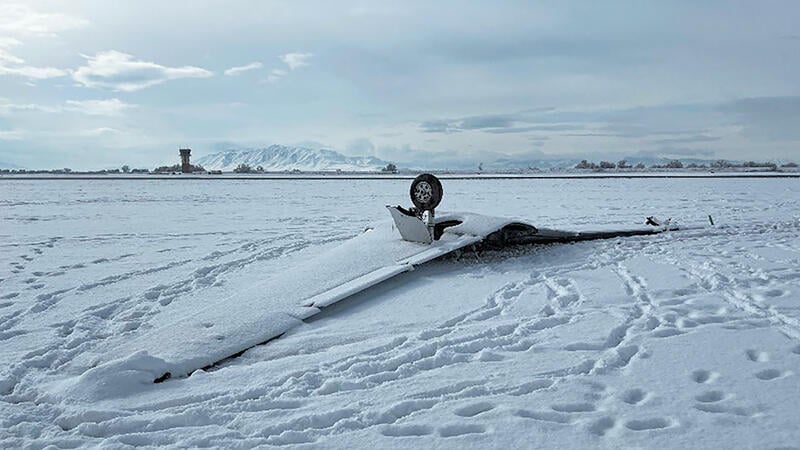
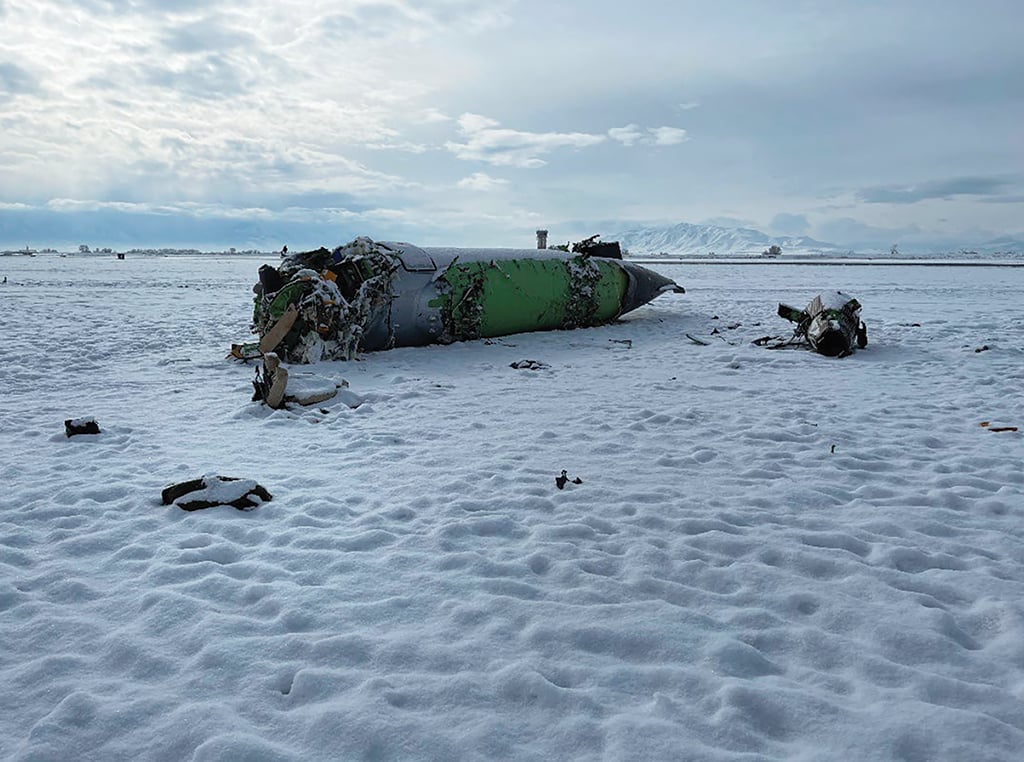
The wings of an Embraer Phenom 300 separated from the aircraft during the crash sequence at Provo Municipal Airport in Utah.
Most pilots understand that significant visible ice contamination on a wing can cause severe aerodynamic and control penalties. However, accident history reveals that pilots do not recognize how fine particles of frost or ice, merely the size of a grain of table salt, and as sparse as one grain per square centimeter, can destroy enough lift to prevent a plane from taking off.
According to the NTSB’s Safety Alert titled “Aircraft Ground Icing,” these virtually imperceptible amounts of ice on an aircraft wing’s upper surface during takeoff cause the same aerodynamic penalties as much larger and more visible ice accumulations.
The airline industry has operated with relatively few incidents due to ground icing in recent decades because of the adoption of the widely accepted guidelines on ground deicing and anti-icing procedures. The airline industry also benefits from operating at larger airports that have an adequate infrastructure of ground vehicles with elevated platforms and numerous personnel who are specially trained in the application of deicing and anti-icing fluids.
The support infrastructure and focused training is not as readily available in the business aviation environment. This is sadly reflected in fatal, unrecoverable takeoff accidents in which the premature stall is so sudden that the pilot is unable to react.
On Jan. 2, 2023, at Provo Municipal Airport (KPVU) in Utah, an Embraer EMB-505 Phenom 300 was removed from its heated hangar for refueling for a personal flight planned to Chino, California. The 62-year-old male pilot-in-command possessed an ATP and flight instructor certificates with a total of 3,456 hr. of flight experience.
The pilot held type ratings for the Cessna Citation 500, Citation 525S and Embraer Phenom 300 models.
The heated hangar was about 60F. It was the pilot’s normal practice to preflight the Phenom 300 inside the hangar so that the only task left to do before boarding the jet was refueling. The pilot had reportedly only deiced on two occasions in the previous eight years.
The jet’s manager advised the pilot that if the aircraft needed to be deiced to contact the FBO. However, that FBO’s truck was out of service. Personnel from the airport’s other FBO reported that the accident pilot did not contact them.
Water droplets were visible on both wings, according to the refueler. The jet remained outside for about 40 min. with no deice or anti-ice treatment before takeoff. At the time of the ensuing accident, and in the 3 hr. previous to the accident, light snow, mist, IFR ceilings and a temperature of -1C (30.2F) were reported. Witnesses noted a mixture of snow and misty rain varying in intensity between light and medium.
Multiple witnesses observed the Phenom 300 begin its takeoff roll and, upon rotation, enter a nose-high attitude. It immediately rolled left. The left wing impacted the runway surface, followed by the nose section. The pilot was killed, and two passengers were seriously injured. Another passenger suffered minor injuries.
The twinjet was equipped with a wing and horizontal stabilizer anti-icing system to prevent and remove any ice formation on the leading edges. The cockpit voice recorder (CVR) captured the Wing Stab ice switch being activated 9 min. after engine start while performing a checklist, but it was turned off shortly thereafter.
The switch remained off for the remainder of the recorded data. Even though the post-accident photos reveal the Wing Stab ice switch in the “on” position, the official report states that the switch moved to the “on” position during the crash sequence.
The jet’s pilot operating handbook (POH) states that aircraft surfaces contaminated by ice, frozen precipitation or frost must be deiced before departure. The POH also states that the aircraft must be anti-iced when the risk of freezing precipitation exists or is taking place.
The POH instructs that the entire wing should be inspected during the pre-takeoff contamination check. It recommends that since the entire wing is visible from a cabin window, the visual inspection should be done by a crewmember from the cabin. The NTSB’s investigation found no evidence from the CVR of the pilot confirming a check of the wings for ice accumulation.
The NTSB determined the probable cause of the accident to be the pilot’s failure to deice the aircraft before takeoff in weather conditions conducive to ice accumulation, which resulted in an ice-contaminated wing and subsequent stall during takeoff.
Business Aviation’s Past
The deicing problem has existed in business aviation for many years. The crash of a Canadair CL-600 Challenger at Montrose, Colorado, on Nov. 28, 2004, occurred under similar circumstances.
Snow was falling while the aircraft was parked on the ramp. The CVR captured the captain asking the first officer, “How do you see the wings?” The first officer stated, “Good,” and the captain replied, “Looks clear to me.”
The pilots failed to ensure that the jet’s wings were free of ice or snow accumulation while the aircraft was on the ground, which resulted in a stall during the attempted takeoff. Three of the six occupants were killed, and three suffered serious injuries.
A similar event involving a Challenger 604 happened at Birmingham Airport (BHX), England, on Jan. 4, 2002. According to the investigation by the UK Air Accidents Investigation Branch (AAIB), immediately after takeoff from Runway 15 at the airport, the jet began a rapid left roll, which continued despite the prompt application of full opposite aileron and rudder.
The left winglet contacted the runway shoulder, the outboard part of the left wing detached and the jet struck the ground inverted, structurally separating from the forward fuselage. All five aircraft occupants were killed.
It was determined that the roll resulted from the left wing stalling at an abnormally low angle of attack due to frost contamination. The AAIB report stated that the pilots should have been aware of wing frost during preflight preparations, but the aircraft was not deiced.
Flawed Visual Observation
The NTSB Safety Alert “Aircraft Ground Icing” expresses concern that many pilots do not recognize that miniscule amounts of ice adhering to a wing can result in severe aerodynamic penalties. Despite evidence to the contrary, these beliefs may still exist because many pilots have seen their aircraft operate with large amounts of ice adhering to the leading edges and consider a thin layer of ice or frost on the wing upper surface to be more benign.
The safety alert contains a number of warnings to pilots that repeatedly have been misunderstood.
Ice accumulation on the wing’s upper surface may be difficult to detect from the cockpit or cabin. Even with a wing inspection light, attempting to ascertain a wing’s condition through a window does not constitute a careful examination.
“Depending on the airplane’s design (size, high wing, low wing, wing color) and the environmental and lighting conditions (wet wings, dark night, dim lights, etc), it may be difficult for a pilot to see frost, snow and rime ice on the upper wing surface from the ground or through the cockpit or cabin windows,” the NTSB advises. “Ice can also be difficult to detect from the front and back of the wing because it is clear or white.”
Some pilots incorrectly believe that if they cannot see ice or frost on the wing through a cockpit or cabin window then the wing is free of contamination, or that the accumulation is so minute as to be inconsequential.
No amount of snow, ice or frost accumulation on the wing upper surface should be considered safe for takeoff. Small patches of ice or frost can result in localized, asymmetrical stalls on the wing, resulting in roll control problems during liftoff.
It is critically important to ensure, by any means necessary, that the upper wing surface is clear of contamination before takeoff. The NTSB believes strongly that the only way to ensure that the wing is free from critical contamination is to touch it.
Winter Ground Ops
Jet engine components are also susceptible to contamination by ice during ground operations. If the weather conditions on the ground include falling frozen precipitation, it is possible for snow to be blown into the engine inlet. Upon contact with the warm engine inlet surfaces, that snow will melt and drip down to the bottom of the inlet. Depending on the outside air temperature and length of time, those metal surfaces and the liquid can freeze. It only takes a small amount of frozen liquid at the bottom of the inlet to prevent rotation of the engine fan blades.
Even after an engine is started, it is possible for snow and slush to accumulate within the engine intake ducting as well as the rear surfaces of engine compressor/fan blades during ground operations in conditions of moderate to heavy freezing precipitation.
Ice accumulation on the surfaces of engine compressor/fan blades may severely affect the aerodynamic performance of the blades and cause compressor stall, engine surging and engine malfunctioning and/or reduced thrust (EASA Safety Information Notice No: 2008-29, April 4, 2008).
These accumulations may not be prevented by the use of engine anti-icing, especially when engines are operated at or close to ground idle RPM.
Intake duct deposits and engine blade deposits may detach and be ingested by the engine during the subsequent application of high-power settings for takeoff, resulting in adverse effects on engine operation and possible flameout.
According to GE Aviation technical pilot Andy Mihalchik, if the pilots or maintenance personnel note ice or snow on the engine’s spinner with either no visible ice/now or a thin layer of ice/snow visible on the fan blades, the flight crew should accomplish the ground ice shed procedure.
Is engine anti-ice incapable of preventing this ice accumulation? No, engine anti-ice systems are designed primarily to deter the accumulation of ice on the intake of the engine nacelle. Ice that has accumulated on the fan blades while the engine is at idle speed must be removed by engine run-ups prior to takeoff.
Ground ice shed procedures usually contain an acceleration of the engine RPM to a minimum thrust setting and then a dwell time at that thrust setting. The acceleration increases centrifugal forces and slightly flexes the fan blades resulting in mechanical shedding of ice.
The dwell time contributes to the thermomechanical ice shedding of rotating and static hardware resulting from increased fan airflow temperatures and pressures. Asymmetric fan ice shedding may cause momentary increases in perceived and indicated engine vibration. Fan vibration levels should return to normal levels as fan ice sheds.
Weather System Limitations
At the time of this writing, a vast swatch of the U.S. was experiencing severe winter weather, stretching from Texas to the Atlantic Coast. If you happen to be operating your business aircraft in similar conditions, your aircraft preparation and ground operations require much more attention.
The following are general examples that are common cold-weather system limitations in business aircraft. Obviously, it important for you to observe the specific limitations of your aircraft. If it has been cold-soaked, the battery may need to be warmed to a minimum specified temperature prior to start. If you know the aircraft is going to be cold-soaked, remove the battery and store it in a warm place.
Flight deck avionics may need to be warmed up. The warming may take up to 30 min. The auxiliary power unit (APU) will accomplish this task more rapidly than the engines on the ground. If the APU is inoperative, the engines will need to be at a mid-range N-2 value in order to provide enough hot air through the bleed air system. You must ensure the instruments are operating properly.
When operating in extremely cold temperatures, the fuel solubility is reduced and will super-cool any water in the fuel. Your maintenance technician should drain the tank and fuel filter drains frequently. If the drain becomes blocked, it is probably because of ice formation.
When possible, arrange for aircraft to be hangered, if available. If unable to obtain hangar space and winter precipitation is expected overnight, anticipate having a cold-soaked aircraft in the morning as well as contamination on the airframe. If you anticipate that aircraft deicing may be required, you should ask the FBO about its availability. These issues could impact your next morning’s departure.
Engine inlet and exhaust covers and pitot tube covers should be installed on overnight stops to protect against unwanted accumulation of frozen precipitation.
By no means does this article address all the threats to an aircraft during winter ground operations. Following the recommendations within your aircraft operating manual is always prudent, but as you can see from the examples above, there are a number of threats that have been discovered only through incident reports.
Winter ground conditions create additional workload requiring time and attention to properly identify and manage these threats.

Related Content