The FAA has released an updated version of its Global Navigation Satellite System (GNSS) Interference Resource Guide, focused on global GPS/GNSS jamming and spoofing trends.
Released in March, the version 1.1 document incorporates changes recommended by an industry-government GPS/GNSS Disruption Action Team. The FAA released an earlier version of the guide in December 2025.
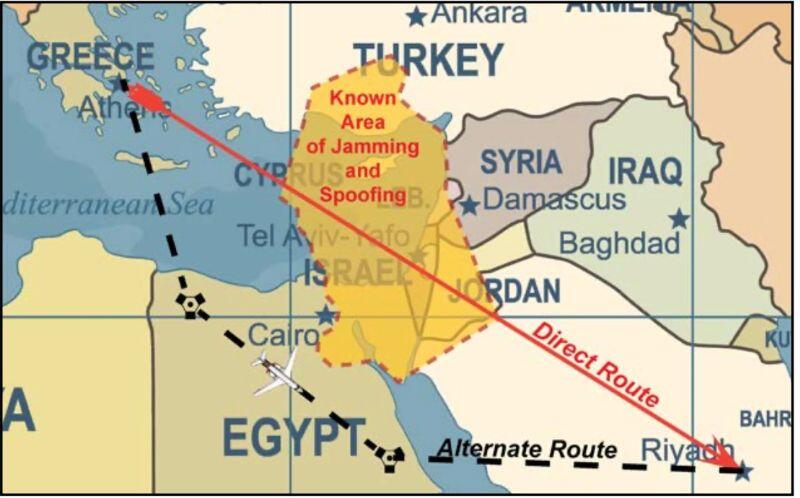
The updated guide provides data on top impacted areas of spoofing, in which GPS-like signals may be acquired and tracked by civil aviation receivers in combination with, or instead of, intended signals. These areas include the Eastern Mediterranean Sea, Black Sea, Russia and the Baltic region, the India/Pakistan border, Iraq and Iran, North and South Korea, and areas around Beijing, China.
The U.S. national airspace system has experienced numerous GPS/GNSS interference events, most of which are associated with planned national security and testing activities, the guide says.
However, unintentional interference can be caused by faulty commercial equipment blocking the reception of a signal in a localized area, or by inadvertent reradiated GPS/GNSS signals from avionic repair shops in and around airports.
In 2022, multiple aircraft reported unreliable signal reception near Denver International Airport, caused by an unauthorized transmitter broadcasting on the GNSS frequency, affecting civilian flights, air traffic control and other GNSS-dependent systems.
“This guide is not just a resource for pilots; it also provides information for operators and avionics manufacturers,” said Richard Boll, who chairs the NBAA Airspace and Flight Technologies Subcommittee. “Because this version is so significantly revised, stakeholders familiar with the previous version should review the new guide and implement recommendations appropriate to their operation.”
The guide describes impacts of GPS/GNSS jamming and spoofing on aircraft systems and provides suggested pilot procedures, and training recommendations.

Related Content