This article is published in Business Aviation & AAM Report part of Aviation Week Intelligence Network (AWIN), and is complimentary through Mar 27, 2026. For information on becoming an AWIN Member to access more content like this, click here.
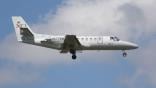
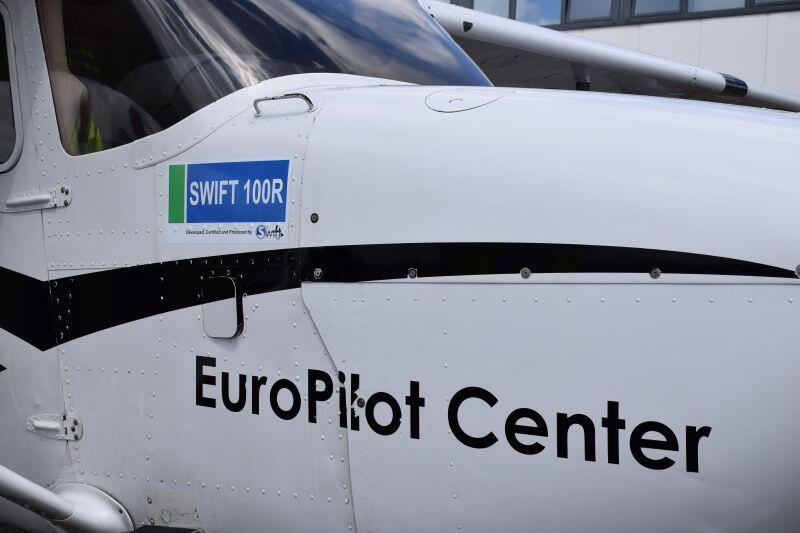
Swift Fuels 100R unleaded avgas has been supplied to airfields in Germany, the Netherlands, Austria, and Belgium.
The FAA has expanded the approved list of piston aircraft engines that can burn Swift Fuels 100R unleaded aviation gasoline, moving the fuel closer to wider distribution across the general aviation industry in the U.S. and Europe.
An amended supplemental type certificate (STC) the FAA issued on March 11 adds multiple engine models to the Approved Model List (AML) of piston engines allowed to burn the new unleaded avgas “and clarifies approved fuel specifications with updated limitations and conditions,” the agency said.
Swift received its initial STCs in September 2024 that allow Cessna 172R/S Skyhawks powered by Lycoming IO-360-L2A piston engines to burn 100R, a 100-Motor-Octane unleaded avgas. Since then, Swift says it has been working with the FAA to finalize certification requirements for approving 100R in engines and aircraft capable of operating on its lower-octane UL94 unleaded avgas.
As with UL94, which Swift has produced since 2015, the lower-performance engines added to the AML are expected to be the first of successive tranches of 100R engine approvals.
“On a separate path but in parallel with this work, Swift Fuels will be seeking to certify a slate of engines and aircraft representing a higher-octane, BMEP (Brake Mean Effective Pressure) and compression ratio group we call the ‘550-Series’ which includes the Continental TSIO-550-K and the naturally aspirated IO-550-N engines and many other similar engine configurations,” Swift says. “This set is underway now and is expected to be completed before the end of 2026.” BMEP is a metric for evaluating engine performance.
“On yet a third path but in parallel, Swift Fuels will be seeking to test and approve various large bore radials and turbocharged engines that remain to be addressed,” the fuel developer adds. “This final set is also underway now and is expected to be completed before the end of 2027.”
Engine models on the AML must be paired with airframes that are separately STC-approved to use 100R. The AML now lists 88 engine makes by manufacturers including Continental and Lycoming, each representing a series of engine models.
Swift’s fuel is one of three high-octane unleaded formulations that are being advanced toward the FAA and GA industry’s goal of phasing out 100LL leaded avgas by 2030 in the contiguous U.S. and by 2032 in Alaska. Swift, based in West Lafayette, Indiana, received a production specification for 100R from standards organization ASTM International in September 2025, which is considered a major step to commercializing the fuel.
Since November 2024, Swift says it has supplied 100R to five flight schools in the U.S. that use Cessna Skyhawks and five airfields in Germany, the Netherlands, Austria, and Belgium that have been approved to use the fuel.
The expanded AML of engines is “another step in the evolution of an unleaded fuel,” said Curt Castagna, president and CEO of the National Air Transportation Association. “I anticipate we’ll see more similar announcements—more AML ‘adds’ to the STC.”
Castagna, who co-chairs the industry-government Eliminate Aviation Gasoline Lead Emissions initiative, said the early experience of using Swift 100R in Cessna 172R and S models indicate the fuel “is performing well and has had no materials compatibility issues that have been reported to us. We think the end results of the demonstration flights have been positive.”