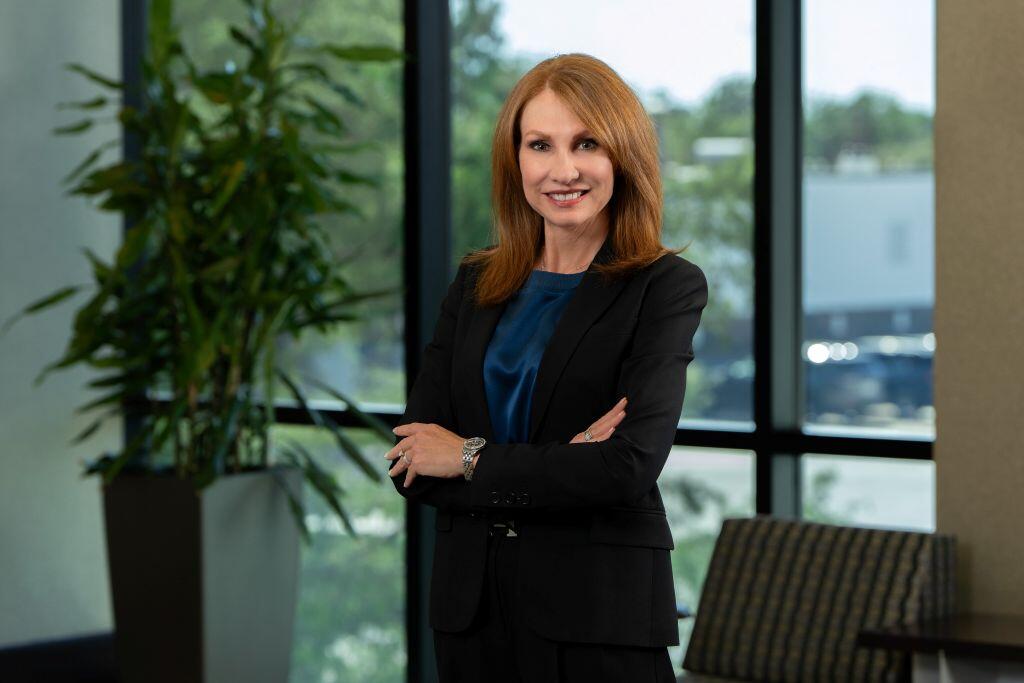
WICHITA—Kriya Shortt assumed the position of senior vice president of parts and distribution for Textron Aviation in January 2026, along with roles as president of McCauley Propeller Systems and Able Aerospace, a component repair and overhaul business based in Mesa, Arizona.
Shortt spent nearly 10 years on the senior leadership team, including three years as senior vice president of parts and programs before assuming the role of president and CEO of Textron eAviation following Textron’s purchase of Pipistrel. Shortt joined what was then Cessna Aircraft, now Textron Aviation, 30 years ago, following a stint managing the front office of the Cessna Flying Club. Textron Aviation operates seven parts distribution centers worldwide with embedded part stockrooms within its 20 global service centers.
Q. It sounds like you have quite a big role. What does it involve?
A. It’s a big role, but it’s a great team. In parts distribution, we’re really affecting everything that you would think. We are making sure that we have the parts that our globally installed customer base wants and needs for their aircraft when they need them. We have inventory planning; we partner with the supply chain who is working in collaboration with our suppliers to make that happen (and more).
Q. You held a similar position before leaving to head eAviation. How much has changed?
A. It’s a full circle moment, which is really the first time in my career that that has happened. You have to say nothing is ever the same, right? The business has continued to grow, the team, while the team is probably 90% the same folks that were on my staff previously, but there’s been some change and they have grown. I would hope that after two and a half years at eAviation, I’m coming back not as exactly the same person either. So, it’s similar but different.
Q. What were the highlights of your time at Textron eAviation?
A. There are so many highlights. To be privileged to be a startup within the structure of a publicly traded company was great because I got some of the best learning from a startup, which are speed and agility and pivoting when necessary to make decisions. We were in scope a much smaller team—500 people total versus Textron Aviation’s 14,000 employee base. So, you would expect that speed and agility to look and feel a little bit different. I’d like to hope that some of the way that our team worked and led and collaborated in eAviation, we can bring some of that back here. How you think about the decision-making cycle and taking decisions more quickly to be able to positively impact both team and customer. I think that’s one of the largest learnings that I had besides the technical piece and having end-to-end accountability, which I do have at Able and McCauley.
Q. What is the status of supply chain challenges today as you see it?
A. Contextually, I think it’s important to remember where we were when I was here last. I was here from basically the onset of COVID through August of 2023. I would tell you that I see that we have seen recovery in terms of where things were maybe at the trough of challenges. Certainly, we’ve seen positive signs. But we also take care of the world’s largest installed base of products, and so we are taking care of production aircraft as well as out-of-production aircraft. You’re always going to see some challenges and that’s where the collaboration, whether it’s with fabrication on make parts or with the our suppliers on our supplied components is so key. The teams work diligently every single day to make sure everything from a brand-new aircraft that delivered last week all the way through something that delivered decades ago can still be serviceable safely to take care of our customers and their mission sets ... That is one thing I see us continuing to execute on is the growth of our global distribution footprint.
Q. What are some of the biggest changes you’ve encountered?
A. One of the biggest changes is—I had been here through the capital planning and building of the Wichita Parts & Distribution center, but we hadn’t actually opened it. It’s really great to come back and see the whole of the warehouse full. Having all the parts in Wichita in one location has 100% benefited our customers and the company as well. That’s been a great change, and we continue to look at our largest markets and make sure that we can position our parts closest to our customers, whether that’s our footprint in Europe—We have a growing a footprint in Asia Pacific, Alaska or Brazil.
Q. What’s the advantage for customers?
A. For our customers, it is the ability to have a consolidated shipment. They might call in and order four part numbers and not know that those were being pulled from two distinct locations in Wichita in our past scenario. Now that can all be consolidated into a single shipment for them. (Today), we enjoy a very late cutoff with FedEx, and we’re grateful for that. We opened a customer pickup lane because sometimes customers—they are either here locally or they make their own arrangements to have parts picked up, which we can accommodate now. The other is really the partnership that we enjoy with FedEx. We actually have FedEx on site. Their loading mechanisms, (Unit Loading Device pods) sit on site here. FedEx has employees on site, and they’re loading those. So, that integration is definitely something that is new and beneficial to our customers. We have the latest cut off time in the industry (for a part to get shipped out the door.)
Q. How many parts are we talking about?
A. Across our various warehouses, we have about 150,000 active and unique part numbers that are stocked. We’re maintaining relevancy on over 600,000 parts. We don’t always have those in stock, but those are parts that are associated with the product portfolio that we still support. There’s a lot of efforting that goes into that.
Q. What is your biggest challenge?
A. The fleet size and diversity. It’s such a privilege to be part of Textron Aviation and to serve that customer base, but it’s also a challenge, right? I mean you could be the owner of a 1960s-era (Cessna) 172 and be looking for something super specific, which we want to be able to fulfill. We may not have it in stock, but we’re going to figure out how to be able to help you with that. That is the breadth of what we do. So that would be the largest challenge.
Q. What do you enjoy most about your job?
A. The thing that I like the best is I have and I get to work with the best team and customers in the industry. I have a team who every single day comes in and they want to figure out how they can satisfy that need for that 1970s-era 172 or that Citation Bravo or some aircraft that is no longer congruent to the production line and they’re not going to be satisfied until they figure out how to solve that.

Related Content