This article is published in Business Aviation & AAM Report part of Aviation Week Intelligence Network (AWIN), and is complimentary through Nov 07, 2026. For information on becoming an AWIN Member to access more content like this, click here.
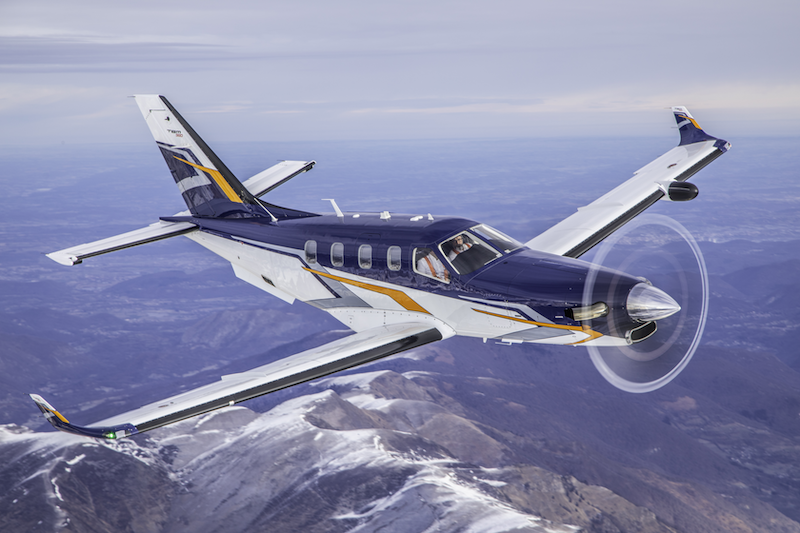
Daher says it has delivered 39 TBM 980s since unveiling the aircraft in January.
As it expands its presence in the U.S., French manufacturer Daher Aircraft is also seeing an expansion in the operating roles of its TBM and Kodiak turboprops.
Typically sold to owner-operators for business and recreational purposes, the TBM-series turboprop is increasingly being used for charter, says Michel Adam de Villiers, Daher Aircraft vice president of sales. Meanwhile, the rugged, unpressurized, short-takeoff-and-landing-capable Kodiak series favored by government agencies is becoming more attractive to small airlines.
Daher markets the TBM line it acquired from Socata in 2014 as the world’s fastest single-engine turboprop, with max cruise speed of 330 KTAS. Latest iterations fly to a maximum range of 1,730 nm.
“With the additional cost now for the fuel, an airplane like the TBM burning about 60 gal. per hour is becoming less than half of the price of a light jet,” says de Villiers. “In addition to the improvement of the plane in terms of payload and speed, the aircraft is becoming very attractive to small charter flights of just below 1000 mi. Today, you can charter the TBM from many operators for about $2000 per hour.”
Daher redesigned the cockpit and made the optional pilot door standard equipment when it introduced the TBM 900 series. This allows the pilot to enter the aircraft without climbing over the center pedestal or passengers, who enter the cabin through a side door with a built-in air stair.
The aircraft accommodates two pilots and one to four passengers. The cabin can be quickly reconfigured for club seating or with all seats facing forward.
“You can change it within half an hour,” de Villiers says. “You can remove two seats and use a large rear cabin to load whatever you want—golf bags, or what we've seen is companies that will fly two technicians to repair some big piece of equipment. They can carry luggage in the back with [an interior] of four seats: two pilots and two passengers plus luggage.”
Daher unveiled the latest iteration of the product line—the TBM 980, with Garmin G3000 Prime avionics suite—on Jan. 15 at its production facility in Tarbes, France. The TBM 980 and its predecessor, the in-production TBM 960, are powered by 895-shp Pratt & Whitney Canada PT6E-66XT engines with Hartzell five-blade composite propellers.
Former NetJets and Atlantic Coast Airlines pilot Eric Walden is a long-time TBM operator who is slated to speak during Daher’s press conference at NBAA-BACE. The founder and president of Charlottesville, Virginia-based Little Hawk Logistics, Walden has flown charter flights using TBMs since March 2015. Charters are operated under the Part 135 certificate of Little Hawk’s partner, 45 North Aviation.
Little Hawk currently operates two TBM 900s and a TBM 910, with bases at Charlottesville-Albemarle Airport (CHO) in Virginia and Scottsdale Airport (SDL) in Arizona. The 2017-model TBM 910 entered revenue service in July 2026, enabling Little Hawk to launch on-demand service from SDL this October to serve the western market.
The company’s TBMs have carried 6,500 passengers and served more than 500 airports around the U.S., with approximately three out of five of the airports having no scheduled airline service, according to Daher. Forty of the airports have runways shorter than 4,000 ft.
“The TBM's combination of speed and runway flexibility is central to Little Hawk Logistics’ business model,” Daher says. “The TBM 910 can cruise at up to 330 KTAS, while providing access to airports that may be impractical for larger aircraft. The company operates the aircraft over a range of up to 1,250 nm, including an alternate [airport] and fuel reserves, and with seating for up to five passengers.”
The Kodiak’s capability to land at small airports and on unprepared surfaces makes it attractive for small carriers, particularly in South America, flying passengers from outlying airfields to larger commercial airports, de Villiers says.
Daher acquired Kodiak from Quest Aircraft of Sandpoint, Idaho, in 2019. The French manufacturer announced the delivery of the 400th aircraft—a Kodiak 100 Series III—from Sandpoint on July 29, 2026.
After acquiring Quest, Daher introduced the Kodiak 100 Series III in 2021 and the larger, faster Kodiak 900 in 2022. Both are powered by PT6 turboprop engines. The 1,129-nm-range Kodiak 900 has a 3.9-ft. longer fuselage than the Kodiak 100, which allows for a double club cabin seating configuration.
Daher now counts about 1,000 TBMs and 280 Kodiaks operating in the U.S. As of mid-October, it had delivered 39 TBM 980s in total from Tarbes.
This year, Daher plans to build 13 Kodiak 100s and 13 Kodiak 900s—one more aircraft in total than the 25 Kodiaks it produced at Sandpoint in 2025. It recently sold the first Kodiak 900 to an operator in Europe.
Both the TBM 980 and Kodiak 900 will be displayed at NBAA-BACE.
Daher broke ground on a third final assembly line at Witham Field in Stuart, Florida, in July. The new facility, which is collocated with Daher’s aerostructures plant in Stuart, remains on track to begin operations in 2027, de Villiers says. Initial plans call for assembling TBM kits sent from France.

Related Content