This article is published in Business Aviation & AAM Report part of Aviation Week Intelligence Network (AWIN), and is complimentary through Oct 29, 2026. For information on becoming an AWIN Member to access more content like this, click here.
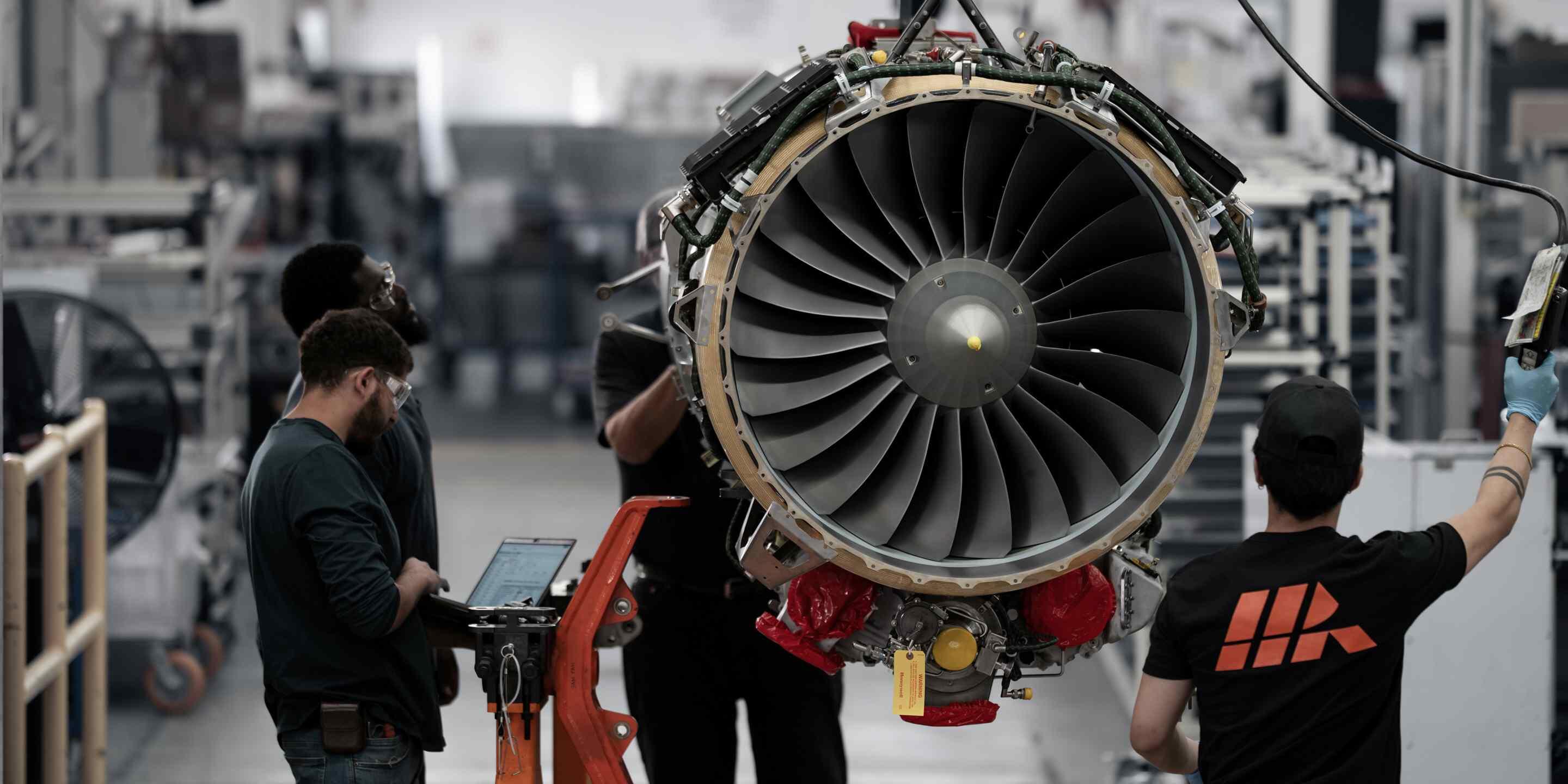
LAS VEGAS—Amid rumors of a new wave of large cabin business jet replacement studies, Honeywell Aerospace is doubling down on plans to test advanced cores for both an upgraded next-generation HTF7000 super midsize engine as well as a larger HTF derivative with up to 12,000 lb. thrust.
The work is based on company-developed technology, some of which is supported under the FAA’s long-running Continuous Lower Energy, Emissions and Noise (CLEEN) program. Under the latest Phase IV of CLEEN, awards for which were announced earlier this month, Honeywell will be working on tests of an advanced axi-centrifugal compressor, further enhancements to a low‑emissions combustion system developed in the previous CLEEN phase and advanced turbine coatings.
Nearer-term test work is focused on a demonstrator high-pressure (HP) core under CLEEN Phase III. Originally expected to run later this year, Honeywell now expects the core to be powered up in the first half of 2027 to enable incorporation of lessons learned from related component and module tests.
“We moved that core test into 2027 because we've had some other things that we want to integrate into that testing. That is still proceeding well, and we expect to meet all our objectives,” says John Head, Honeywell Aerospace vice president and general manager for engines. “There's an opportunity for us to add something to a test that just makes it more efficient,” he adds.
“As we get learning from those component and module levels, it affects the objectives, and it affects the configuration that we want to test at the core level,” says Paul Woodcock, senior director and chief technology officer of propulsion engines at Honeywell Aerospace. “So that's really what's happened: we've had some learnings.”
“We are focused on our next-generation HTF. So we're not just tweaking the configurations with coatings and minor changes; these are quite significant changes that we are testing and maturing,” Woodcock says. “That all feeds into our configuration, so it is a dual-purpose technology development program and the CLEEN program is an excellent vehicle for us to test these technologies in coordination with the FAA,” he adds.
The 16:1 pressure ratio HP core of the current HTF7000 is configured with four axial and one centrifugal compressor stage, plus a two-stage HP turbine. “Our new technology engine that we are testing as part of the CLEEN Phase III program is a five-axis plus centrifugal. So, we've added a stage of compression to get to a higher-pressure ratio, and we are conducting these tests at HTF 7000-scale,” Woodcock says.
“It is efficient for us to test at HTF7000-size as we test individual modules and so on, but we test that technology that then can be scaled to a product of our choosing,” he says. As well as improvements to the HTF7000, the program is “also looking at the next generation that would be focused on the next size category, so picking up from where the HTF7000 left off, and pushing up our thrust capability up into the 12,000 lb. range,” Woodcock says.
Springing off the engine’s existing SABER combustor, Woodcock says further optimization is possible. “We are also looking at some more advanced axial stage rich quench lean technology that may make its way into the next generation of engines,” he says. This technology will be studied under the CLEEN Phase IV program.
Honeywell has outlined plans for a next-generation engine for entry into service in the 2030s, which will be around 3 PNLdB quieter and 8% or more fuel-efficient than current engines in the HTF7000 class. Emissions are similarly targeted to be cut dramatically—in this case, to levels with around a 70% margin to CAEP/8 standards for NOx, as well as a 70% reduction in non-volatile particulate matter.
“With the technology maturation programs that we have had moving forward with CLEEN III, as we move into the testing for CLEEN IV, we are feeling very confident that we are on track to meet those objectives,” Woodcock says.
Beyond the HTF7000-sized core, Honeywell also plans to run a full-size core for the HTF Next-Gen engine in late 2027 or early 2028. “The advanced core that we are preparing to test will verify a lot of those claims,” Woodcock adds.

Related Content