This article is published in Business Aviation & AAM Report part of Aviation Week Intelligence Network (AWIN), and is complimentary through Nov 07, 2026. For information on becoming an AWIN Member to access more content like this, click here.
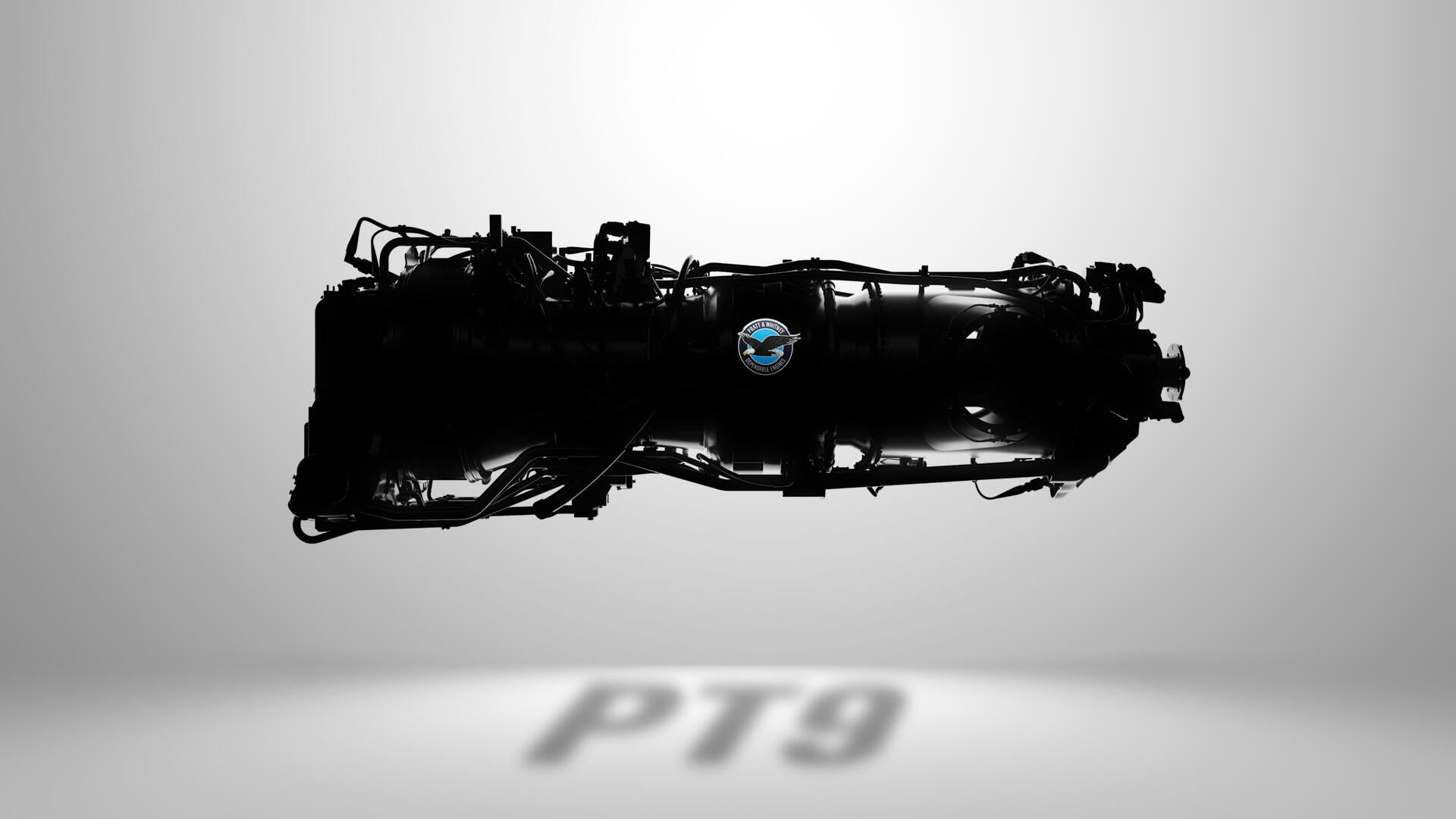
LAS VEGAS—In a surprise move Pratt & Whitney Canada (P&WC) has unveiled the PT9, a certified new centerline engine designed and tested in a secretive five-year development program aimed at advanced propulsion for new-generation single and twin-turboprops.
Targeted initially at the 1,700-2,300 shp range, the PT9 is the first all-new turboprop to emerge from the company in decades. Approved by Transport Canada on Oct. 1, the engine is a scalable, modular design with built-in growth potential and the ability to be integrated in the future with hybrid-electric power systems.
The PT9 will bridge the power range between the larger engines in P&WC’s ubiquitous PT6 series, and the lower rated turboprops in the company’s PW100 series. The engine also provides a counter to emerging competition from engines such as GE Aerospace’s Catalyst while providing a potential jumping off point for future, larger regional powerplants.
Designed to produce 33% more power at altitude with 20% lower fuel consumption compared to current engines in its class, the PT9 incorporates materials and technologies derived from the PW800 turbofan and the recently developed PW127XT regional aircraft turboprop engine.
First indications of the existence of the PT9 emerged in 2025 in FAA regulatory documents, but P&WC has declined to comment on the program until now. Disclosing new details of the engine for the first time at NBAA-BACE, P&WC president Satheeshkumar Kumarasingam stresses the PT9 “is not a replacement” for the PT6. “We still feel that the PT6 has many years ahead of it, but we have leaped into this new power range in this model,” he adds.
Although no specific application has yet been identified, Kumarasingam says, “We are pretty confident of signing one or two customers.”
The engine will be assembled in Canada at P&WC’s Lethbridge, Alberta, facility. “I would say it will be maybe somewhere in the order of 18 months to get to serial production, depending on what the customer engagements will look like,” he adds.
The PT9 development program involved 14,000 test hours and 12 test engines, Kumarasingam says. “Why would we do that? First, it is disciplined investment from RTX, and second it is feedback from customers. We sized this based on market demand and people who said, ‘Hey, we need something in the 2,000-shaft horsepower range,” he adds.
Like the PT6, the engine will feature a reverse flow combustor, as well as a 19-in.-wide “barrel” section which will enable low-drag airframe integration. P&WC declines to specify further architectural details such as whether it incorporates a free power turbine or other PT6 features. According to FAA documents, the PT9 high pressure rotor shaft design is closest to that of the PW307 turbofan.
The PT9 also incorporates more digital prognostic capabilities, including a sensor and performance monitoring system designed to read more than 300 engine parameters. It will also build on advances developed for the PT6 E-Series engines, which were the first in the sector to feature a single-lever, dual-channel integrated electronic propeller and engine control system. The engine includes components made from stiffer, harder alloys than those used in the PT6, as well as additively manufactured elements and fewer life-limited parts to reduce maintenance costs.
Although P&WC anticipates eventually incorporating some degree of hybridization into the PT9, Kumarasingam says there is no link between the new turboprop and the thermal engine concepts developed by the company for its ongoing hybrid-electric work. These include the hybrid electric propulsion (HEP) demonstrator, a modified Dash 8, which will be powered by a 2-megawatt hybrid system combining a thermal engine optimized for cruise and an electric motor used to boost power for takeoff and climb.
“That is actually getting ready to run in a test cell before going to flight next year,” Kumarasingam says. “This is not from that class—it is a separate class,” he adds.
P&WC has also been awarded a project by Europe’s Clean Aviation program to develop a hybrid version of the PW127XT turboprop powering the ATR 72-600 for flight testing by 2030. P&WC also has partnered with electric aviation startups Evo Aero on a hybridized PT6E and the now defunct Maeve Aerospace on a hybrid open fan powerplant developed from the HEP powertrain.


Related Content