This article is published in Business Aviation & AAM Report part of Aviation Week Intelligence Network (AWIN), and is complimentary through Nov 07, 2026. For information on becoming an AWIN Member to access more content like this, click here.
Beyond Aero's Hydrogen-Electric Six-Seater Inches Toward First Flight
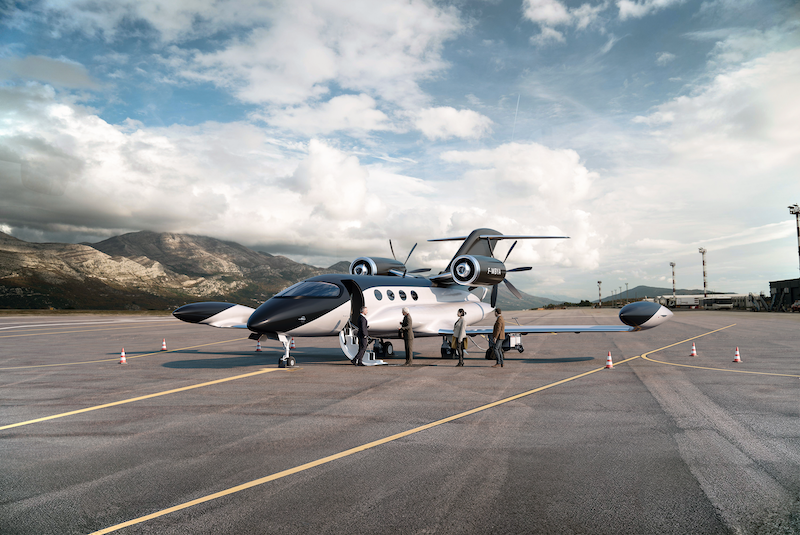
Beyond Aero, a Toulouse-based startup developing the One, a hydrogen-electric business aircraft, is exhibiting at NBAA-BACE for the first time while holding workshops with potential customers and other business aviation industry players here.
Although the company has made strides in small-scale and ground tests, as well as funding, it announced a significant redesign in 2025.
Just months after the One passed a preliminary design review earlier this year, Beyond Aero is studying how to make the most of artificial intelligence (AI) in the development of a new aircraft. Hydrogen, if produced from renewable power, drastically cuts a carbon footprint.
With six fuel cells, the One will have 2.4 megawatts of power, feeding two 1-megawatt electric motors. The company targets an 800-nm range and a cruise speed of 300 kt. for its six-seater. The One will rely on 700-bar gaseous hydrogen to feed its fuel cells, which in turn produce electricity for the motors.
Ground testing of the power train, which includes EKPO fuel cells, is progressing in Toulouse.
After a phase of quiet work during NBAA-BACE shows without exhibiting, Beyond Aero is looking for more visibility. “This is the right time,” CEO and co-founder Eloa Guillotin says. “In our workshops, we were presenting our latest advancements and were letting attendees challenge us.”
This year, the company is showing non-public aspects to operators, airports, pilots and other players, she adds.
Over the last few months, Beyond Aero engineers have focused on how to combine AI assistance and human responsibility.
“This is taking place at the center of the process to obtain a Design Organization Approval (DOA) and a certification,” Guillotin says. “We are looking at how to implement AI in change loops, DOA processes and daily work improvement. We are deploying AI agents companywide.”
The would-be airframer is also preparing a critical design review and onboarding suppliers. “We are raising the level of confidence in our models,” Guillotin says.
Engineers are aiming for a first flight in 2029.

Related Content