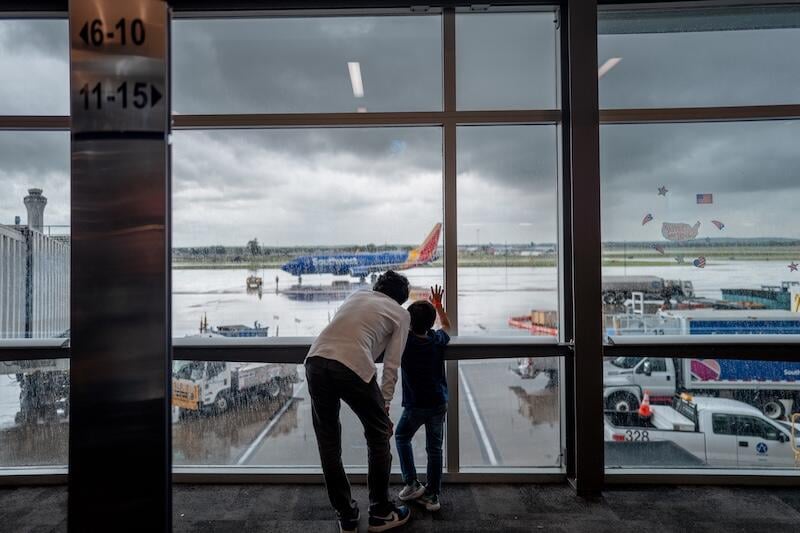
A family watching aircraft on the tarmac at AUS.
Austin-Bergstrom International Airport (AUS) finalized a new use and land agreement (ULA) with its airline tenants, setting the stage for a 32-gate expansion.
The ULA outlines how the airport’s gates—both existing and those to be constructed—will be assigned to airlines over the next decade. The Texas capital’s airport plans to build 12 more gates than the 20 cited when the airport and its airline tenants started negotiating the new ULA in August 2025. The cost of the expansion is estimated at $5 billion.
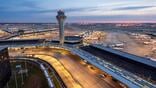
AUS currently has 34 gates, but that figure will nearly double as the airport plans to construct a new major concourse with 26 gates, plus a smaller standalone concourse with six gates.
Southwest Airlines—the airport’s leading carrier with around a 41% passenger market share—Delta Air Lines, United Airlines, American Airlines and Alaska Airlines were signatories to the ULA, which outlines how airline fees are calculated, sets facility rent rates and assigns gates. The airline fees “represent a significant portion of airport revenue [and] directly support AUS’s ability to issue and repay airport revenue bonds and other financing that make the expansion program possible,” the airport said.
As part of the ULA, all of the signatory airlines have committed to operate at AUS for at least another 10 years.
Southwest and Delta, the airport’s two leading carriers, will control a combined 33 of AUS’s 66 gates when the expansion is completed.
AUS has not revealed the specific timeline of the expansion, but the ULA enables the airport to secure funding and solidify plans. Previously, the airport has said it aims to complete the expansion by the early 2030s. The 34-gate Concourse A (now the existing terminal) will also be upgraded as part of the modernization program.
The new Concourse B will be used exclusively for domestic flights, while Concourse A will be used for all international flights plus domestic services.
Delta, the second-leading carrier at the airport with around an 18% passenger market share, will be the anchor tenant in Concourse A, controlling 15 gates. American, which has around a 16% market share, will control nine gates in Concourse A. Alaska, with around a 3% share, will have one gate. The rest of the gates will be common use and utilized for both domestic and international flights. Non-signatory airlines will have access to the common-use gates.
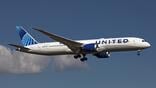
Southwest will be the anchor tenant in the new Concourse B, controlling 18 gates. United, which has around a 12% market share at AUS, will have five gates. Three gates will be common use.
Southwest, which currently controls 10 gates at the airport, will open a crew base for pilots and flight attendants at AUS in March. The airline expects to base 2,000 crew at the airport by mid-2027. The Dallas-based carrier currently operates 130-peak day departures from AUS with service to more than 50 destinations.
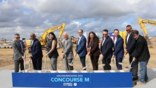
The smaller standalone Concourse M will house six gates, which will not be assigned. “Concourse M will support construction phasing, accommodate new airline entrants and provide operational flexibility for irregular operations, including off-schedule and diverted flights,” AUS said.
FedEx and United Parcel Service also signed a cargo ULA with AUS, committing to continue operating at the airport for the next 10 years.
“The finalized use and lease agreements ensure airlines and cargo companies commit to funding their proportional share of [the expansion program] through the rent and fees generated under the agreements’ cost-recovery structure, supporting the airport’s ability to deliver projects that expand capacity, strengthen resiliency and improve the passenger experience,” AUS said.
The airport said non-signatory passenger and cargo carriers “will continue to operate under standard industry practice by paying per-use charges for airport facilities.”
AUS said the next step is to “seek additional [spending] authority from the Austin City Council for design and construction services,” noting that the “scope and scale of the expansion program and the planned total airport gate buildouts [are] more than initially planned.”
The originally planned 20-gate expansion and supporting infrastructure was expected to cost $4 billion. AUS said adding another 12 gates will likely raise the cost to $5 billion.
“The program, and all associated projects, are funded through traditional airport development funding sources, such as airport cash reserves, current and future airport revenues, future revenue bond proceeds and FAA grants,” the airport said. “No local Austin taxpayer dollars are used to fund the airport’s expansion program.”
AUS CEO Ghizlane Badawi said the ULA “reflects years of partnership, thoughtful negotiations and shared vision with our airline partners.” She added the signatory airlines’ 10-year “commitment provides the financial foundation we need to modernize our facilities.”

Related Content