This article is published in Air Transport World part of Aviation Week Intelligence Network (AWIN), and is complimentary through Nov 13, 2026. For information on becoming an AWIN Member to access more content like this, click here.
Germany is not suffering from a lack of demand. Premium cabins are performing strongly, leisure traffic remains resilient and Frankfurt and Munich are expanding infrastructure to prepare for further intercontinental growth. Yet high taxes, charges and operating costs threaten to keep the country on a lower-growth trajectory than its European peers.
Germany’s airports handled 97.7 million passengers during the first half of 2026, down 0.8% from the same period in 2025. Scheduled seat capacity fell 1.1% and stood at only 82% of 2019 levels, compared with 111% across the rest of Europe, according to analysis of OAG data.
Domestic flying has experienced a particularly sharp contraction. Capacity in the first half of 2026 was 48% of its 2019 level, falling to 18% on decentralized routes that do not feed the Frankfurt or Munich hubs.
Yet Germany’s wider weakness cannot be explained by the domestic market alone. Even if domestic capacity had fully recovered to its 2019 level, Germany’s overall recovery rate would have reached only 92%—still 19 percentage points behind the rest of Europe.
“The main structural reason is Germany’s high level of government-imposed aviation costs,” German aviation industry association BDL spokesperson Alexander Klay told ATW. “Airlines compare locations across Europe when deciding where to station aircraft and add capacity, and Germany remains one of the most expensive markets in terms of taxes and charges.”
The German government’s own analysis points to a more complex combination of factors. A study undertaken by the German Aerospace Center (DLR) for the Federal Transport Ministry identified rail substitution, declining business travel, the loss of traffic to and from Russia and Ukraine, and limited domestic competition following airberlin’s exit as contributing to the slower recovery.
Nevertheless, the rise in aviation costs has been notable. Government-imposed charges increased by €1.1 billion ($1.3 billion) during 2025 to €4.3 billion, according to BDL. The group said that aviation taxes, security charges and air navigation fees have more than doubled collectively since 2019, with air traffic control charges recording the steepest increase at 194%.
It is estimated that state-imposed costs add about €30 to the price of a typical one-way European flight from Germany and can reach €35 in some cases. Airline groups want the total burden reduced by about €2 billion, equivalent to approximately €15 per passenger, to bring Germany closer to the European average.
COST OF COMPETING
The government has begun moving in that direction, rolling back a 2024 increase in the aviation tax and pursuing measures intended to reduce bureaucracy and lower air traffic control and security costs. From July 1, the short-haul tax was reduced by €2.50 to €13.03 per passenger, while the medium-haul rate fell by €6.33 to €33.01 and the long-haul rate by €11.40 to €59.43. “The reversal is an important and welcome signal, but on its own it is not large enough to change Germany’s competitive position fundamentally,” Klay said. “What ultimately matters is the total cost of operating at a location, not one tax in isolation.”
Sweden illustrates how quickly capacity can respond when market conditions improve. The country abolished its aviation tax in July 2025 and seat capacity increased 5% during the first half of 2026. About 700,000 additional seats are scheduled in the second half compared with the same period in 2025, according to OAG data.
That responsiveness is particularly evident among point-to-point airlines, which can move aircraft relatively quickly between European bases as market economics change. However, Ryanair, easyJet and Wizz Air have a more limited role in Germany than in many other major European markets, with Ryanair set to close its seven-aircraft Berlin base in late-October. Lufthansa Group subsidiary Eurowings has filled some network gaps, but its strategy emphasizes yield rather than the high-volume model pursued by Europe’s largest ultra LCCs.
The result is a thinner network, with fewer routes and lower frequencies. The shift of some journeys from air to rail, changed business-travel patterns and Lufthansa Group’s focus on profitability have also contributed, but reduced schedule depth can weaken regional access to the hubs and diminish the connectivity of cities without direct long-haul services.
“We want to close this gap with strong hubs and broad connectivity across the country,” Düsseldorf Airport (DUS) CEO and BDL president Lars Redeligx said. “To achieve that, we need the right framework conditions. Then aviation in Germany can return to growth in the years ahead.”
External shocks have added to these structural pressures. The war in Iran pushed up fuel prices, closed important airspace and prompted capacity reductions, particularly among network airlines. Strikes also disrupted Lufthansa’s operation during the first half of 2026.
Frankfurt Airport (FRA) said almost 700,000 passengers were affected by Lufthansa strikes alone. Total passenger traffic at the airport fell 0.8% during the six months, contrasting with growth across much of airport operator Fraport’s international portfolio. Fraport expects the airport to handle about 63.2 million passengers in 2026, broadly unchanged from 2025 and around 10% below the 2019 total.
HUB INVESTMENT
However, Germany’s largest airports are responding to the subdued market by looking beyond volume alone. Frankfurt and Munich are investing in infrastructure, targeting long-haul connectivity and strengthening their transfer propositions, even as domestic and some short-haul capacity remains constrained.
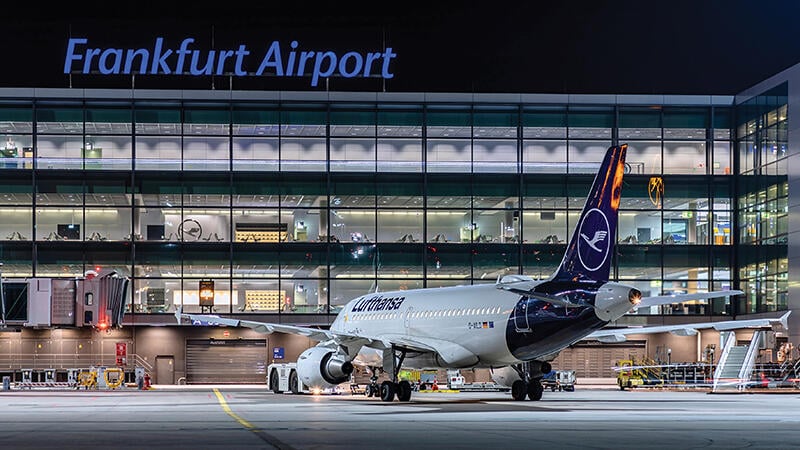
At FRA, the centerpiece of that investment is the €4 billion Terminal 3, which began regular operations in April. The facility initially provides capacity for up to 19 million passengers annually and gives Fraport greater flexibility to redistribute traffic and modernize its existing terminal infrastructure.
“Competition among major hubs is intensifying, especially from airports that combine modern infrastructure, attractive cost structures and strong airline networks,” Fraport SVP aviation and cargo development Simone Schwab told ATW. “Terminal 3 helps Frankfurt respond to this challenge by improving capacity, operational flexibility, passenger comfort and the overall quality of the hub product.
“At the same time, Terminal 1 remains a central and highly important part of the airport system, particularly for the hub operation, established airline partnerships, intermodal connectivity and large parts of the existing long-haul and transfer traffic.”
Fraport sees particularly resilient demand to the Far East, Africa and Latin America. However, Schwab said attracting further airline investment will require improvements beyond airport infrastructure, with carriers assessing taxation, air navigation and security costs, airport charges, operational reliability and regulatory certainty when allocating aircraft.
“For Frankfurt, this is especially relevant because global airlines compare investment opportunities across European hubs, Middle Eastern hubs and other intercontinental gateways,” Schwab said. “A credible reduction in structural cost disadvantages would therefore support renewed airline confidence.”
MUNICH
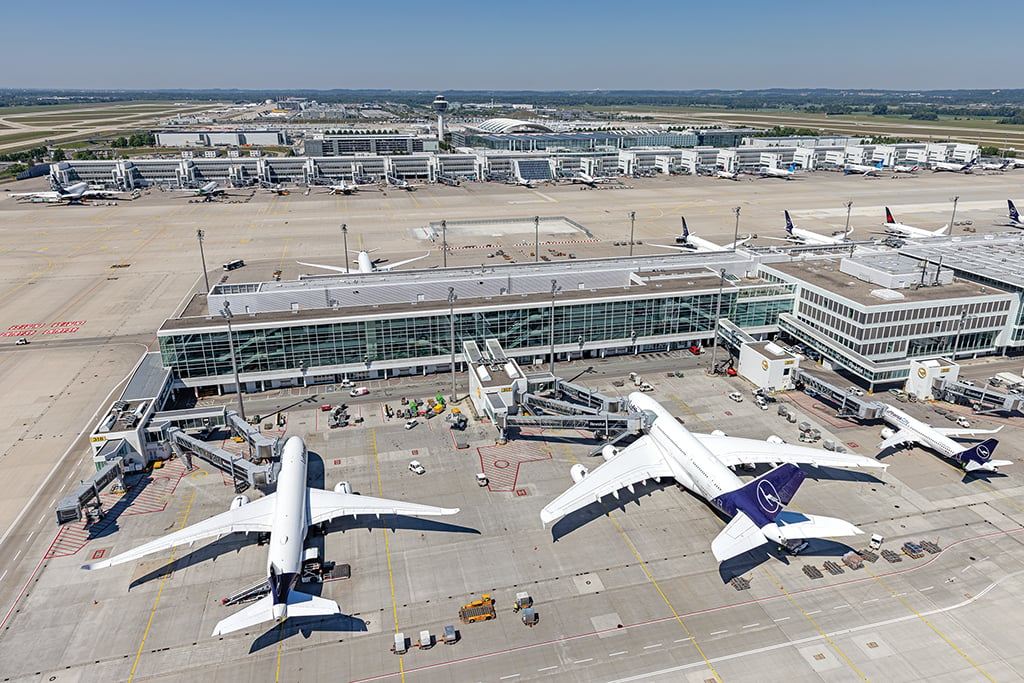
Munich Airport (MUC) is following a similar strategy, strengthening its infrastructure and transfer proposition to capture further long-haul growth. Domestic flying accounted for 14% of its traffic mix in the first half of 2025, compared with 65% for continental services and 21% for intercontinental markets. Transfer passengers now account for 42% of all traffic and 55% in Terminal 2, highlighting the airport’s growing dependence on its hub function.
“Munich is evolving from a market with a significant domestic component toward an increasingly international hub, where growth is driven primarily by European and intercontinental traffic,” Munich Airport SVP aviation Oliver Dersch told ATW.
Lufthansa is scheduled to station a record 37 long-haul aircraft at Munich from November. Dersch said premium leisure demand, business travel and connecting traffic are supporting expansion, while new airline customers in recent years have included Air Arabia, EVA Air, Gulf Air, Royal Air Maroc and Vietnam Airlines.
Munich’s new Terminal 1 pier also supports airlines outside Lufthansa and the Star Alliance. The facility can handle up to 20,000 passengers per day and is being used by 37 airlines serving 48 destinations in 23 non-Schengen countries.
“The new facility enhances Munich’s appeal to airlines outside the Star Alliance group,” Dersch said. “We are in talks with other new carriers and look forward to welcoming new airlines—such as Cathay Pacific, which recently joined us at the pier—in the medium term.”
LUFTHANSA RESHAPES
The development of Germany’s two largest hubs is closely tied to Lufthansa Group’s strategy. Although it remains the dominant airline group at both Frankfurt and Munich, Lufthansa is increasingly directing growth toward lower-cost operations outside its traditional mainline business.
Following the release of the group’s first-half results, Group CEO Carsten Spohr said Lufthansa was shifting growth to the more cost-efficient Lufthansa City Airlines and long-haul LCC Discover Airlines. It also accelerated the closure of Lufthansa CityLine and removed about 20,000 short-haul flights from its summer 2026 schedule, targeting some of its least-profitable short- and medium-haul services. The reductions represented less than 1% of group ASKs.
“I think we have proven that there are alternatives for us to growth in the core airline, which is on short-haul, Lufthansa City Airlines, and on long-haul Discover, putting the non-German AOCs aside for a moment,” Spohr said.
The strategy helps Lufthansa defend its home hubs while controlling costs. City Airlines is being used for short-haul feed, Discover is expanding in leisure markets and Eurowings remains the group’s main point-to-point operator. At the same time, Lufthansa is prioritizing premium cabins, yield and long-haul flying rather than restoring capacity indiscriminately.
That approach supports FRA and MUC but can leave thinner regional and domestic routes vulnerable.
MARKET TRANSITION
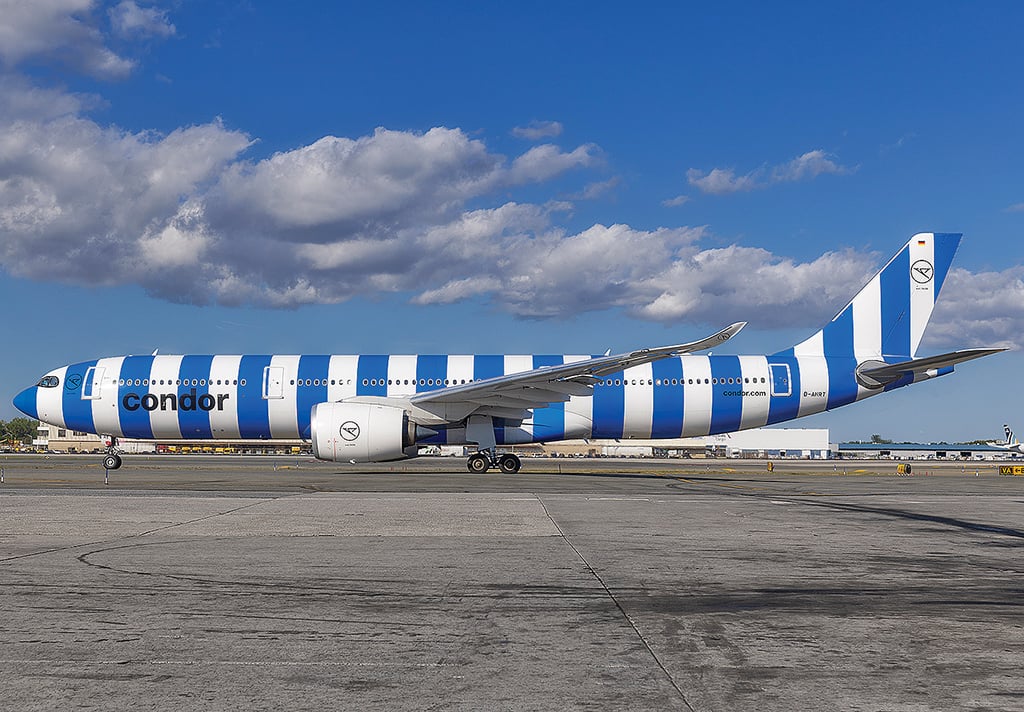
Condor represents a potential challenge to that structure. Frankfurt’s second-largest airline is undergoing another ownership transition after repaying its state-backed loan early. Majority shareholder Attestor plans to acquire the remaining 49% held on behalf of Germany’s federal government and the state of Hesse by Sept. 30, giving it full control. It is also exploring the addition of a strategic airline partner, potentially through a minority investment.
The leisure carrier has been building greater independence from Lufthansa since the latter ended their feeder cooperation. Condor has developed its own short-haul network at FRA to support a long-haul operation centered on 18 Airbus A330-900s. A future strategic shareholder could therefore influence competition at Germany’s principal hub—although no party has publicly confirmed an interest.
Beyond the hubs, some German airports have demonstrated that growth remains possible. Nuremberg Airport (NUE), for example, recovered to 110% of its 2019 passenger volume and recorded its strongest year in 2025. Its recovery has been accompanied by a substantial change in traffic mix, including the loss of domestic services and greater reliance on international leisure flying.
Cargo has provided another source of resilience. German airports handled 2.39 million tons during the first half of 2026, up 3.4% year-on-year and 3.3% from 2019.
Germany therefore retains significant underlying strengths: two global hubs, a large economic base, resilient premium and leisure demand, and one of Europe’s most important cargo systems. But growth continues to lag behind its underlying potential.
The government’s initial tax and regulatory measures mark a change in direction, but airlines and airports maintain that they do not go far enough. The winter 2026-27 schedule underlines the challenge, with German capacity expected to reach only 88% of pre-pandemic levels, compared with a record 118% elsewhere in Europe.
“The federal government has taken important first steps. The relief on aviation tax helps. The drive to reduce bureaucracy is also the right approach,” DUS’ Redeligx said. “Now we need further action.”
SIDEBAR
LOW-COST RETREAT
Germany’s low-cost aviation market has struggled to sustain the expansion that followed airberlin’s collapse in 2017. OAG data show LCCs offered 53 million departure seats from German airports in 2019, accounting for 33.1% of the country’s scheduled capacity. By 2025, the total had fallen 18.3% to 43.3 million seats, while the share had slipped to 31.6%.
UK-based easyJet was initially one of the main beneficiaries of airberlin’s failure. Its acquisition of part of the former airline’s Berlin Tegel operation included slots, leases for former airberlin aircraft and employment offers for flying crews, supporting a 25-aircraft base. EasyJet’s German capacity approached 10 million seats in 2019.
However, that expansion subsequently went into reverse. In May 2022, easyJet announced plans to reduce its Berlin Brandenburg Airport (BER)-based fleet from 18 to 11 aircraft for the winter 2022-23 season. The airline later surrendered slots inherited through the airberlin transaction. By 2025, its German capacity had fallen to 3.3 million seats—67.1% below 2019.
Ryanair has also retrenched in Germany. In August 2024, it announced plans to reduce its Berlin-based fleet from nine to seven aircraft for summer 2025, cutting six routes and 750,000 seats. In April 2026, the airline then confirmed plans to close the seven-aircraft base on Oct. 24 and halve its Berlin traffic from 4.5 million to 2.2 million passengers in 2027, although the airport will continue to be served by aircraft based elsewhere.
“German aviation is broken,” Ryanair CEO Eddie Wilson said when the base closure was announced. “We have no alternative but to switch aircraft from Germany to other more competitive markets elsewhere in Europe.”
Eurowings remained Germany’s largest LCC in 2025 with 15.3 million seats, followed by Ryanair with 9.9 million. However, the overall contraction underlines Germany’s broader challenge: LCCs can readily shift aircraft to more competitive European markets.
—David Casey
SIDEBAR II
TERMINAL 3 EXPANDS FRANKFURT'S AMBITIONS
Fraport has opened the largest infrastructure project in its history, providing Frankfurt Airport (FRA) with capacity to accommodate long-term growth despite the wider German market’s recent weaknesses.
Terminal 3 began regular operations in April following a project Fraport said was completed on schedule and within budget. Fifty-seven airlines relocated to the terminal in four phases.
Piers G, H and J provide initial capacity for up to 19 million passengers annually. A second development phase, including the addition of Pier K, could increase that figure to 25 million.
The terminal features automated baggage check-in, CT security equipment, self-service technology and a new driverless Sky Line transit system connecting it with Frankfurt’s existing terminals and long-distance rail station. The additional space also allows Fraport to redistribute traffic and modernize infrastructure elsewhere in the airport.
“The opening of Terminal 3 is one of the most significant infrastructure milestones in Frankfurt Airport’s recent history,” Fraport SVP aviation and cargo development Simone Schwab told ATW. “Infrastructure alone will not close the gap to competing hubs, but it is a decisive enabler when combined with competitive policy conditions and a consistent focus on customer experience.”
—David Casey

Related Content