This article is published in Air Transport World part of Aviation Week Intelligence Network (AWIN), and is complimentary through Oct 31, 2026. For information on becoming an AWIN Member to access more content like this, click here.
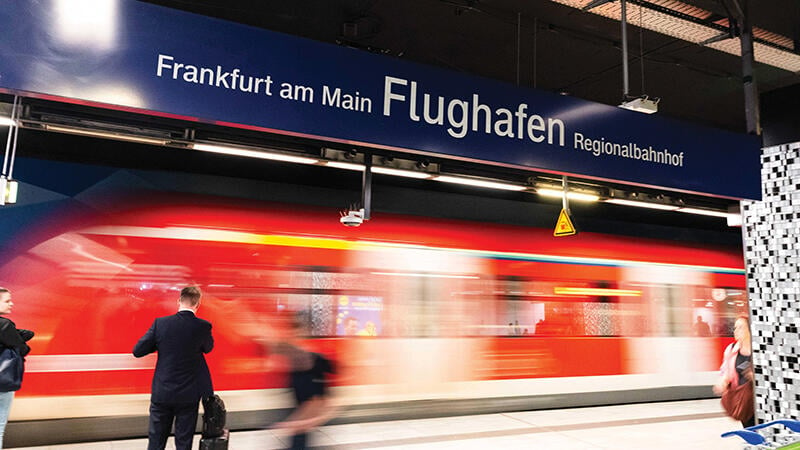
Travelers waiting at the Frankfurt Airport regional train station.
The word “intermodal” is becoming increasingly popular within Europe’s commercial airline sector. To some extent, it is being forced upon airlines by governments because of escalating sustainability concerns.
Those concerns will most likely only deepen after the latest in a series of record-breaking temperatures and widespread fires over much of the continent this past summer.
But intermodal transport offers some genuine benefits, not only for the environment but for airline passengers who can switch between different methods of transport at the start or end of their journeys.
Europe is an ideal region for linking rail or road transport to flights, as many travel sectors are short by global standards. Additionally, an increasing number of European airports have train stations located underneath or immediately adjacent to the terminal.
Lufthansa is one of the continent’s most active operators of intermodal transport, offering both rail and coach services linking to its flights. For example, the German flag-carrier has operated a Lufthansa Express coach service since 1997. Today, it has three routes—Strasbourg, France–Frankfurt Airport (FRA) (220 km/120 nm); Nuremberg Airport (NUE)–Munich Airport (MUC) (165 km/90 nm); and Innsbruck Airport (INN)–MUC (165 km/90 nm). They are all short distances for air routes but accessible in 2 hr. or so by road. Passengers book in advance and receive a ticket before they board the coach service, with the bus terminal sometimes having its own airport-style three-letter code. Passengers must “check in” with the coach driver, but the check-in period is short—perhaps 30 min. before departure. At the end of the journey, passengers still must retrieve their luggage and check it in with airline staff. Passengers receive “air miles” for the ground segment of their journey.
A Lufthansa spokesman said the airline did not disclose how many passengers use its coach services, but that numbers were “developing well. Although we’ve had [the routes] for many years, it’s even now increasing.”
Similar principles apply to the Lufthansa Express Rail system, which provides a much greater choice of destinations than the coaches. This links Frankfurt Airport, Lufthansa’s main hub, to 27 German rail stations (plus Basel in Switzerland).
Passengers check in for both the train and the flight. “At Frankfurt, we have a transfer guarantee,” the spokesman said. “You get a boarding card for the train and [the conductor] scans it. The moment it’s scanned, we know you’re on that train, and we can reasonably expect you for the onward flight. If there’s a delay, we see that the train is late and you might not make the connection, you get re-booked on to a later flight.”
Like the coaches, a combined air-rail ticket grants the user the perk of fast-lane security clearance at Frankfurt and Munich airports. The trains are standard Deutsche Bahn rolling stock; however, one carriage is usually reserved for Lufthansa passengers.
FRANCE AND ITALY
France and Italy also encourage mixed-mode traffic. In France, Air France promotes its Train + Air service with national rail provider SNCF, with routes fanning out from Paris Charles de Gaulle Airport (CDG) utilizing France’s high-speed TGV rail network.
Train + Air tickets offer passenger services including a single point of contact with Air France, rebooking if either the flight or train service is delayed or canceled, and priority baggage drop-off at CDG.
In recent years, the French government has attempted to funnel domestic air travelers onto the rail network through a ban on short-haul flights when a rail alternative of under 2.5 hr. exists. However, the ban has had less impact than anticipated, with it applying in practice to only a few connections.
Similarly in Italy, ITA Airways partners with state-owned train operator Trenitalia to allow single-ticket booking for combined air and high-speed rail travel. Rome Fiumicino Airport’s integrated rail station includes dedicated intermodal check-in and bag drop options for qualifying rail-to-air passengers. One example is a service departing from a regional Italian train station, arriving at Rome Fiumicino’s train station, checking in at a dedicated desk for an ITA Airways flight to London, with an onward connection to Edinburgh, all via a single ticket. In March, ITA broadened the scope of its intermodal services through a partnership with travel distribution system AccesRail and private-sector train operator Italo. Like Trenitalia, Italo offers high-speed services throughout Italy.
In the Netherlands, KLM offers international high-speed train services direct from Amsterdam Schiphol (AMS) to Brussels Midi/Zuid rail station (165 km/90 nm) and to Antwerp (125 km/67 nm).
CONNECTIVITY AND SUSTAINABILITY
European environmental campaigners are keen to move more air passengers to rail services; however, the European Commission (EC) is wary of seeming to force travelers onto alternative forms of transport.
“We shouldn’t put one transport mode against another, because ultimately people and businesses will choose what works best for them,” The head of the EC Directorate-General Mobility and Transport (MOVE), Magda Kopczyńska, noted in 2024. Rather, she said the EC is urging all forms of transport to become as sustainable as possible. Kopczyńska rejected the idea that the need to cut emissions conflicted with the economic imperative of keeping Europe connected.
“Those two are not only possible to reconcile, but they have to be reconciled. If we start putting them [connectivity and sustainability] against each other, then we will inevitably start making wrong choices,” Kopczyńska said. “We have to make them both work.” Among the hurdles to this goal are a lack of public awareness of such intermodal arrangements and differing national ticketing arrangements.
Beyond Europe, the United Arab Emirates is applying its take on intermodal transport. In Dubai, eVTOL air taxi operator Joby Aviation plans to launch the world’s first electric air taxi service from a purpose-built vertiport adjacent to Dubai International Airport (DXB). The service will initially connect the airport to three other points in the emirate. Further ahead, more destinations are planned, notably to Abu Dhabi, avoiding the congested highway between the two cities.

Related Content