This article is published in Air Transport World part of Aviation Week Intelligence Network (AWIN), and is complimentary through Jun 17, 2026. For information on becoming an AWIN Member to access more content like this, click here.
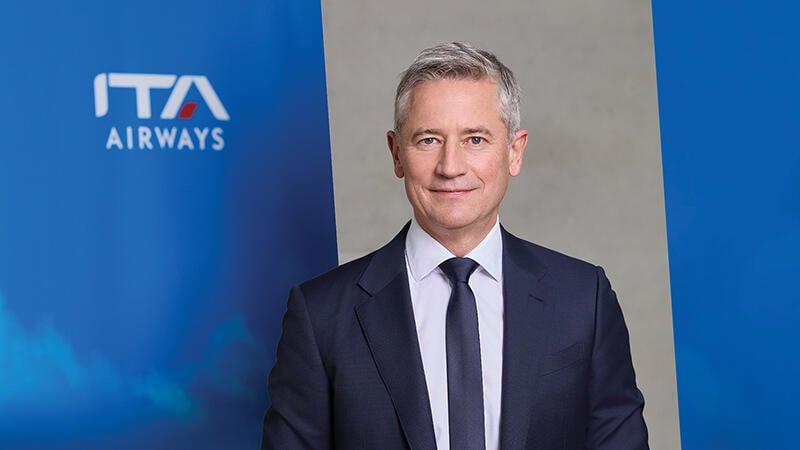
Joerg Eberhart took the helm at Italian carrier ITA Airways in January 2025 after careers at Lufthansa and Air Dolomiti. ITA, which was created in 2021 after Alitalia ceased business, operates mainly out of two hubs: Rome Fiumicino and Milan Linate. Lufthansa took a 41% stake in ITA in 2025, and ITA delivered a net profit of $209 million for the year before joining the Star Alliance in April. ATW conducted and edited this interview from a Window Seat podcast recorded in April.
It’s been a busy 18 months since you joined ITA. What are your key takeaways? It was a greenfield approach, or pioneer work, I would say, even with the many resources that came from Alitalia. It was then a long way to get to 103 aircraft in our fleet. It was a good decision to opt for an Airbus-only fleet. Within two years, we will be at more than 90% new-generation aircraft. On new technology, we are now also looking into processes, optimization and into integration projects with Lufthansa Group that will realize synergies on the cost side and also on the revenue side.
What are the next major milestones for the rest of 2026? We are going to phase in two more long-range aircraft, which means we had to find two more destinations, and one will be Houston from May 1. We have not yet decided on the second destination. Once we enter into the [transatlantic immunized] joint venture with United Airlines and Air Canada, we can also optimize our networks with them. We need antitrust immunity for that, and we filed for approval a couple of months ago so I would say that from around six months, we should be able to enter the joint venture.
Lufthansa has the option in June to increase its stake from 41% to up to 90%? That’s right. In June, we’ll open a window for the whole month in which Lufthansa could execute a call option to go up to 90%. From our perspective, of course, the decision rests with Lufthansa, but from our perspective, an early execution of the option would put us in a position to realize synergies much earlier.
How is the war in Iran impacting your operations? The impact of this conflict is quite contained for the time being. We only had to cancel three routes: Tel Aviv, Dubai and Riyadh. Of course, in the medium- and long-term, we are facing higher fuel prices that could partly be compensated for by hedging and partly by higher fuel surcharges. But, as for the whole industry, if the conflict extends into the second half of the year, everybody could have problems because the [new] hedging period would not cover the higher fuel expenses on the fuel and demand might become less strong than it is today. We are preparing for different scenarios; in the long-conflict scenario, we cannot exclude cutting capacity.
What’s your overall fleet and network strategy through 2030? The base plan sees growth in the long-range that begins this year. We started with 24 widebodies and that fleet will increase to 30 aircraft by 2030. We are looking at the Airbus A330-900 and the A350-900. We are also optimizing the situation in [Milan] Linate, where we have still a slot portfolio that allows us to do many domestic flights. There might be some [slot] optimization potential with the Lufthansa Group. In winter, for example, we gave some slot pairs to Austrian Airlines that enabled them to move their operations from [Milan] Malpensa to Linate.
What do you see in terms of potential for new destinations and market focus? Primarily the market for long range is the US. Secondly, there is still potential in South America, where we are already quite strong. ITA alone is flying more to South America than any other member of the Lufthansa Group, and there’s still potential to increase that, but also potential for new destinations. We are looking to Lima, for example. We are looking to Santiago de Chile. We might consider Bogota, which is operationally difficult. Everybody’s hoping that Caracas will reopen, in which case that would be a candidate. So, we have a lot of ideas.
Where do things stand with your narrowbodies in terms of Pratt & Whitney engine issues? Currently, we have 18 narrowbody aircraft on the ground due to the problems. It’s affecting the Airbus A320 family, but also the A220. Hopefully within the next three to five years, the numbers will go down, but it depends on engine shop cycles. It could be 12 months, could be 15 months. We are learning every day about the situation.
Is there any prospect of reviving the Alitalia brand or will the brand remain ITA Airways? In general, we will stick to the ITA Airways brand, where we have already invested time, money and communications. In Europe, it’s quite a well-known brand already. Less so on other continents, but we are working on that. We might, let’s say, take some elements of the old Alitalia brand, but then we would have to identify positive content. Alitalia struggled [in its later years] and was burning money and giving poor service, so we would have to go back maybe to the 1960s or ‘70s when Alitalia was a very well-regarded brand around the world. We might combine some of those elements from the old Alitalia brand with our modern ITA, but we don’t know yet how or when.
Listen to the full interview with Joerg Eberhart on ATW’s Window Seat podcast at https:// aviationweek.com/podcasts/window-seat-podcast/podcast-ita-airways-ceo-what-lies-ahead.