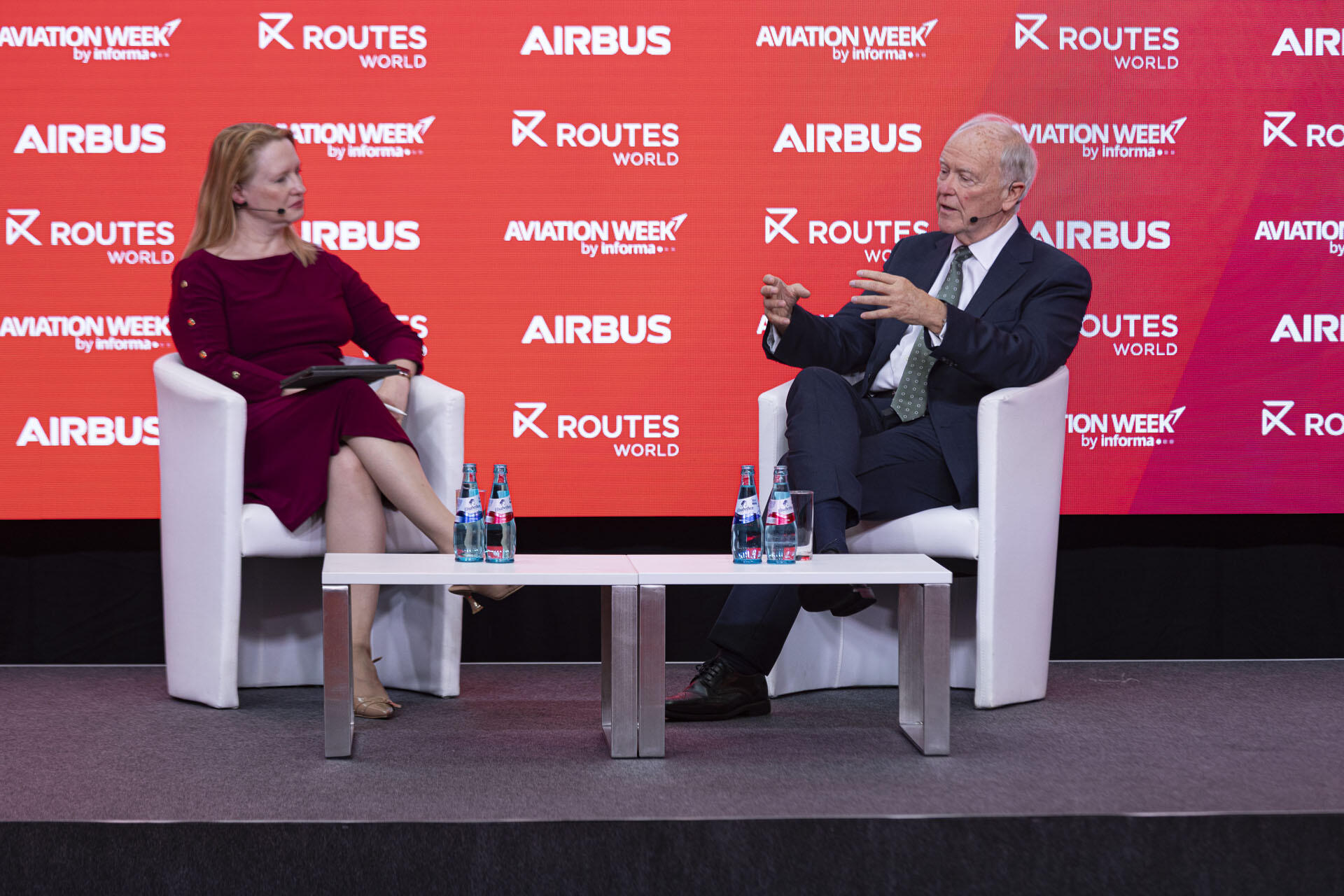
Emirates' Tim Clark (right) speaks onstage at Routes World 2026 in Frankfurt.
FRANKFURT—Emirates Airline President Tim Clark revealed that his carrier told Boeing about three years ago that it would reject its earliest production 777X aircraft, saying the decision was documented well before the issue became public.
Clark said the aircraft would require extensive modifications to meet current standards, and insisted Emirates would accept only newly manufactured jets.
Speaking at Routes World 2026 in Frankfurt, Clark expressed surprise that the rejection of the early aircraft had garnered outsized attention in July this year, given that Boeing had already been informed of the airline's position. “To be quite honest, I was quite shocked,” he said, referring to what he considered old news. “It was absolutely clear we will not take these in. And that our new aircraft will be newly built. Why this came up or why it was being opened and stuff, I have no idea,” he said. “The fact was clear; it was documented.”
The decision affects some of the earliest 777-9s built for Emirates, part of an initial production batch of approximately 20 aircraft that have spent years awaiting certification and delivery.
Clark said Emirates wanted aircraft built under Boeing's newer production and quality-control processes rather than jets assembled before later program changes. “Remember, the aircraft that were built, the first one in July 2019,” he said, referring to the period before further certification and production changes. “We really wanted aircraft that were built under the new regime of building aircraft.”
Asked what would happen to the rejected aircraft, Clark indicated that was Boeing's responsibility. “Whether they can revamp them, offer them at this kind of price is up to Boeing,” he said.
The situation recalls Boeing's experience with its early 787s, particularly the aircraft known as the “Terrible Teens.” Those early production aircraft required extensive modifications and were heavier than later examples, prompting some customers to reject them and forcing Boeing to find alternative operators, often at substantial discounts.
Emirates is not alone in rejecting early 777Xs. Lufthansa CEO Carsten Spohr confirmed in August that the German airline, the first to commit to the 777X and the first scheduled to put it into service, also plans to decline some of the earliest airframes built for it in favor of newer production examples.
More News And Analysis From Routes World 2026
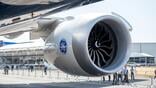
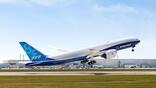
The 777X was launched at the Dubai Airshow in November 2013, with Emirates as its largest launch customer. The airline originally committed to 150 aircraft, comprising 115 777-9s and 35 777-8s, with deliveries initially planned to begin in 2020. Emirates subsequently expanded its commitment, ordering another 90 777Xs at the 2023 Dubai Airshow while adjusting its existing order, bringing its total to 205 aircraft. A further 65 777-9s were ordered in November 2025. The backlog stands at 235 777-9s and 35 777-8s, according to Aviation Week Fleet Discovery data. The airline remains the largest customer for the 777X, accounting for a substantial share of the program's global backlog.
Despite the rejection of early aircraft and ongoing delays, Clark said the decision would not affect Emirates' network plans. The carrier is already extending the service lives of its Airbus A380s and Boeing 777-300ERs while awaiting new deliveries, supported by a major cabin refurbishment program. The airline expects its first 777-9s in 2027, seven years later than originally planned.
Clark said the wider problem facing airlines was the inability of manufacturers to deliver enough aircraft to meet demand. “Demand is going to exceed the capacity that the manufacturers can produce,” he said. “If it were me, I would build more factories. It's like, with so much demand, build more airplanes.”
Emirates' long-term fleet strategy depends heavily on the 777X as the eventual replacement for much of its existing widebody fleet. Clark said the airline would continue operating its A380s into the early 2040s, but their retirement would create a substantial capacity gap. “The A380 will go out of our fleet in the early ‘40s, and therefore we will have to be content with the 777X, trying to get that stretched to the '777-10' to give us more seats,” he said. The 777-9, even in a dense configuration, would accommodate around 150 fewer passengers than an Emirates A380, making it difficult to replace the larger aircraft on a like-for-like basis at airports where additional slots are unavailable.
Clark has been pressing Boeing to study a so-called 777-10, and the airline's latest order at the November 2025 Dubai Airshow helped entice Boeing to look at it more closely. The agreement for 65 additional 777-9s included conversion rights to either the 777-8 or a future 777-10 and backed Boeing in undertaking an engineering feasibility study of the stretched aircraft. The proposed variant could accommodate approximately 50 more passengers than the 777-9, giving Emirates an aircraft closer to the capacity it requires as the A380 fleet is gradually retired.

Related Content