This article is published in Aviation Week & Space Technology and is free to read until Nov 18, 2026. If you want to read more articles from this publication, please click the link to subscribe.
In an aerospace industry increasingly defined by supply chain resilience and vertical integration, GE Aerospace’s proposed $11.75 billion acquisition of Consolidated Precision Products could be one of the most strategically significant deals in recent memory.
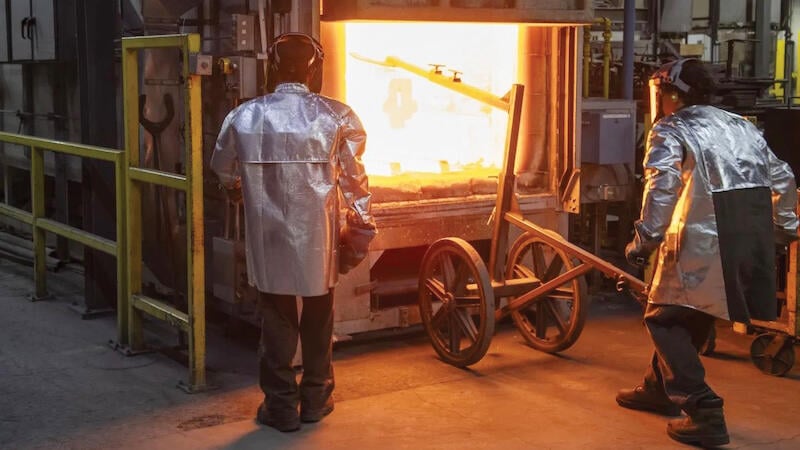
At its core, the transaction addresses one of the most critical bottlenecks in modern gas turbine manufacturing: investment castings. Consolidated Precision Products (CPP) is an important producer of investment castings, the highly precise process used to manufacture turbine blades and vanes. The most advanced of these are single-crystal castings, which enable turbines to operate at higher temperatures, improving fuel efficiency, thrust and durability.
Aeroengine and industrial gas turbine (IGT) OEMs and suppliers spend roughly $11 billion annually on investment castings, about 30% of it devoted to single-crystal components. Yet production remains highly concentrated in a duopoly: Precision Castparts and Howmet Aerospace control some 80% of capacity for these critical parts. The entry barriers to the business are enormous; it is the ultimate “black art” in manufacturing technology.
Demand is now accelerating from three directions. Commercial aircraft production is ramping up to support record backlogs. Aftermarket demand remains robust as airlines keep fleets flying longer. Meanwhile, IGT production is surging to support the build-out of artificial intelligence data centers. The result is a classic supply-demand imbalance characterized by rising prices, extended lead times and constrained capacity.
Engine OEMs have spent decades attempting to reduce their dependence on the casting duopoly. Pratt & Whitney opened an airfoil production facility in Asheville, North Carolina, in 2022, but it remains primarily focused on machining rather than large-scale single-crystal casting. Rolls-Royce has been more successful—it has produced single-crystal airfoils internally for decades and recently announced a major capacity expansion. GE steadily shifted business to CPP, the third-largest supplier, and has become its biggest customer; the acquisition is the logical culmination of that strategy.
But this deal is about more than securing supply. Single-crystal blades and vanes are a source of competitive differentiation because they sit at the heart of modern turbine technology. High-pressure turbine (HPT) blades and vanes routinely operate in gas streams hundreds of degrees hotter than the melting point of the underlying alloy. They survive through a combination of advanced superalloys, single-crystal casting, thermal barrier coatings and sophisticated internal cooling passages.
As operating temperatures rise, casting technology becomes more important. Consider the evolution from the CFM International CFM56 to the Leap. The former, based on 1970s-era technology, operates at pressure ratios of roughly 30-35:1 and turbine inlet temperatures approaching 2,500F. The Leap operates at pressure ratios of almost 50:1 and temperatures of at least 2,900F, and it has double the number of HPT airfoils.
At these conditions, even small changes in cooling effectiveness become critical. Cooling passages, coatings and casting precision increasingly determine engine durability and performance. That is one reason why several modern engine programs required expensive hot-section redesigns—a trend that will likely continue.
Pratt, for example, recently introduced an Advantage upgrade package for its geared turbofan that incorporates redesigned HPT hardware to improve its time on wing. Rolls introduced a Trent 1000 durability program that includes a 40% increase in cooling airflow through redesigned HPT blades.
The implications could extend beyond GE itself. Shifting demand away from the investment-casting duopoly could result in higher prices for nonvertical aeroengine and IGT customers as they protect their profit margins.
The deal also could signal a broader shift toward vertical integration across the aeroengine ecosystem. Castings are only one potential bottleneck. Forgings, advanced materials, thermal coatings and other specialized manufacturing capabilities are growing in importance as production rates climb.
In the final analysis, GE Aerospace’s acquisition of CPP might prove to be a strategic masterstroke and a harbinger of a more vertically integrated aeroengine supply chain.

Related Content