This article is published in Aviation Week & Space Technology and is free to read until Oct 24, 2026. If you want to read more articles from this publication, please click the link to subscribe.
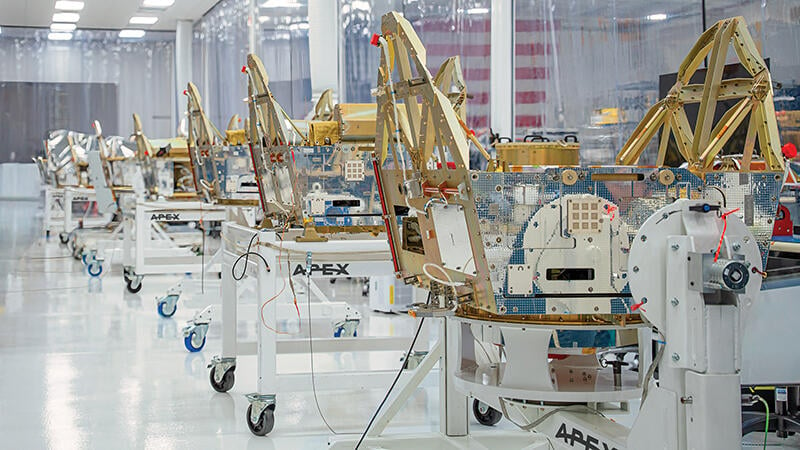
Elveo said it would work with Apex to scale up satellite production.
Satellite service providers are dialing up efforts to turn the term “disconnected” into a relic. The next few years will see a sharp inflow of direct-to-device satellite systems to connect users and their smartphones, or smart devices, no matter where they are. Industry is poised for an increase in service providers and enhanced capabilities.
“Direct to device is certainly at an inflection point,” Novaspace CEO Pacôme Révillon said as he kicked off the World Space Business Week (WSBW) gathering here on Sept. 14. More than 120 mobile network operators have signed agreements with direct-to-device (D2D) operators for services, he noted.
- Elveo picks Apex to aid satellite production
- Space42 and Viasat commit $1 billion to Equatys partnership
SpaceX, which provides basic D2D capabilities through some of its Starlink satellites, expects in the coming year to advance plans to deploy a more sophisticated service that would go beyond the basic texting now available, Chief Financial Officer Bret Johnsen said Sept. 10 at a Goldman Sachs investor event. Satellites to be lofted next year will have 5G-type service, he said, so that connectivity could be available in the first half of 2028.
Elveo Mobile, formed through the merger of Lynk Global and Omnispace, is looking to have D2D service operational in mid-2028 and talking with launch service operators to deploy the low-Earth-orbit (LEO) systems, CEO Ramu Potarazu says.
Elveo plans to have 320 satellites on orbit for persistent global coverage for voice. The company could offer an intermittent service option earlier, with an initial batch of 40 spacecraft, Potarazu told Aviation Week during WSBW.
Elveo on Sept. 13 disclosed a partnership with spacecraft production specialist Apex for a dedicated factory in the U.S., although the site has yet to be revealed. “We have the design, we have the spectrum, and what they bring to the table is high-velocity manufacturing,” Potarazu said. Production is due to start next year.
Apex has developed a concept it calls Factory X—effectively a cookie-cutter satellite production facility that could start churning out spacecraft within a year. Elveo intends to leverage that approach for a site it plans to build in the U.S., the companies said, before expanding to Europe and Asia.
“We are already actively exploring an additional site here in Europe together with our partner SES, and then we’re also in exploratory discussions with respect to a third, Asian nation,” Apex Chief Strategy Officer Ram Viswanathan said.
“Working with our partner Elveo will help bring critical D2D services to European customers on the timeline they demand,” SES CEO Adel Al-Saleh said in a statement.
Key to meeting the tight timeline to put the system into operations will be rocket availability now that flight opportunities are scarce. “We are in very heated negotiations with some people that can help us,” Potarazu said. He added that Elveo is in talks with launch service operators globally.
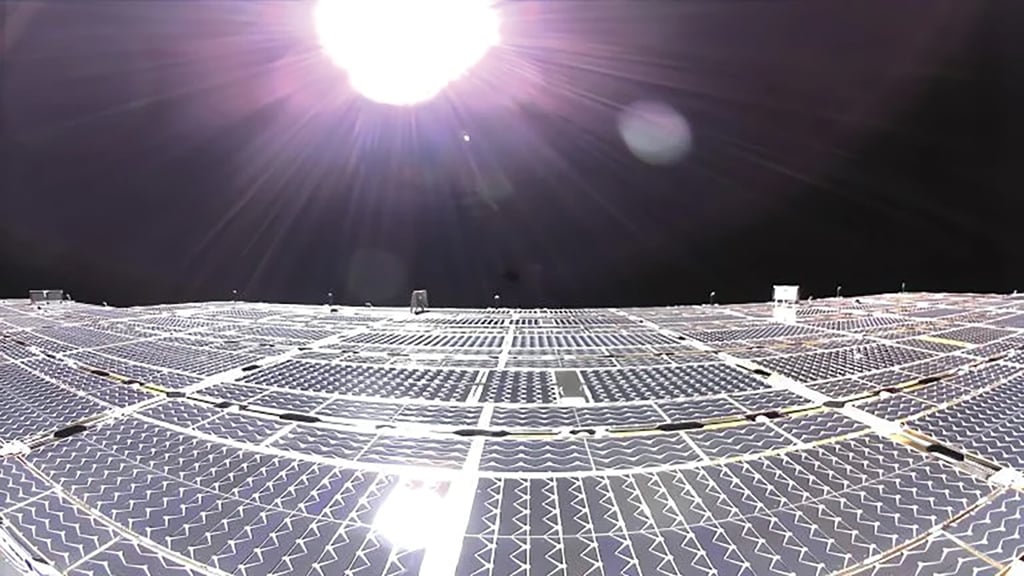
The company has opted for a satellite design that can be stacked like pancakes on a launcher, Viswanathan said. A SpaceX Falcon 9 should be able to deploy 25-30 satellites per launch, with potentially more capacity on other systems.
Elveo recently secured SES as a backer for its program. The LEO constellation is planned to be interoperable with medium Earth orbit and geosynchronous orbit using intersatellite links.
To help reduce risk, Elveo has flown the underlying technology on 10 satellites and tested it with mobile network operators, Viswanathan said. The company also plans to deploy four prototype satellites of the operational configuration, which will provide edge computing capabilities to reduce latency for some services.
Satellite operators Space42 and Viasat, which last year disclosed their plans for a D2D partnership, announced at WSBW that they have committed $1 billion for shared space infrastructure to formalize their Equatys joint venture plan.
Equatys is intended to offer prospective D2D operators access to a pooled satellite constellation, promising lower up-front infrastructure costs. The constellation is to launch with fewer than 200 satellites and expand to 2,800 spacecraft distributed over three LEO layers in 60 orbital planes, Viasat CEO Mark Dankberg told reporters at WSBW. Equatys plans to deploy the constellation using smaller launchers and to commence service in 2029.
Space42 is underpinning the joint venture with $600 million, and Viasat will contribute $400 million. Equatys has access to more than 100 MHz of globally coordinated mobile satellite services spectrum available for D2D deployment, the companies said.
Space42 Managing Director Karim Sabbagh likened Equatys to a tower company in terrestrial infrastructure through which multiple mobile network operators can provide service. A typical use case would be preventing dropped voice calls, such as while driving, Dankberg said. When a call is about to drop, it could be handed over to a satellite, even briefly, to maintain service, he said.
Dankberg and Sabbagh expect other companies—ranging from equity investors to mobile network operators that hold spectrum but lack a complementary infrastructure—to join Equatys.
“We don’t need to have the biggest satellites or the most satellites if we can bring to bear the most spectrum,” Dankberg said. “Spectrum is a much more efficient way to generate the bandwidth.”
Countries could become partners, too, providing satellites that support service in a specific country and making them available via Equatys to serve other markets.
The D2D market, while still nascent, is becoming crowded. Equatys and Elveo are entering a market contested by SpaceX and AST SpaceMobile, which is deploying its constellation. AST SpaceMobile aims to commence service next year—somewhat later than planned after it lost one spacecraft due to a mishap on launch.
Amazon this summer formally requested authority to deploy an LEO D2D service. The company had agreed in April to buy Globalstar to underpin its ability to connect satellites to mobile phones and other devices. The constellation that it would operate alongside its Amazon Leo system, now in deployment, would consist of up to 5,105 satellites; service is due to commence in 2028. Amazon plans to work with telecommunication companies to bring the service to customers, rather than selling directly.
Despite the crowded field, newcomers are optimistic that they will find a foothold, particularly as SpaceX is considering taking the role of mobile network operator, which would prompt incumbents to look for partners and alternative service providers.
Potarazu said service providers will be seeking multiple service options and that its global spectrum rights make Elveo an attractive partner to fill that role. The company would scale up the constellation later to expand its services that can support voice, messaging and applications to provide full streaming services.
Equatys’ founders expect to gain a small but profitable share of the mobile market. Even securing merely a share in the $50 billion addressable market that excludes Russia and China would yield an attractive revenue opportunity, Dankberg and Sabbagh said.
What is more, the size of the market could be far larger than currently expected, since many services emerging through D2D connectivity may be as yet undiscovered, AST SpaceMobile President Scott Wisniewski suggested. “An overly precise definition of use cases dramatically underappreciates the nature of the world we live in—the value of connectivity,” he said.


Related Content