This article is published in Aviation Week & Space Technology and is free to read until Oct 03, 2026. If you want to read more articles from this publication, please click the link to subscribe.
Aerospace Corp. Pushes Adoption Of DiskSat Tech After Successful Demo
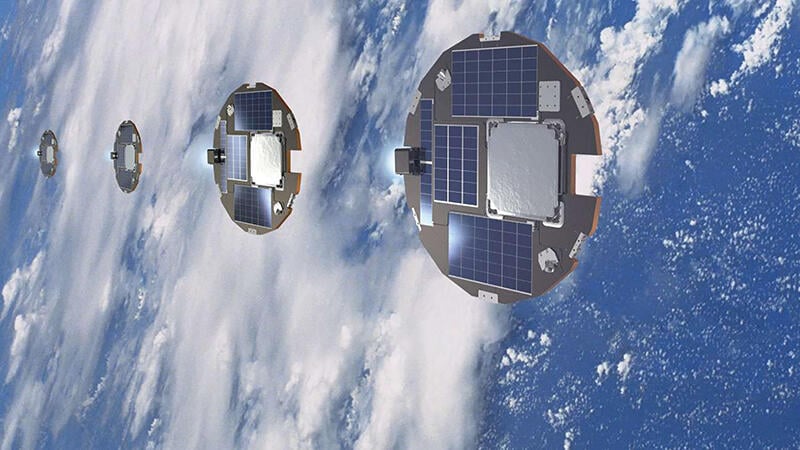
The DiskSat’s ability to fly “edge-on” reduces atmospheric drag in very low Earth orbit.
A little more than eight months after launching a four-set of its novel DiskSat, The Aerospace Corp. sees an opportunity to reshape the small satellite industry.
The federally funded research and development center (FFRDC) envisions flattening satellites from the common cubic form to a wafer-like geometry.
- Larger surface area offers potential for better radar or communications antenna performance
- The flat satellites are designed to stack like plates inside of a rocket fairing
The Aerospace Corp.’s DiskSat is a disk-shape spacecraft, 1 m (3.3 ft.) in diameter but only 2.5 cm (1 in.) thick. The satellites are designed to stack like plates inside a rocket fairing, allowing a launch vehicle to carry more into space. Their flat profile also offers considerably more surface area for solar panels than comparable cubic satellites, including cubesats, potentially increasing the vehicle’s power-generation capabilities.
The Aerospace Corp. says its demonstration mission of four DiskSats, launched in December, has hit its milestones and is moving toward an experimental flight phase in very low Earth orbit (VLEO), where they will attempt to fly as low as 250 km (150 mi.) above Earth.
After a promising start, the FFRDC has licensed its DiskSat technology to three commercial companies. Propulsion specialist Neumann Space, space systems developer Orbotic Systems and space computing company Satlyt have nonexclusive licenses, The Aerospace Corp. said Aug. 25 at the Small Satellite Conference in Salt Lake City.
The Aerospace Corp. previously pitched the DiskSat as a follow-on alternative to the cubesat, a hugely successful open satellite standard that has been critical to the growth of the small satellite industry over the past 25 years. However, the FFRDC has recently emphasized technology transfer deals via commercial licensing.
“The goal is to have a very low barrier to entry,” says Mike Fox, systems director with The Aerospace Corp. “There are ways in which we license that we have to follow, and we’re working within those parameters to get it out to as many people as possible.”
For its part, Neumann Space of Adelaide, Australia, is likely to manufacture its version of the DiskSat with a local partner, Managing Director James Schultz says.
Neumann Space sees the DiskSat standard as an ideal vehicle for its Neumann Drive, an electric propulsion system that uses solid metal propellant, such as molybdenum, instead of conventional gas propellant. The company has created a version called the Flatypus for the DiskSat and other flat satellites.
“Because we’ve got solid metal, we can pack a lot of fuel into a very small amount of space,” Schultz says. The Neumann Drive’s lack of propellant tanks, plumbing and other hardware allow it to be configured into flat satellites, such as the DiskSat, the company says.
The Aerospace Corp. says the DiskSat, weighing about 17 kg (37 lb.), has approximately 13 times more surface area and the same volume as a 20U cubesat. That means more solar panels, more electrical power and, on the other side, a larger area for a radar or communications antenna.
“You don’t need to have some elaborate deployment system to deploy a large antenna [for communications],” says Darren Rowen, director of the small satellite department at The Aerospace Corp. “Other missions, such as position navigation and timing, space weather, or synthetic aperture radar imagery, are well suited for this platform.”
Because a DiskSat can fly with its narrow edge facing the airflow, the type suffers less from atmospheric drag than conventional cubic satellites, especially in VLEO, where the atmosphere is thicker and causes faster deorbiting, The Aerospace Corp notes.
The DiskSats are propelled by a field-emission electric propulsion (FEEP) system, which produces thrust by electrically ejecting metal ions. “The FEEP thruster provides sufficient thrust to maintain an altitude as low as 250 km for more than one year,” The Aerospace Corp. said in a recent paper.
The DiskSat demonstration mission was funded by sponsors NASA and Space Systems Command (SSC); the spacecraft carry a secondary payload that The Aerospace Corp. declines to disclose.
“VLEO capabilities enable improvements to imaging resolution, communications monitoring and atmospheric measurements,” the SSC noted in announcing its sponsorship of the DiskSat demonstration mission in 2024.