This article is published in Aviation Week & Space Technology and is free to read until Aug 15, 2026. If you want to read more articles from this publication, please click the link to subscribe.
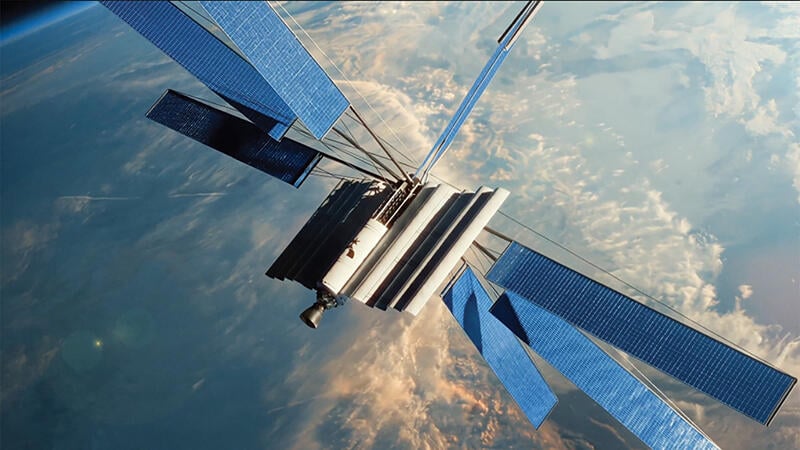
Cowboy Space plans to develop a combined data center and upper-stage rocket.
In their ambitious designs for orbiting data centers, space companies are going to new lengths—literally.
Take SpaceX’s proposed AI1. Its wingspan with solar arrays fully extended is about 70 m (230 ft.). That is the better part of a football field, or a few meters shorter than the solar arrays powering the International Space Station.
- Planned data centers would dwarf predecessors in physical size and constellation scale
- Radiating thermal heat from AI chips poses major problem
But it is not just about size. Developers are pushing designs to new extremes in multiple ways to solve tricky problems with launching, powering and cooling artificial intelligence (AI) data centers in space.
The first hurdle is Earth’s gravity. To compete with terrestrial AI data centers, SpaceX and others are banking on the company’s Starship Super--Heavy launch system. If it works as advertised, the rocket would make launch capacity relatively cheap and plentiful.
“You need a large mass to orbit capability, which is what Starship will give us,” SpaceX CEO Elon Musk said in a presentation about AI1 on June 8. “We need to send millions of tons to orbit and beyond.”
Musk said SpaceX aims ultimately to launch a terawatt of computing capacity into space, although the timeline for that build-out is undeclared. That would far outstrip what is being built on Earth, where about 23 gigawatts of capacity was under construction in September, according to BloombergNEF.
Cowboy Space, formerly known as Aetherflux, announced plans in May to develop a launch vehicle with a 1-megawatt data center integrated into the rocket’s upper stage to save weight. A rendering shows six solar panels arrayed around the upper stage.
The company aims to build a reusable launch vehicle—no small feat in itself—“but the business model is explicitly designed not to depend on it,” Cowboy Space CEO Baiju Bhatt told Aviation Week at the time.
“Third-party launch capacity isn’t guaranteed at the scale we need, and we’ve concluded the unit economics of space-based compute are most efficient with a vertically integrated, in-house launch program,” he said. “Owning the rocket makes the cost-per-GPU-hour competitive.”
Once in space, the challenges do not stop for data centers.
“What is the actual engineering problem here?” Ian Dahl, SpaceX’s director of satellite engineering, asked in the AI1 presentation. “It’s really a combination of delivering power and taking the waste heat and energy away and sending it into the vacuum of space.”
Unlike Earth, where air can help carry away the waste heat from data centers, heat must be ultimately radiated as infrared energy into space. And AI chips require a lot of energy and generate a lot of heat.
Musk said the AI1’s solar panels are designed to generate 250 watts/m², and the vehicle’s radiators to emit 1,400 watts/m². The 110-m² (1,180-ft.2) radiators would expel heat on both sides, use a pumped liquid coolant to transfer heat from the data center in the middle of the structure and be “oriented knife-edge to the Sun,” he says.
Startup Sophia Space hopes to condense the solar-to-compute-to--radiator process by sandwiching all three components next to each other.
“This entire conversation around [orbital data centers] begins and ends with thermal rejection,” CEO Rob DeMillo said in June at the Space Tech Expo in Anaheim, California. The company’s modular tile system would extend from a central flat-panel satellite structure and resemble a slightly thicker solar panel array.
“It allows us to take the heat that gets generated by the [central processing units] and [graphics processing units] and immediately passes them off to the radiator, which passes it off to space, and the system is so efficient,” DeMillo said.
Some ideas may be too novel to get off the ground. Starcloud, a startup supported by AI-chip-maker Nvidia, announced a partnership in October to study building a massive “gigawatt--scale” orbiting data center using autonomous, self-assembling solar array and thermal radiator modules from startup Rendezvous Robotics.
In February, Starcloud switched to a slightly more conventional idea to deploy and operate a constellation of up to 88,000 satellites as “a distributed data center in space,” according to a filing with the Federal Communications Commission (FCC).
SpaceX’s Starmind constellation ambitions top them all. The company envisions deploying up to 1 million orbiting data centers, a January filing with the FCC states. The spacecraft would connect via a vast network of laser communications—a rare system prior to the mass deployment of SpaceX’s Starlink internet satellite constellation a few years ago.