This article is published in Aviation Week & Space Technology and is free to read until Nov 29, 2025. If you want to read more articles from this publication, please click the link to subscribe.
Technologies developed for the 2024 ADRAS-J mission are being repurposed for new services.
The Japanese are world-renowned for their cleanliness. Walk the streets of Tokyo, and there is not a loose piece of trash in sight. After major sporting events, Japanese fans stay and bag garbage. So it fits the stereotype that the country would lead the world in cleaning up space junk.
Astroscale, Japan’s leading space debris removal company, has found that the technologies underpinning its on-orbit service make for a tidy business—potentially several businesses, in fact. The Tokyo company was founded in 2013 with the sole stated aim of cleaning up the growing mess of derelict rocket bodies, dead satellites and other debris orbiting Earth. It dubbed its employees “space sweepers.”
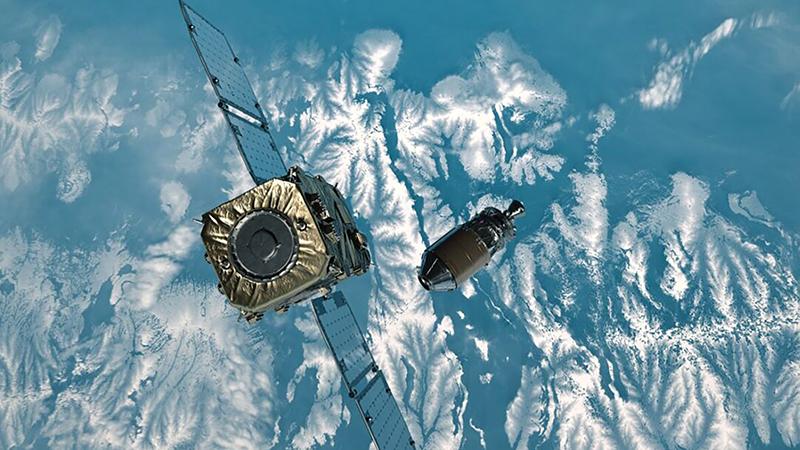
The company sent its Active Debris Removal by Astroscale-Japan (ADRAS-J) spacecraft to approach and maneuver alongside an abandoned H-IIA upper-stage rocket body in low Earth orbit (LEO) in 2024. Astroscale has yet to remove debris from space, but it is getting close. The ADRAS-J came within 15 m (50 ft.) of the derelict upper stage. That year, the Japan Aerospace Exploration Agency had also awarded the company a follow-on mission, scheduled for launch in 2027, to use a larger ADRAS-J2 spacecraft to remove and return the H-IIA rocket body from space.
- ADRAS-J spacecraft came within 15 m of derelict upper stage
- Company is planning nearly a dozen demonstrations, including overseas
After demonstrating that it can fly close to another object in space—rendezvous and proximity operations, in industry parlance—Astroscale has been on something of a tear. This year alone, the company has announced multiple new demonstrations in in-space servicing, on-orbit refueling and military space domain awareness.
Many of Astroscale’s missions use similar rendezvous and proximity operations technologies, including sensors and guidance, navigation and control, as well as techniques honed from ADRAS-J’s mission. Three spacecraft that Astroscale is developing for Japanese government-funded missions use the same bus structure: ADRAS-J2, In-situ Space Situational Awareness-Japan 1 (ISSA-J1) and Refueling for Extension and Flexibility-Japan (Reflex-J1).
“Naturally, we try to maximize the commonization among the satellites in design and selection of hardware,” Eddie Kato, president and managing director of Astroscale Japan, tells Aviation Week.
The ISSA-J1 mission is anticipated for launch in 2027. The spacecraft is expected to diagnose and inspect two large pieces of satellite debris in two different orbits. The Reflex-J1’s mission is scheduled for launch in 2028. The company plans for that spacecraft to use a robotic arm to demonstrate chemical propellant refueling in LEO.
The ability to get a close-up look at another spacecraft is increasingly piquing the interest of world militaries, including the Japanese Defense Ministry, which in recent years has seen its budget balloon as concerns about China grow.
The ministry contracted Astroscale in February to develop and fly a “responsive space system demonstration satellite prototype” in geostationary orbit (GEO). As part of the demonstration, the spacecraft—which is considerably smaller than other vehicles under development for the Japanese government—would be equipped with a laser communications terminal so that it could transfer space domain awareness data quickly to a laser relay satellite in GEO made by Space Compass of Tokyo.
Kato anticipates the Japanese government will fund in-space manufacturing demonstrations soon, presenting an opportunity for Astroscale to use its robotic spacecraft in yet another application. Astroscale is interested in collaborating with companies that have in-space welding technology; Kato points out a Japanese start-up, Space Quarters, that is developing electron-beam welding systems for assembling large structures in orbit and on the lunar surface.
Astroscale has set up subsidiaries in France, Israel, the UK and the U.S., where its local entities are pursuing development and demonstration work with national governments. Astroscale UK has a long relationship with Eutel-sat OneWeb and the UK government, including demonstrating satellite docking technologies. The company was awarded £5.15 million ($6.9 million) by the UK government in June to develop two formation-flying cubesats that will collect data on space weather.
Sharing intellectual property across international subsidiaries is tricky, however. National governments are not keen to have technologies that were developed in their countries—and at their citizens’ expense—transferred abroad, Kato says. “These entities are independently operated with a minimum collaborative relationship,” he explains.
But as Astroscale is running nearly a dozen spacecraft demonstrations, some with overlapping missions, Kato says the company is moving into a new phase: assessing what can be shared and repurposed across the larger international business.