This article is published in Aviation Week & Space Technology and is free to read until Mar 07, 2026. If you want to read more articles from this publication, please click the link to subscribe.

U.S. Space Development Agency Explores On-Demand Deorbiting

satellites in space

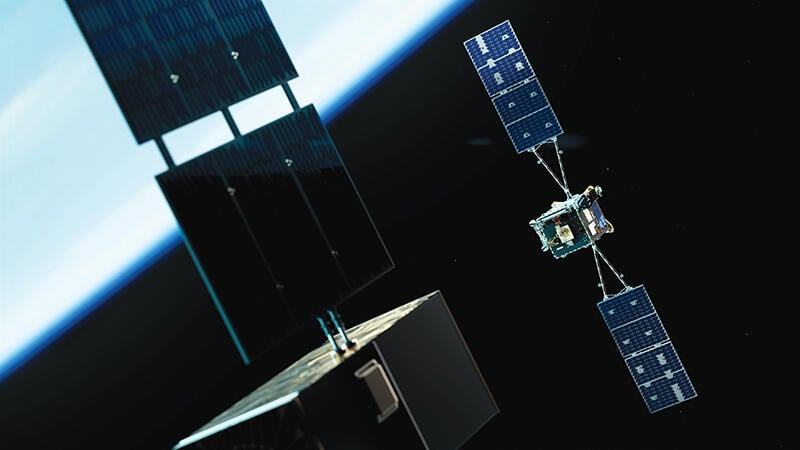
Starfish Space envisions a tow-truck-like service to deorbit satellites from LEO.

Credit: Starfish Space

As the number of satellite constellations in low Earth orbit continues to swell, managing the end of the operational lives of the spacecraft has become a growing concern. The U.S. Space Development Agency is moving early on the problem, planning for the assisted removal of certain satellites as part of routine constellation management rather than as an afterthought.

In a step that could effectively put a tow truck on call in orbit, the Space Development Agency (SDA) awarded a contract to Tukwila, Washington-based startup Starfish Space to deorbit at least one of the agency’s satellites in a mission targeted for 2027. Under the $52.5 million contract, Starfish is to build, launch and operate the Otter, a small servicing vehicle, to perform “an initial deorbit” of an SDA satellite, the company announced Jan. 21. The award follows a 2024 call to industry in which the SDA awarded six study contracts to companies exploring on-orbit servicing, including Starfish.

  • Starfish could deorbit satellites under SDA contract
  • Technology could also be used for warfighting in space

While the base award covers one satellite deorbit, the SDA can exercise options to remove additional satellites using the same Otter.

Starfish designed the spacecraft to conduct multiple disposals on a single mission and to service satellites that were not built with cooperative interfaces, cofounder Trevor Bennett tells Aviation Week. That flexibility is particularly relevant for the SDA, which flies satellite buses from multiple vendors.

To date, the agency has deployed nearly 70 satellites to low Earth orbit (LEO) as part of its Proliferated Warfighter Space Architecture (PWSA), a planned constellation of hundreds of spacecraft linked by optical intersatellite connections to provide continuous data transport and missile warning and tracking. The first 27 satellites were launched in 2023-24, another 42 were launched last fall, and more are on the way this year.

The SDA has identified neither which satellite would be removed nor the reason for doing so; a spokesperson tells Aviation Week a decision has not yet been made. The systems are designed with a five-year operational life span to encourage rapid technology updates and replenishment.

Bennett hopes the SDA mission will validate a commercial “deorbit-as-a-service” model for managing end-of-life disposal in LEO. The company ultimately envisions an on-demand service that could support multiple customers.

The award aligns with other government-backed debris removal demonstrations, such as Japan’s with Astroscale and the UK’s with Clearspace UK. Astroscale and Starfish are also partnering with the U.S. Space Force to perform demonstrations of on-orbit docking and refueling this year.

But unlike those efforts, the SDA contract is not framed solely as a technology demonstration but as an operational capability.

SDA satellites are designed to deorbit themselves naturally in compliance with U.S. Orbital Debris Mitigation Standard Practices. Still, the agency wants commercially available “assisted disposal options” in case of a contingency, as on-orbit anomalies remain a persistent risk, the spokesperson says.

“As we developed the PWSA, we recognized that our risk posture and the imperative to deliver capabilities to the warfighter at speed might result in some satellites being unable to deorbit themselves,” the spokesperson says, noting that the SDA expects to use future deorbit awards “as needed” to supplement built-in disposal capabilities.

Concerns about congestion and collision risks are rising as LEO constellations multiply. For years, operators viewed debris removal as risky and expensive, limiting market growth. But with roughly 300 new constellations operating or in development, such services may begin to look like indispensable insurance, Analysys Mason Principal Analyst Dallas Kasaboski says.

Government contracts remain critical for jump-starting emerging markets, and the SDA’s willingness to move quickly could help normalize in-space servicing, Kasaboski says.

Operators are increasingly focused on protecting their own orbital neighborhoods, Bennett notes. Deorbit-as-a-service allows constellation owners to remove failed satellites, preserve long-term system health and, in some cases, relocate spacecraft while conserving onboard fuel.

As the U.S. and other countries increasingly view space as a warfighting domain, the technology for in-space servicing also can be used for counterspace activities. Analysts and commercial trackers have observed Chinese satellites grappling and relocating other spacecraft, blurring the line between servicing and interference.

Bennett declines to address potential military applications for Starfish’s technology but notes that the company sees building the fundamental technologies to do rendezvous and proximity operations, docking and interfacing with satellites as “the first steppingstone” of many in the startup’s journey.

Vivienne Machi

Vivienne Machi is the military space editor for Aviation Week based in Los Angeles.