This article is published in Aviation Week & Space Technology and is free to read until Apr 04, 2026. If you want to read more articles from this publication, please click the link to subscribe.

NASA Adds Lunar Lander LEO Docking Demo To Artemis Campaign

space service module

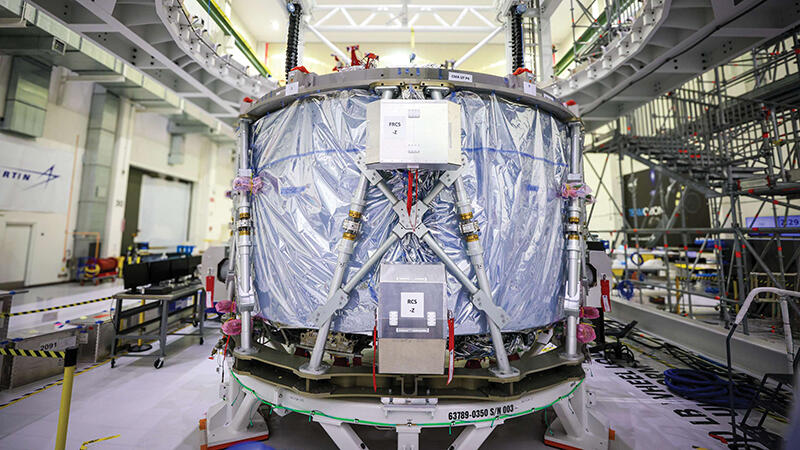
The European Space Agency’s fourth Orion service module arrived at NASA Kennedy Space Center in January, joining European Service Module 3, which arrived in September 2024. Spacecraft for Artemis V and VI are in production.

Credit: Airbus

With the Artemis II flight test on hold due to a Space Launch System rocket repair, NASA Administrator Jared Isaacman revised the blueprint to land astronauts on the Moon in two years.

For starters, Isaacman wants to increase the flight rate of the Space Launch System (SLS), which is being prepared for its second mission, Artemis II—a 10-day piloted test run of the Lockheed Martin-built Orion spacecraft.

  • Isaacman wants to boost the SLS flight rate
  • The agency seeks a new SLS upper stage
  • NASA eyes early 2028 for crewed lunar landing

Following launch on the SLS, the Orion, with a crew of four, is to spend 25 hr. in high Earth orbit to check out its environmental control and life support systems, the top mission goal. If it is in good shape, Orion would then use its European Space Agency-provided service module propulsion system to fly toward the Moon, swing 4,600 mi. past the far side and slingshot back to Earth for a splashdown off the coast of San Diego eight days later.

At best, it will be 3.5 years between Artemis II and the predecessor Artemis I mission, an uncrewed flight test around the Moon that took place in late 2022. “Launching a rocket as important and as complex as SLS every three years is not a path to success,” Isaacman told reporters Feb. 27. “Your skills atrophy. You lose muscle memory.”

NASA had envisioned landing astronauts on the Moon with Artemis III in 2028. Under Isaacman’s revised blueprint, that milestone remains on the calendar, with a possible second landing that year as well. But that will not happen on the next Artemis mission. Instead, Artemis III, which moves up to mid-2027, now includes a crewed Orion spacecraft in low Earth orbit (LEO) for rendezvous and docking tests of one or both Artemis program lunar landers.

SpaceX and Blue Origin hold Human Lander System (HLS) flight service contracts with NASA to ferry astronauts to and from lunar orbit and the surface of the Moon. “This is really the only pathway in order to achieve success with the lunar landing within the time frames that we are targeting,” Isaacman said.

Bumping up the SLS launch cadence to at least once a year also requires cancellation of planned system upgrades to the Block 1B and Block 2 configurations from the current Block 1 design, he added. The upgrades include a new four-engine Exploration Upper Stage built by Boeing. Instead, NASA plans to freeze the SLS design at what Isaacman termed a “near-Block 1 configuration.”

“It is needlessly complicated to alter the configuration of the SLS and Orion stack to undertake subsequent Artemis missions,” NASA Associate Administrator Amit Kshatriya said in a statement. “There is too much learning left on the table and too much development and production risk in front of us. Instead, we want to keep testing like we fly and have flown.”

The Boeing-built SLS core stage for Artemis III is undergoing processing and integration at NASA’s Michoud Assembly Facility in New Orleans and is expected to transit to the Kennedy Space Center by June 30. Once in the Vehicle Assembly Building (VAB), the core stage is to be integrated with its engine section, which features the final set of four modified RS-25 main engines left over from the 1981-2011 space shuttle program. Manufacturer Aerojet Rocketdyne developed a new RS-25 variant for missions beginning with what is now Artemis IV.

NASA’s Artemis II stack
After 39 days at the launchpad, NASA’s Artemis II stack returned to the Vehicle Assembly Building on Feb. 25 for repairs and servicing. Credit: NASA

The agency also has one more SLS upper stage, known as the Interim Cryogenic Propulsion Stage (ICPS), powered by a single liquid-hydrogen (LH2) and liquid-oxygen (LOX) Aerojet Rocketdyne RL10 engine.

The ICPS is a variant of the upper stage used on the United Launch Alliance’s (ULA) now-retired Delta IV Heavy rocket. ULA manufactures another LH2-LOX upper stage, the Centaur V, for its Vulcan boosters. Blue Origin uses the LH2-LOX upper stage BE-3 on the New Glenn, and ArianeGroup uses the LH2-LOX Vinci upper stage on the Ariane 6.

Technical assessment and procurement options for an ICPS successor for the SLS beginning with Artemis IV are pending, along with decisions on:

• Northrop Grumman’s Booster Obsolescence and Life Extension contract for upgraded SLS solid rocket motors, a change NASA planned to introduce beyond the initial lunar landings.

• Bechtel’s Mobile Launcher 2, a ground platform structure to support the larger, more powerful, now-canceled SLS variants.

• Potential changes to the Artemis program’s planned lunar-orbiting Gateway outpost, a multinational, part-time crewed platform to stage sorties to the lunar surface and test technologies for future missions to Mars.

Boeing’s support for the revised Artemis portfolio was included in the agency’s Feb. 27 press release, and Lockheed quickly added its own statement. “Everybody agrees this is the only way forward,” Isaacman said.

NASA had planned to announce the Artemis revamp at the conclusion of the Flight Readiness Review for Artemis II. However, on Feb. 25, the SLS crawler transporter made an 11-hr., 4-mi. trek from Launch Complex 39B back to the VAB for rocket repairs and servicing. The rollback scotched a planned March launch attempt.

During the SLS’ 39-day stay at Launch Complex 39B, NASA conducted two practice countdowns that included fully fueling the SLS core and upper stages with more than 700,000 gal. of cryogenic propellants. The first wet dress rehearsal ended early due to a hydrogen leak. With the second, NASA declared success and marked March 6 as the target launch date for Artemis II.

But late Feb. 20—a day after wrapping up the second successful practice run—the Kennedy Space Center team monitoring SLS, Orion and 39B ground systems saw that the helium system used to pressurize tanks and purge gases in the SLS upper stage was malfunctioning.

They switched to a backup system but quickly realized limited access at the launchpad meant the stack had to return to the VAB. Troubleshooting focused on a filter in the umbilical between ground equipment and the flight hardware, a failed quick-disconnect umbilical interface and/or a failed check valve onboard the vehicle.

On March 3, NASA said a seal in the quick-disconnect that routes helium from the ground systems to the rocket had dislodged, obstructing the helium flow. Technicians replaced the seal while NASA mulled steps to prevent a repeat.

A similar issue bedeviled the launch team ahead of Artemis I, which lifted off on Nov. 16, 2022, after three rollbacks—two for technical reasons and one to avoid a hurricane—culminating in what became an eight-month launch campaign. Artemis I was the first in a series of missions designed to expand and sustain human presence beyond LEO, beginning with the Moon and cislunar space.

NASA is hoping for better luck with Artemis II. If the SLS and Orion can be back at Launch Complex 39B in the March 19-21 time frame, the agency could have a shot at the six-day launch period that opens April 1. If not, the next opportunity that meets mission requirements—including Earth-Moon orbital phasing, lighting and other factors—is April 30.

While in the VAB, in addition to resolving the helium system issue, NASA planned to activate and test a new set of SLS flight termination system batteries, replace flight batteries on the ICPS, core stage and solid rocket boosters and charge the Orion launch abort system batteries. The work opens launch opportunities into June. NASA declined to release potential launch dates beyond April 30.

Artemis II follows the 25-day Artemis I flight test, which returned to Earth with unexpected wear on its heat shield. NASA later determined the spacecraft’s ablative material had trapped gases released during Orion’s Mach 32 descent into the atmosphere. Pressure from the outgassing built up and caused cracking. That, in turn, caused char material to pop off, a phenomenon that NASA computer modeling had not predicted.

The agency decided to modify the Orion’s Artemis II reentry profile and change the heat shield design for future flights, although at the time, NASA was planning for all of those flights to return from lunar, not Earth, orbits. Any potential changes to the Orion for the replanned Artemis III are to be determined.

Isaacman did say that the Orion-HLS docking demonstration in LEO would not necessarily require SpaceX and/or Blue Origin to include on-orbit propellant transfers, which are part of the architecture for lunar landings. “We are very early in mission design,” he said.

NASA’s revisions to the Artemis program coincided with the Feb. 25 release of an annual report by the Aerospace Safety Advisory Panel (ASAP), which was established in the wake of the 1967 Apollo 1 fatal launchpad fire as an independent safety watchdog for the agency.

ASAP noted the previously planned Artemis III mission rested on more than a dozen first-time technologies, including 15 SpaceX Starship-Super Heavy fueling launches to support the Starship HLS and a depot station in LEO for cryogenic refueling. The panel urged NASA to restructure the Artemis program with “a more balanced risk posture.”

“What we’re doing is exactly in line with what ASAP asked us to do,” Isaacman said. “Zooming out here, it should be incredibly obvious you don’t go from one uncrewed launch of Orion and SLS, wait three years, go around the Moon, wait three years and land on it. That’s what our ASAP committee took issue with. That’s what we’ve acknowledged inside the leadership of NASA.

“NASA has been working on these plans, knowing this is not the right approach,” he added. “There has to be a better way, in line with our history. We did not just jump right to Apollo 11. We did it through Mercury, Gemini and lots of Apollo missions with a launch cadence of every three months. We shouldn’t be comfortable with the current cadence. We should be getting back to basics and doing what we know works.”

Irene Klotz

Irene Klotz is Senior Space Editor for Aviation Week, based in Cape Canaveral. Before joining Aviation Week in 2017, Irene spent 25 years as a wire service reporter covering human and robotic spaceflight, commercial space, astronomy, science and technology for Reuters and United Press International.