This article is published in Aviation Week & Space Technology and is free to read until Feb 21, 2026. If you want to read more articles from this publication, please click the link to subscribe.
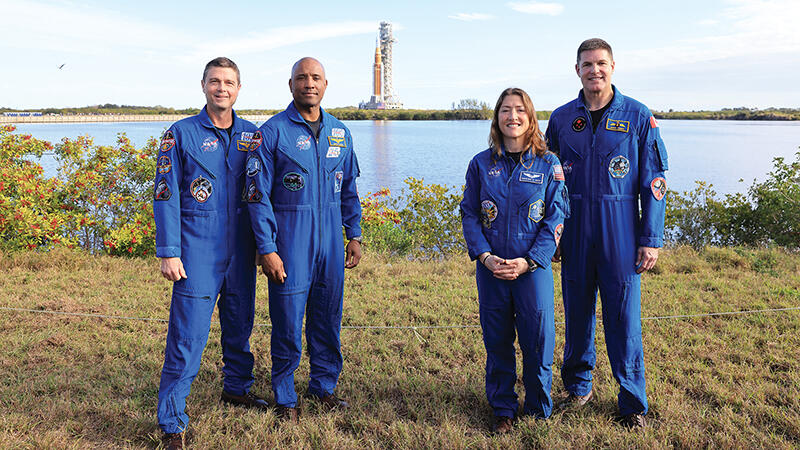
The Artemis II astronauts are (from left) commander Reid Wiseman, pilot Victor Glover, mission specialist Christina Koch, all with NASA, and mission specialist Jeremy Hansen, with the Canadian Space Agency.
No one in NASA’s Artemis II crew had been born when astronauts last ventured into deep space for the final Apollo program Moon landing in 1972. For the last half-century, human space efforts have focused on science research and technology initiatives aboard low-Earth-orbit spacecraft, culminating with the Inter-national Space Station.
But having turned over low-Earth-orbit crew transportation to SpaceX—and with the 15-nation International Space Station (ISS) nearing the end of its operational life—the U.S. space agency is returning lunar exploration to center stage with the Artemis campaign, the first crewed flight of which is set to launch by April.
- Launch dress rehearsal is next milestone
- NASA juggling Artemis II, Crew-12 missions
That mission, known as Artemis II, is designed to send four astronauts on a 10-day flight around the Moon. The primary goal of the flight test is to check out the Orion’s spacecraft environmental and life support systems, which are designed to support a crew of four for 28 days. The mission will mark Orion’s first flight with astronauts, culminating a 20-year, $20 billion development and test program with prime contractor Lockheed Martin.
Uncrewed Orion spacecraft have made two previous flights. Exploration Flight Test-1, part of the Constellation program under former President George W. Bush’s administration, launched from Cape Canaveral on Dec. 5, 2014, aboard a United Launch Alliance Delta IV Heavy. The prototype orbited twice, reentered the atmosphere and splashed down into the Pacific Ocean to test the spacecraft’s heat shield and parachutes.
Eight years later, a second Orion spacecraft lifted off from Florida aboard NASA’s heavy-lift Space Launch System (SLS) rocket, a Saturn V-class booster that in 2012 replaced the Constellation program’s Ares rocket program.
The Boeing-made SLS performed flawlessly during its Nov. 16, 2022, debut, sending the Orion spacecraft on a trajectory that ultimately reached about 40,000 mi. past the far side of the Moon. The Artemis I flight test successfully concluded 25 days later with the capsule’s splashdown in the Pacific, but its Mach 32 reentry into the atmosphere left some burning questions about Orion’s ablative heat shield.
To manage the extreme heat, NASA had tested an aerobraking maneuver known as a skip reentry. Instead of plunging straight into the atmosphere, Orion dipped into the atmosphere’s upper layer and then skipped back out using aerodynamic lift. It then reentered a second time, reducing peak heating on the shield. Aside from reducing deceleration and G-forces on the spacecraft, the technique allowed the Orion to adjust its trajectory before final descent so it could target its splashdown zone more precisely, improving future astronaut safety and recovery operations.
Postflight analysis, however, showed unexpected wear in the ablative outer material of the Orion’s heat shield, which did not properly vent the gases produced during reentry. That led to widespread cracking and char loss.
After two years of analysis and testing, NASA decided to modify the reentry trajectory for Artemis II and ordered design and manufacturing changes to prevent gas buildup and cracking on future Orion heat shields.
On Jan. 17, NASA’s second SLS, topped with a new Orion capsule, was rolled out to Kennedy Space Center Launch Complex 39B, setting the stage for a tanking test ahead of launch on the first crewed flight into deep space in more than 50 years. Among the hundreds of NASA and contractor workers, family members and guests gathered to watch the SLS rollout were the Artemis II astronauts: NASA’s Reid Wiseman, Victor Glover and Christina Koch, and the Canadian Space Agency’s Jeremy Hansen. All were born between 1975 and 1979.
“I hope someday my kids are going to be watching, maybe decades into the future, the Artemis 100 mission,” NASA Administrator Jared Isaacman, 42, told reporters as the SLS-Orion stack rolled out of the Vehicle Assembly Building. “The architecture . . . with the SLS and the Orion spacecraft is just the beginning. Over time, launching missions like this, we are going to learn a lot, and the vehicle architecture will change. As it changes, we should be able to undertake repeatable, affordable missions to and from the Moon. This is the start.
“The cost to undertake a mission like Artemis II is not inexpensive, but where it’ll go, as we learn and gradually incorporate reusability, is what’s going to enable missions like Artemis 100 and beyond,” he added. “We are doing this to fulfill a promise to the American people that we will return to the Moon—a promise to all the pioneers, the engineers, the scientists, the astronauts, the researchers from the 1960s who laid the foundation we are standing upon right now.”
NASA’s Office of Inspector General reports show costs for the SLS, Orion and Exploration Ground Systems are expected to surpass $90 billion through Artemis IV, including more than $55 billion spent by September 2025. “The downstream consequences of continued cost increases and schedule delays across Artemis programs and projects could ultimately compromise the Artemis campaign and NASA’s mission as a whole,” the Office of Inspector General noted in its annual NASA Top Management and Performance Challenges report, issued on Jan. 15.
The agency is working toward a possible liftoff of Artemis II in February, depending on the results of the wet dress rehearsal expected around Feb. 2. If no significant problems are encountered, NASA could be prepared to begin a two-day launch countdown shortly thereafter. “The wet dress is the driver to launch,” Charlie Blackwell-Thompson, launch director for the agency’s Exploration Ground Systems Program, told reporters Jan. 16.
Based on the position of the Moon relative to Earth as well as Orion operational constraints and crew safety requirements, the Artemis II flight test could lift off Feb. 6-8 or Feb. 10-11. However, NASA also is working to advance the SpaceX-provided launch of a new crew to the ISS following the early return of Crew-11 astronauts due to an undisclosed medical concern (page 20).
Whether NASA could or would support both missions simultaneously will remain theoretical until at least the Artemis II wet dress rehearsal is complete. “We’ve held schedule pretty well getting to rollout,” Isaacman said. “We have zero intention of communicating an actual launch date until we get through wet dress, but [February] is our first window, and if everything is tracking accordingly—I know the teams are prepared, I know this crew is prepared—we’ll take it.”
The agency has additional launch opportunities March 6-9, March 11, April 1 and April 3-6.
Artemis II is intended to mitigate risks for Artemis III, which is expected to send astronauts to the surface of the Moon for the first time since Apollo 17 in 1972. Unlike the 1969-72 Apollo program, NASA plans for Artemis to be an ongoing series of missions leading to a base on the Moon and sustained human presence in deep space.
The initiative includes commercial partnering agreements with SpaceX and Blue Origin to provide astronaut transportation services to and from lunar orbit and the surface of the Moon. Both companies have submitted plans to NASA to accelerate their Human Landing System development efforts. “These are both very good plans,” Isaacman said. “They both reduce technical risk from where we were before, so that’s good. But in the end, it’s going to come down to launching vehicles very frequently to learn.”
SpaceX, which holds a $2.9 billion contract for Artemis III lunar flight services, must conduct multiple flight tests of its Starship-Super Heavy system, including a demonstration of on-orbit propellant transfer to refuel the Starship spacecraft and an uncrewed Starship landing on the lunar surface.
So far, SpaceX has conducted 11 Starship-Super Heavy flight tests. The initial six and last two were largely successful, including controlled splashdowns of returning vehicles and catching returning boosters in the launch gantry.
Blue Origin, which holds a separate $3.4 billion contract for lunar landing services for Artemis V, has flown its New Glenn rocket just twice. The company, owned by Jeff Bezos, plans to fly a smaller version of its lunar lander to the surface of the Moon this year.