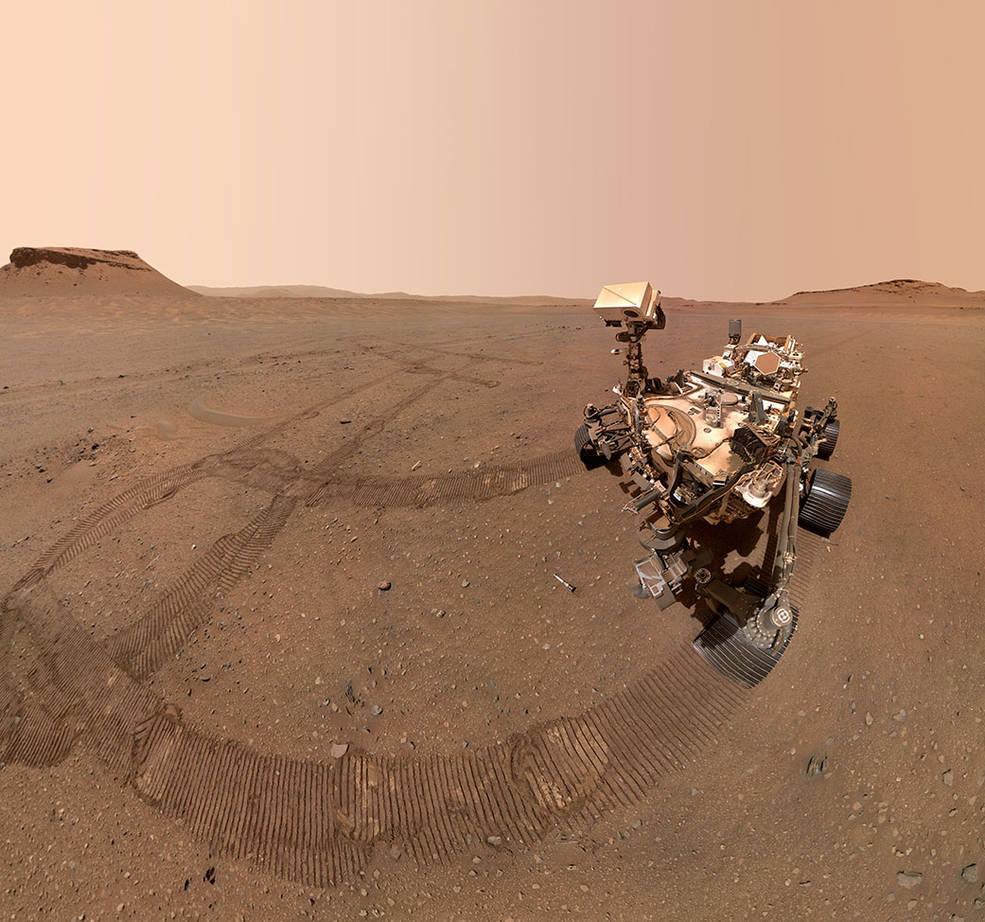
NASA’s Mars Perseverance rover.
NASA has selected seven companies eligible for contract awards to advance robotic surface mobility on Mars under the Mars Exploration Program's Science Transport and Robotic Innovation for Deployment and Exploration (STRIDE) initiative.
Under STRIDE, the agency seeks to support the development of innovative robotic mobility systems enabling future Mars missions' access to challenging terrain. while able to travel greater distances to investigate scientifically valuable regions that are difficult to reach with current mobility systems.
Set to get underway this Fall, STRIDE is to have a total estimated value of $17 million, according to the agency's July 8 award announcement.
Those firms selected for contracts are AeroVironment, of Arlington, Virginia, Astrobotic, of Pittsburgh, Pennsylvania; Venturi Astrolab (Astrolab), of Hawthorne, California; Ground Control Robotics, of Atlanta, Georgia; Honeybee Robotics, of Longmont, Colorado; Intuitive Machines, of Houston, Texas; and MEI Technologies, of Webster, Texas.
NASA currently has two rovers actively exploring Mars. Perseverance touched down in Jezero Crater in February 2021 with the Ingenuity drone helicopter to seek evidence of past biological activity on the red planet. Curiosity touched down in Gale Crater in August 2012 to investigate changes in the environmental habitability of Mars over time.
Three previous NASA Mars rovers, the Mars Pathfinder Sojourner and the Mars Exploration Rovers, Spirit and Opportunity, landed in 1997 and 2004. Though successful, they struggled with issues that included mobility in the Martian sand and dust storms that inhibited solar power generation.
As a forward-looking goal of its Artemis program, NASA plans to establish a sustainable human presence at the Moon with a base camp developed in phases as it returns astronauts to the surface of the Moon in 2028 with the Artemis IV mission. NASA intends to apply lessons learned as part of efforts to develop future human expeditions to Mars.

Related Content