This article is published in Aviation Week & Space Technology and is free to read until Jun 05, 2026. If you want to read more articles from this publication, please click the link to subscribe.
Russia Rekindles Launcher Ambition With Soyuz-5
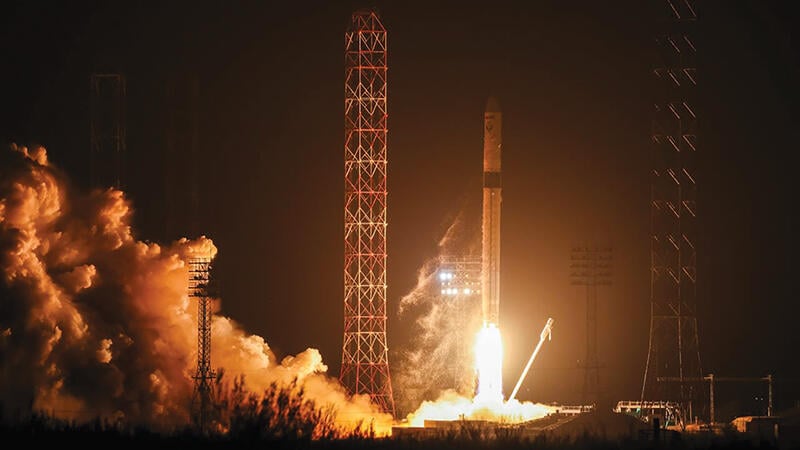
The Soyuz-5’s debut marked the first new Russian rocket design in over a decade.
After more than a decade of erosion in its launch prowess, Russia is trying to make a comeback with a new Soyuz rocket.
Russia and Kazakhstan have pulled off the much-delayed inaugural launch of the Soyuz-5 medium-lift rocket, which could play a pivotal role in Moscow’s effort to gain pace in the proliferated constellation business.
- The first stage is powered by an Energomash RD-171MV engine
- The rocket can loft a 17-metric-ton payload to low Earth orbit
The rocket took off at 2 p.m. EDT on April 30 from the Baikonur Cosmodrome in Kazakhstan. The first stage burned for almost 3 min. before separation and second-stage ignition. The fairing opened about 6 sec. later, and the dummy payload deployed around 9 min. 32 sec. after liftoff. The payload then flew along a suborbital trajectory and splashed into the Pacific Ocean, Roscosmos said, noting that all stages performed nominally.
The mission marked the first launch of the new Russian-made rocket since the Angara-A5 in 2014. Russia has fallen far behind the U.S. and China in its annual launch cadence; it lofted a mere 17 missions last year compared with more than 90 for China and double that for the U.S.
The Soyuz-5 lifted off from Baikonur’s Launchpad 45, which previously was used for the Russo-Ukrainian Zenit rocket. That partnership broke up in 2014 after Moscow’s illegal annexation of Crimea. A private effort by Russia’s S7 Group to resume the program failed, and the last Zenit-3SLBF flew from the pad in 2017.
Soyuz-5 development kicked off in 2016 under the Baiterek joint venture between the governments of Russia and Kazakhstan. The rocket was designed by Samara, Russia-based Progress Rocket Space Center, which created the Soviet and then Russian Soyuz launch workhorse.
The liquid-fueled, two-stage Soyuz-5 can carry 17 metric tons of payload to low Earth orbit (LEO)—3 metric tons more than the Zenit-3 and more than twice the capacity of the Soyuz-2 family.
Its first stage is powered by an Energomash RD-171MV—a modernized version of the engine used on the Zenit-3—with four nozzles. The RD-171MV can produce 800 metric tons of thrust, making it the world’s most powerful space engine, according to Roscosmos. Its second stage is powered by a 60-metric-ton-thrust RD-0124MS engine, designed by Russia’s KB Khimavtomatiki. The same engines are used on the third stages of Russia’s Soyuz-2.1b and Angara-A5 vehicles.
The Soyuz-5’s diameter of 4.1 m (13.5 ft.) is slightly larger than the 3.9-m-dia. Zenit but still within the former Zenit launchpad parameters. Weighing as much as 531metric tons, the Soyuz-5 is 58-65 m tall, depending on the fairing, making it also taller than the Zenit.
According to Progress, the Soyuz-5 can use the proven Fregat upper stage, inherited from the Soyuz-2, to deploy multiple payloads.
While Russia was responsible for Soyuz-5 development, the Kazakh government financed the launchpad changes. The Soyuz-5, like its predecessor, has an automated launch sequence that requires fewer personnel on the pad.
The rocket first arrived at the pad on March 31, but issues with the control system caused repeated delays to the mission.
Roscosmos plans to hold several more test flights before approving the Soyuz-5 for commercial use. Neither Kazakhstan nor Russia has disclosed commercial orders for the system.
However, the Soyuz-5 could be crucial to serving the growing number of Russian space startups planning to launch their own satellite constellations. These companies have limited access to launchers abroad because of sanctions over Moscow’s war on Ukraine and busy manifests at those still willing to work with Russian entities.
Commercial customers using the Soyuz-5 could give Roscosmos more capacity to save its legacy launchers—such as the Soyuz-2, Proton and Angara—for government payloads.