This article is published in Aerospace Daily & Defense Report part of Aviation Week Intelligence Network (AWIN), and is complimentary through Feb 14, 2026. For information on becoming an AWIN Member to access more content like this, click here.
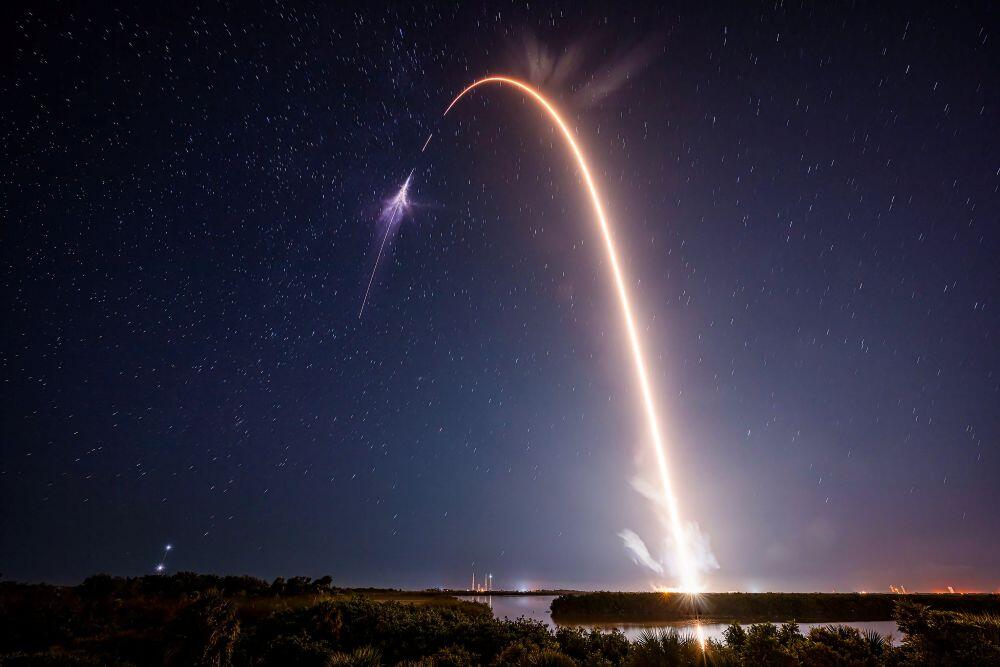
SpaceX closed 2025 with 165 Falcon 9 flights, a record.
CAPE CANAVERAL—The number of orbital launch attempts worldwide last year surpassed the record 2024 flight rate by 25%, with SpaceX and China accounting for the bulk of the launch activity.
Including three near-orbital flight tests of SpaceX’s Starship-Super Heavy launch system, the number of orbital launch attempts worldwide reached 329 last year, an annual analysis of global launch and satellite activity by Jonathan’s Space Report shows. Of those 329 attempts, 321 reached orbit or marginal orbits.
In addition to five Starship-Super Heavy launches—three of which reached their targeted near-orbital altitudes and are included in the global tally—SpaceX launched 165 Falcon 9 rockets in 2025, surpassing its 2024 record of 134 Falcon 9 and two Falcon Heavy flights. No Falcon Heavy rockets flew in 2025.
U.S. providers, including Rocket Lab Electron orbital flights from its New Zealand spaceport, added another 30 orbital launches to the 2025 tally, solidifying the U.S. as the world leader in space launch.
China, which attempted 92 orbital launches in 2025, is second, followed by Russia, with 17 launches last year and Europe with eight. Rounding out the 2025 orbital launch manifest were five orbital launch attempts from India, four from Japan, two from South Korea and one each from Israel, Iran and Australia, the analysis shows.
The U.S. rocket fleet now includes Blue Origin’s New Glenn, which flew twice in 2025. United Launch Alliance’s Vulcan, which debuted in 2024, flew once in 2025, along with five Atlas V rockets. ULA ended Atlas V production in 2024 and has 10 rockets in inventory. Four of those are expected to launch batches of the Amazon LEO (low Earth orbit) broadband constellation, previously known as Kuiper. Boeing purchased six Atlas flights for CST-100 Starliner missions to the International Space Station. In late November, NASA scaled back its commitment to fly on Starliner from six to four missions. What affect, if any, that will have on the Atlas V flight manifest is not yet known.
While China is second to the U.S. in overall launch rate, it dominates in terms of the number of different types of orbital launch vehicles. Eight different U.S. rocket variants, operated by six companies, launched in 2025: Blue Origin’s New Glenn; Firefly Aerospace’s Alpha; ULA’s Atlas V and Vulcan; Northrop’s Minotaur; Rocket Lab’s Electron; and SpaceX’s Falcon 9 and Starship.
In contrast, 10 Chinese organizations flew 25 different types of orbital vehicles last year. Fifteen of those vehicles are government-owned and operated, including nine by the China Academy of Launch Vehicle Technology (CALT), which is affiliated with the China Aerospace Science and Technology Corp.
Seven private companies in China flew another eight types of rockets, while two more vehicles were flown under government-commercial partnerships.
Combined, the global fleet of launch vehicles delivered 4,522 payloads into orbit, of which 3,719 belong to U.S. entities. China’s tally is 371 payloads, and Russia’s is 88, the analysis shows. By mass, that equates to 2,921 tons by the U.S., 338 tons by China and 67 tons by Russia.
As of Dec. 31, there were 32,214 cataloged objects in Earth orbit or beyond, of which 14,300 were active payloads, the analysis shows. Two-thirds of those are SpaceX Starlink satellites, which fly in 10 orbital shells at four inclinations and varying altitudes, the report shows.
“Most of the older V1.0 satellites have been retired. V1.5 satellites continue in service, as well as the larger V2 Mini and V2 Mini Optimized models,” writes Jonathan McDowell in the analysis. The V2 Mini Direct-To-Cell (DTC) satellites operate in the two lowest orbital shells.
SpaceX began rearranging the constellation in 2025 with some V2 Mini satellites being lowered from the 540-560 km shells to the 450-500 km range “possibly to ensure rapid reentry in case of failure and/or to provide stronger signal reception,” McDowell notes.
By Dec. 25, SpaceX had launched 10,801 Starlink satellites. Of those, 1,391–13%— had reentered, mostly as a result of deliberate retirement. McDowell estimates 134 spacecraft—1.2%—failed prior to reentry. Another 11 satellites had failed in orbit and were undergoing natural orbital decay.
One satellite—Starlink-35956—sustained a debris-generating in-orbit breakup, which is still being assessed, McDowell notes.
SpaceX closed the year with 9,399 operational Starlink satellites. Of those, 8,163 were assessed to be in operational orbit shells, including 154 undergoing phasing relocations. Another 897 Starlinks were in the process of orbit raising to join the operational constellations, and 339 were orbit lowering for retirement, the analysis shows.