This article is published in Aviation Week & Space Technology and is free to read until Aug 01, 2026. If you want to read more articles from this publication, please click the link to subscribe.
NASA is repurposing the Advanced Electric Propulsion System to support its SR-1 nuclear reactor program.
Driven by an urgent U.S. government mandate to develop space nuclear power and propulsion, NASA is leading a whole-of-government charge to accelerate the deployment of reactors on the Moon and in orbit.
But after six decades of stop-start development since the experimental SNAP-10 reactor launched to space in 1965, can U.S. space nuclear ambitions finally get off the launchpad?
- 20-kWe fission-powered nuclear electric propulsion is NASA focus
“We just really need to prove that we can do this,” L3Harris exec says
National security requirements, combined with the White House’s strategic vision for U.S. space superiority, have elevated space nuclear capability to a national priority, says Kristin Houston, president of space propulsion and power systems at Aerojet Rocketdyne, part of L3Harris Technologies.
“We are ready for the nuclear era—it’s coming,” she says.
The National Initiative for American Space Nuclear Power anchors the U.S. strategy. Office of Science and Technology Policy Director Michael Kratsios unveiled the road map at the annual Space Symposium in Colorado Springs, building on milestones NASA Administrator Jared Isaacman outlined at the agency’s Ignition event in March.
At the center of the plan is Space Reactor-1 Freedom (SR-1), a 20-kilowatt-electric (kWe) fission-powered nuclear electric propulsion (NEP) system slated for launch by 2028. SR-1 is planned to power a spacecraft carrying three Ingenuity-class helicopters to Mars before continuing deeper into the Solar System. NASA describes the reactor as “the first step in a deliberate sequence” that will lead to Lunar Reactor-1, a fission surface power system designed to keep a lunar base operating through long periods of darkness and in locations where solar power is impractical.
Flying SR-1 before attempting a lunar landing will reduce mission risk and help NASA build the required supply chain and workforce, the agency says.
After decades of stalled progress, the stakes for U.S. space nuclear power have risen sharply. China and Russia are developing a joint nuclear powerplant to support a future lunar research station, with operations targeted for 2036. At the same time, growing competition in space is driving the Pentagon to pursue highly maneuverable spacecraft that will require new propulsion systems capable of operating farther from Earth and moving more dynamically in orbit.
The U.S. military is not rushing to field nuclear propulsion, however. Senior officials want to determine whether the technology can deliver the high thrust and high delta-v needed for future satellite missions.
Meanwhile, the Pentagon’s highest-profile effort—a DARPA-NASA nuclear thermal propulsion (NTP) demonstration—was canceled under NASA’s fiscal 2026 budget after encountering regulatory challenges and schedule delays.
Fragmented leadership, rather than technical obstacles, has hampered recent U.S. programs, Bhavya Lal, a professor of policy analysis at the Rand School of Public Policy, said at the American Institute of Aeronautics and Astronautics’ Ascend conference in Washington in May. NASA develops the spacecraft, the Energy Department oversees the reactor and fuel elements, the Pentagon approves national security space launches, and the FAA authorizes commercial launches. Each agency holds veto authority, but none possesses “cradle-to-grave” responsibility, Lal said.
By contrast, in the 1950s, U.S. Navy Adm. Hyman Rickover directed every aspect of the Navy’s early reactor program, from design through deployment, creating submarine propulsion technology that has operated for 70 years without a reactor incident, she noted.
The current Trump administration intends to coordinate space nuclear propulsion development as a national initiative, straight from the White House, Aaron Miles, coordinator for strategic capabilities at the Office of Science and Technology Policy, said at the Ascend conference.
While some efforts will inevitably extend beyond the current presidential term, “it is important to meet a certain threshold during the [political] cycle, and that threshold should include a nuclear reactor in space,” Miles said.
The selected architecture is based on a closed Brayton cycle power conversion system in which the working fluid stays inside the engine and heat is introduced from a reactor and expelled with a heat exchanger. This system will be integrated with a High-Assay Low-Enriched Uranium (HALEU)-fueled kilowatt-class nuclear reactor derived from the Idaho National Laboratory’s ongoing Versatile Autonomous Lightweight Kilowatt-class Reactor Experiment (Valkre).
Thermal transfer will be achieved through heat pipes, and composite and titanium radiators will be used for heat rejection. A boron carbide shield will provide radiation protection.
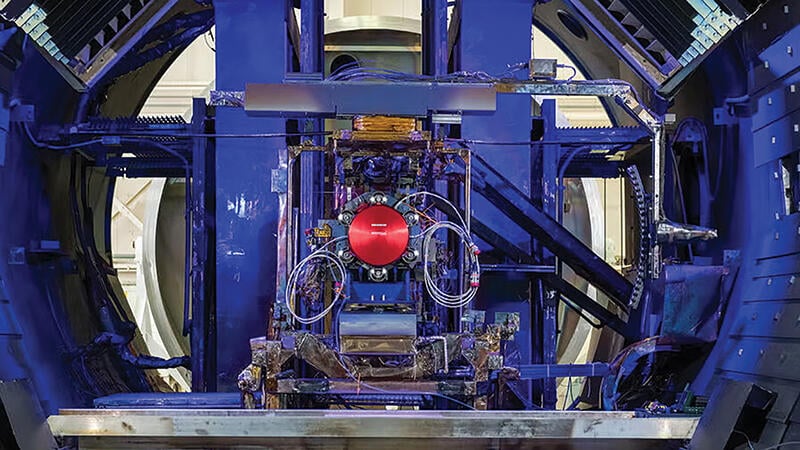
NASA also plans to repurpose the Power and Propulsion Element originally developed for the now-canceled Lunar Gateway as SR-1’s primary propulsion system. Aerojet Rocketdyne is building key hardware, including two 12-kW Advanced Electric Propulsion System Hall thrusters originally designed for the Gateway program.
Adapting the thrusters from solar electric propulsion to nuclear electric propulsion is “likely the least risky part,” Houston says, noting that one qualification thruster will begin an extended-life test at NASA’s Glenn Research Center this summer. More difficult challenges include reactor-to-electric power conversion, reactor shielding and spacecraft integration, she says.
“We just really need to prove that we can do this,” Aerojet Rocketdyne’s Houston says. “Let’s get SR-1 out there, and then we can scale and grow and do that right.”
—With Garrett Reim in Washington