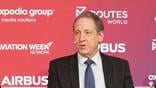
Podcast: Talking With The Head Of Singapore’s Civil Aviation Authority
CAAS Director General Han Kok Juan talks about key Singapore aviation projects, SAF levies and planning for air traffic growth.
Subscribe Now
Don't miss a single episode. Subscribe to Aviation Week's Window Seat Podcast in Apple Podcasts, Spotify or wherever you get podcasts.
Discover all of our podcasts at aviationweek.com/podcasts
AI-Generated Transcript
Karen Walker (00:10):
Hello everyone, and thank you for joining us for Window Seat our Aviation Week and ATW air transport podcast. I'm ATW Aviation Week, air transport editor-in-chief Karen Walker. Welcome on board. And I'm delighted to be joined today by ATW Asia senior editor Chen Chuanren. And we are recording this program in Singapore and are joined by a very special guest indeed. And that's the director general of the CAAS, Han Kok Juan. Now, the Civil Aviation Authority of Singapore is Singapore's equivalent of the FAA overseeing its aviation sector. Kok Juan, a very warm welcome. Of course, it's been a tough year for aviation in many respects, but Singapore continues with its success and has a long and impressive record as a global commercial aviation hub. So please, can we start by telling us about some of the key moments or issues that you've been dealing with this year?
Han Kok Juan (01:07):
The Singapore Air Hub has done relatively well in 2026. For the first nine months, January to September, we have seen a 0.4% growth on pax and an 8.5% growth on cargo. This is notwithstanding a challenging global environment with a rise in fuel prices and conflict in the Middle East. At the same time, we have expanded our connectivity, growing our city links from 172 at the end of 2025 to 175 at the end of September 2026.
Karen Walker (01:50):
So fantastic news. You are of course still growing, still you've got the important Terminal 5under development right now as well, which will expand your capacity even further. So, there’s a lot going on.
Chen Chuanren (02:05):
Yes, DG, I think in Singapore you are rolling out the SAF [sustainable aviation fuel] levy, which is first in the world to do so. Could you give us some update on this program, and what are some of the short-term and long-term goals that you expect from the SAF levy?
Han Kok Juan (02:21):
Yeah, thank you very much, Chuanren. As an active member state of the ICAO, Singapore supports ICAO's long-term aspirational goal of net zero carbon ambitions for international aviation by 2050. We have taken a practical balanced approach where we pursue both competitiveness and sustainability goals, not one at the expense of the other. And the way we do so is through the implementation of a mandated SAF levy and the central procurement of SAF so that we can send a clear demand signal to industry, achieve economies of scale and put in place the necessary operational mechanisms to support the growth of a SAF market. The SAF will be implemented for flights departing Singapore from January 1, 2027. All the operational mechanisms have been in place. We plan to call for our first procurement of SAF tender. Fifteencompanies have come forward to participate in the briefing, and we are very encouraged by the positive response.
Karen Walker (03:39):
It's interesting because you are saying yes, this has still got to be done. We know how important SAF is to sustainability goals, but it's also very expensive and in very limited supply. So, what you are saying is that a balance and reality approach is about making sure that first of all, the goals are realistic and that the SAF will be there.
Han Kok Juan (04:02):
Yes. We balance ambition with market realities, and the way we do so is putting in place a SAF levy that is reasonably affordable at a price which airlines and passengers can afford. At the same time, we have also set sustainability standards that are acceptable to the industry. For example, we have set a standard of 40% carbon emissions, which is above the 10% minimum under cost year, but still acceptable to the market. It allows us to be ambitious in achieving meaningful carbon emission reduction while at the same time giving us access to a wide spectrum of pathways and feedstock, both current as well as emerging. I think this also provides a strong signal to be able to stimulate production and investments in new pathways and feedstock across the entire Asia Pacific region.
Chen Chuanren (05:13):
And I know high on the agenda is also the development of air traffic management systems and also coordination with regional ATMSs. Could you describe how you are working with regional air traffic service providers to elevate their capabilities and at the same time also working with other further air service providers on concepts like TBO [trajectory based operations]?
Han Kok Juan (05:40):
Yeah. As we know, ICAO has projected very strong growth in aviation, nearly tripling over the next 25 years. Countries around the world will have to make major investments to have the capacity to serve the demand and to take advantage of the opportunities that the demand brings. Even as we invest in capacity on the ground, airport terminals, aircraft infrastructure, we need to build capacity in the skies. And many countries around the world are growing their pool of air traffic controllers for which I think today there is a global shortage, partly because it is a highly skilled profession, and it takes many years to train. Countries around the world are also investing in new systems, upgrading, refreshing O1s to be able to provide reliable air traffic management services. But because the growth is so tremendous and aviation is fundamentally cross border, it is insufficient for countries to just invest in their own systems and to just build up their own capabilities.
(06:59):
A lot more gains can be achieved if we are able to work together across jurisdictions so that we can reap greater benefits from the individual investments that we make. Just as an example, Karen, when you fly from Singapore to the US, you actually traverse multiple flight information regions. It is insufficient for one region to be very well equipped, but when the aircraft cross into another region, the processes, the systems are very different. If we are able to work together to smooth out your journey gate to gate, it will be a far smoother experience for the passenger, lower operating costs for airlines, and it will allow us to reap greater gains from the investments that we individually make. In that regard, there are actually various initiatives underway. At the global level in ICAO, Singapore has put up a proposal to develop a minimum implementation path to air navigation service modernization.
(08:05):
And ICAO will then stipulate the baseline investments that every ICAO member state should make and to make sure that all these systems being put in place are interoperable. There will be a significant change that would benefit us around the world. So, the proposal to develop this has been endorsed at the last ICAO Assembly. There is a global working group set up to develop this. In fact, as we speak, the working group is now gathered in Singapore developing the key elements of this minimum implementation path, and we hope to work toward endorsement by ICAO Assembly in 2028.
Karen Walker (08:52):
Excellent. So, a key thing that Singapore is all about of course is partnerships, but it's that recognition that with aviation it can't just be one area, one sector. It's got to be across all the sectors.
Han Kok Juan (09:06):
Yes, most definitely. Because we are a small island state, we very well recognize the global nature of aviation, and we have every interest to one, to work with other partners around the world, other governments, industry, to grow the global aviation sector. And we believe that all of us would benefit from the growth of the sector, and it will translate to economic opportunities for countries, business opportunities for companies as well as better jobs for all our people.
Karen Walker (09:44):
Excellent. And that of course is what aviation does for nations and people. So, one last question, if I may. Obviously, you've had a lot going on, you're involved in a lot of different projects and things right now. Can you name some of the very key top priorities for 2027?
Han Kok Juan (10:01):
For 2027, we will continue to plan long-term and to build for the future. There are three key elements that we will continue to work on, the three Cs. One, to continue to grow our connectivity, to expand the number of city links that we have with the rest of the world from over 170 today working toward 200 in about 10 years’ time. We are also expanding capacity. The Changi Airport Terminal 5 project is underway. We are also building capacity in the skies so that we have the necessary capacity to support growth. And then finally, we are strengthening our capabilities in both manpower and technology so that we are well-equipped to serve the demand that will materialize over the coming years.
Karen Walker (10:58):
So, no stepping off in 2027, you're going to have plenty to do.
Han Kok Juan (11:03):
Always the case in global aviation.
Karen Walker (11:06):
Very true. Thank you so much for joining us today. We really appreciate it. And of course ourthank you to our producer, Natalia Pelayo, and a huge thank you to our listeners. We love having you on board. Remember to follow us on Apple Podcasts or wherever you like to listen. Until next time, this is Karen Walker and Chen Chuanren disembarking from Window Seat.


Related Content