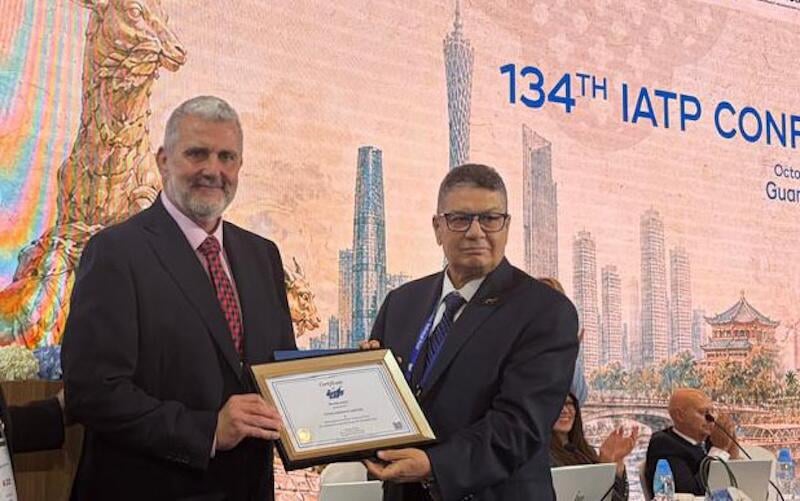
Titan Airways’ Phil Donahoe (left) marks the carrier’s entry to IATP in Guangzhou, China.
GUANGZHOU, China—The International Airline Technical Pool (IATP) has admitted seven more airlines, expanding its technical resource-sharing network as airlines face growing pressure on parts, maintenance capacity and operational support.
The cooperative's new members are Air Cairo, Air Europa, Challenge Air Cargo, MSC Air Cargo, Parata Air, Titan Airways and YTO Cargo Airlines. The variety of operators within this latest cohort reflects demand from carriers with different fleet profiles and technical support requirements.
IATP's expansion comes as airlines look to reduce inventory commitments, improve component availability and access assistance at outstations where maintaining dedicated resources can be difficult. IATP leadership identified cost reduction as a key attraction, alongside the opportunity to cooperate across spare parts, maintenance and aircraft recovery.
For Challenge Air Cargo, the value of membership lies in both contributing to the pool and drawing on support across its international network, according to an executive at the airline. The Malta-based freighter operator currently flies 12 aircraft — six Boeing 747-400s, four 767-300s and two 777-300s — and expects six more 777-300s to join following cargo conversion within the next 24 months.
Eyjolfur Vestmann Ingolfsson, who leads Challenge Air Cargo's materials and logistics department, says the airline could make 747-400, 767-300 and 777-300 spares available to IATP at its main materials and maintenance hub in Liege, Belgium. In return, it wants access to spares and aircraft-on-ground (AOG) support at outstations including Dubai, Hong Kong, Mumbai and Shanghai, as well as line maintenance, recovery assistance and pooled wheels and brakes for the three aircraft types.
With some destinations served only a few times a week, holding dedicated inventory at each station can be inefficient, Ingolfsson says. Challenge's materials and logistics team in Malta manages support for the wider group, giving it a central point for coordinating both the provision and receipt of assistance. However, its main materials and maintenance hub is based in Liege.
Speaking to Aviation Week in Guangzhou, China, on the sidelines of the 2026 IATP Conference, Xiaobo Fu, YTO Cargo Airlines' materials planning supervisor, says the airline's expanding freighter fleet and international routes had made joining IATP timely. "Our main challenge is the turnaround time for rotable components," Fu says. "We hope IATP engagement can shorten the lead time for spare parts and stabilize the supply chain to avoid aircraft ground events."
YTO operates 14 freighters out of Hangzhou, China, including Boeing 757s and 767s. According to Fu, component pooling was the most relevant IATP service for its operation. The airline expects shared access to components to reduce inventory investment while improving its response to AOG events as its domestic and cross-border cargo network grows.
For UK-based Titan Airways, the decision also reflects the practical value of the network. Phil Donahoe, head of supply chain at the charter operator, recalls an earlier AOG incident involving a UK government aircraft carrying the prime minister during the United Nations General Assembly. IATP members helped coordinate a response, an experience he says had influenced Titan's decision to seek membership.
Other new members bring additional resources and developing technical capabilities to the network. Air Europa highlighted consumables, expendables and rotable components it could share. The airline operates a mix of Boeing 737NGs, 737-8s and 787s.
South Korea's Parata Air, a recently established airline expanding its international routes, outlined plans to grow its fleet from five aircraft to nine by the end of 2027 while developing line maintenance and component repair capabilities.
MSC Air Cargo, meanwhile, has a fleet of three 777 freighters linking Europe to Asia and North America. Air Cairo also joins the expanded membership as it continues to develop its fleet and network.
The membership intake, an annual record for IATP, adds airlines with different requirements, but their presentations at the Guangzhou conference point to a common objective: making technical resources more accessible across a wider network.

Related Content