This article is published in Aviation Week & Space Technology and is free to read until Mar 28, 2026. If you want to read more articles from this publication, please click the link to subscribe.
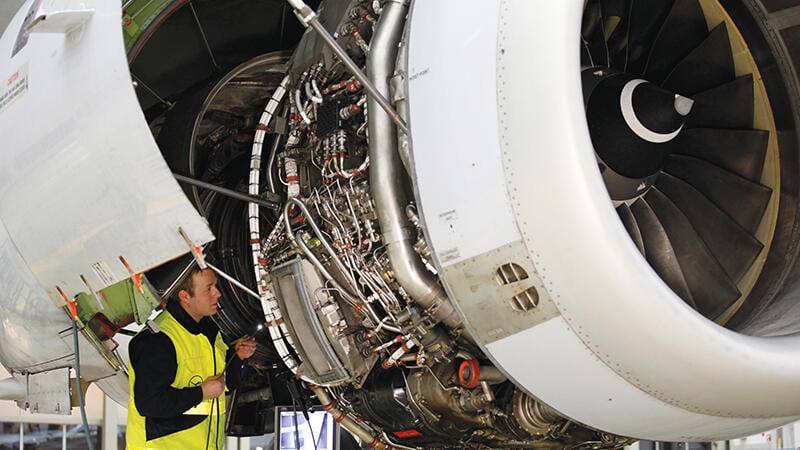
Sustained spending on older platforms, such as the IAE V2500, continues to bolster total aftermarket activity.
Airframe manufacturers are steadily boosting deliveries of new aircraft, but aftermarket support for older models is expected to maintain its strong trend for the foreseeable future as global traffic demand remains robust. For aftermarket providers, this presents another year of opportunities and related challenges.
The MRO segment has been commercial aviation’s savior, particularly since the 2020 downturn. Despite a global shortfall of about 5,000 aircraft deliveries since 2018, airlines have kept pace with passenger demand: International Air Transport Association (IATA) data shows that demand has surpassed pre-downturn figures as measured in revenue passenger kilometers.
One major reason? Continued use of older aircraft that many airlines had earmarked for retirement.
Keeping scores of Airbus and Boeing aircraft in mainline operations that are more than 20 years old can be lucrative, but it is also constraining. Engine and component shops are jammed, and new spare parts remain scarce, particularly those sourced from suppliers that are simultaneously supporting increased production rates on current-generation models. Adding pressure to affected stakeholders, the oldest current-generation engines, notably the CFM International Leap and Pratt & Whitney PW1000G geared turbofan, are entering their initial overhaul windows while early reliability and durability problems are being addressed.
But for many engine MRO providers, such problems are welcome challenges that indicate broader positive trends. “The strength of the engine aftermarket has been one of the enduring aspects of the post-pandemic recovery,” RBC Capital Markets analyst Ken Herbert wrote in a December research note previewing the 2026 aerospace landscape. “In our view, the shift of aftermarket economics to the engine market will continue in 2026. We believe the engine suppliers will continue to benefit from pricing tailwinds, work-scope expansion and pent-up demand.”
Such benefits are not universal, however. Operators are driving pricing tailwinds—part of a broader trend that is earning scrutiny from airline C-suites.
Overall annual MRO spending has risen 40% since 2019 to support 10% more global capacity, AeroDynamic Advisory calculates. Engine spending is outpacing the rest of the aftermarket—it is projected to claim a 53% share of 2026’s total commercial aftermarket revenue of $139 billion, Aviation Week’s latest forecast shows, up from 49% in 2025 and 46% in 2024.
Labor costs are part of the reason, as are rising costs of parts for increasingly complex and technically sophisticated engine designs. But supply chain headwinds are doing their fair share of damage.
An Oliver Wyman analysis prepared for IATA concluded that airlines paid about $3.1 billion in “additional maintenance costs” linked to supply chain constraints in 2025. “[The] global fleet is older than it should be, and older aircraft are more costly to maintain,” the report notes.
Airlines spent another $1.4 billion in “excess” inventory to mitigate parts availability risks, including obtaining spares and having components repaired in a timely manner.
The combination of parts scarcity and heavier workscopes often required for higher-time engines are extending turnaround times. This drives up overhaul costs and forces operators to lease more engines to fill gaps, putting even more pressure on airline balance sheets. Operators spent an estimated $2.6 billion on “excess” engine leases to keep airframes flying in 2025, IATA says.
Then there is the missed-opportunity cost. This year, annual global traffic as measured in revenue passenger kilo-meters is once again projected to outgrow capacity (measured in available seat kilometers), continuing an annual streak that dates back to 2021. While rising load factors help airline profits, they also signal pent-up demand.
“In addition to the mounting costs, supply chain challenges inhibit airlines from deploying sufficient aircraft to meet growing passenger demand,” IATA says.
An expected uptick in aircraft retirements, made possible by rising delivery rates of new aircraft, is expected to help bolster used serviceable material (USM) availability. That should help speed up some engine turnaround times. But the broader trends will not change anytime soon.
“Parts and engine maintenance capacity remain the tightest constraints in the commercial aftermarket,” a Jefferies aftermarket analysis says. “Scarcity of [USM] and limited spare engine pools are pushing lease rates and shop visit costs higher, while long induction queues and OEM-gated workscopes extend turnaround times. . . . Module-swap and exchange programs are being used to bridge gaps, but structural bottlenecks in testing, [staffing] and core part supply persist.”
While the constraints will test aftermarket providers, those that earn passing grades stand to reap significant benefits. A sizable jump in spending across the commercial aftermarket landscape is expected this year, the latest quarterly MRO survey from RBC Capital Markets shows.
Total MRO sales are projected to post a low-double-digit increase in 2026, with the scorching-hot engine segment reaching the mid-single digits. Despite faster aircraft delivery paces at both Airbus and Boeing, retirements will remain low.
Traffic demand’s growth pace might slow some. IATA’s most recent figures in December projected that revenue passenger kilometers will climb 4.9% this year versus 5.2% in 2025. Available seat kilometers, a better measure of MRO demand, are expected to edge up 4.7% year over year, down from 4.9% a year ago.
The projected declines in the two key macro metrics are triggering some concern among aftermarket providers. Asked to rank the top three factors that will influence near-term MRO growth, the 40-plus survey respondents placed traffic demand third overall on a list of 16.
Finishing at the top were two familiar issues: spare parts availability (both obtaining needed material in a timely manner and obtaining it, period) and the pace of new aircraft deliveries. More than 50% of respondents flagged the issues as among the top three key factors that will influence growth in the first half of 2026.
Overall, respondents expect an 8.5% increase in total MRO sales through the end of June.
“The next six-month outlook remains consistent with the broader results of our survey—continued strength in engine MRO and [high-single-digit] commercial aftermarket demand growth,” Herbert wrote. “These results continue to support a more gradual normalization of the commercial [aftermarket] and support continued strength into 2026.”
The full-year projections are even more encouraging: Total MRO sales are expected to rise 10.9%, led by the 11.7% jump in engine work and 11.6% increase in component work.