This article is published in Aviation Week & Space Technology and is free to read until Feb 25, 2026. If you want to read more articles from this publication, please click the link to subscribe.

Korean Air And Sanad Have Big Engine MRO Milestones In 2026

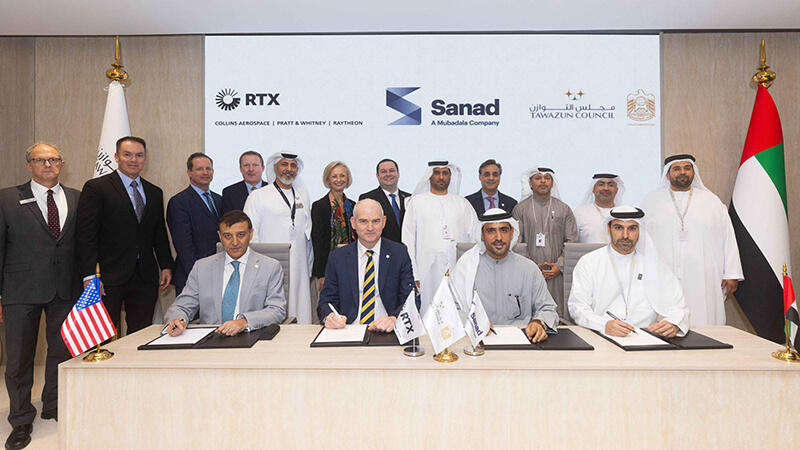
 RTX's Pratt & Whitney adds Sanad Group to the GTF MRO Network

Sanad Group joined the GTF MRO Network of RTX's Pratt & Whitney.

Credit: RTX

Sanad, wholly owned by the Abu Dhabi sovereign investment company Mubadala, and Korean Air have something in common: This is going to be a very important year for their engine businesses. Why?

Sanad forged several big deals and invested in new capabilities in 2025 that position it for growth but will require multidisciplinary action in 2026. During the Dubai Airshow, the company announced the launch of an asset management division that integrates engine leasing, parts trading and life-cycle support. By combining these functions and deepening collaboration with operators, lessors and traders, Sanad hopes to provide more sought-after engine material and services to shorten engine downtimes.

In particular, this new division “is going to evolve more toward . . . midlife and end-of-life products and acquiring those engines to support short-term leasing solutions” and used serviceable material, Sanad Group Chief Financial Officer Kashish Kohli says.

Sanad has invested $100 million so far to support the asset management division, including four Rolls-Royce Trent 700 engines from Etihad Airways and one from Rolls-Royce & Partners Finance, as well as two IAE V2500-A5 engines from Fortress Transportation & Infrastructure Investors and Magellan Aviation Group.

While the asset management division will initially focus on the Trent 700 and V2500 engines, “the idea is to create something that integrates and complements the MRO division,” Kohli says. “The focus is not going to stop there.”

In February 2025, Sanad also struck a deal with Pratt & Whitney to become the first and only member of the geared turbofan network in the Middle East and North Africa region. As part of that deal, it will start constructing a purpose-built 70,000-m2 (753,000-ft.2) facility with two test cells in Al Ain this year, which is to receive its first engine induction in 2028, Kohli says. At its peak, the facility is expected to induct 360 engines annually, he adds.

Given all of this, Kohli says: “To be honest, 2026 will be a focus year for execution.”

Korean Air is similarly in execution mode for its big engine facility on Yeongjong Island in South Korea, about 7 km (4.4 mi.) from Incheon International Airport. “This facility is a key strategic asset designed to shift the landscape of the global MRO market,” Korean Air Executive Vice President Jong Seok Yoo says. “Spanning 140,000 m2, roughly the size of 20 soccer fields, it will be the largest engine MRO facility in Asia.” The project is designed to service at least 500 engines annually, he adds.

The “smart factory” facility will use data-driven process management with fully automated logistics “to dramatically enhance precision and efficiency,” Yoo says. It is more than half-finished and is “on track for physical completion by October 2026, with full operations commencing by the second quarter of 2027,” he notes. Korean Air inducted its first engine in its new 62,000-lb. engine test cell in December.

“We are constructing this new facility not merely to expand capacity but to secure technical leadership in a rapidly changing market and to proactively meet the surging demand for next-generation engines,” Yoo says.

That is a big statement—but it is fitting for this large, high-tech facility.

All around the world, this is a year of execution for the engine aftermarket.

Lee Ann Shay

As executive editor of MRO and business aviation, Lee Ann Shay directs Aviation Week's coverage of maintenance, repair and overhaul (MRO), including Inside MRO, and business aviation, including BCA.