This article is published in Aviation Week & Space Technology and is free to read until May 14, 2026. If you want to read more articles from this publication, please click the link to subscribe.
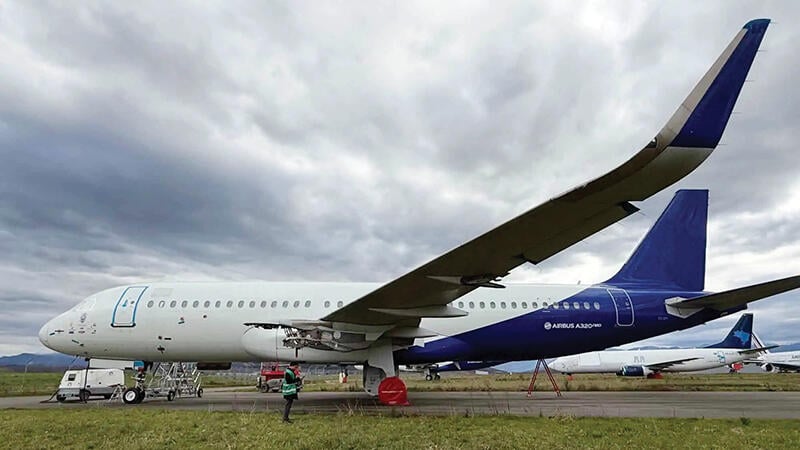
Young Airbus A320neos are increasingly being purchased for teardowns.
A growing pool of players is snapping up used airframes and engines for teardowns, intensifying competition in aviation’s used serviceable material market. And while some of these purchases support older platforms that airlines are keeping in service longer due to ongoing production delays and quality issues, the age of aircraft being tapped for part-outs is decreasing considerably as well.
In the past four years, AerFin has acquired about 160 airframes and engines for teardown. Last year, Werner Aero bought more than 20 airframes and engines. In February, Magnetic Trading acquired two Airbus A320-214s, and EirTrade Aviation announced it would tear down what it says are the two youngest A320neo airframes to date, at 3.5 and four years. Executive Jet Support recently acquired a young Airbus A321 for teardown and last year boosted its portfolio of Embraer E-Jets, A320s, A330s and turboprops. In the first few months of this year, Setna iO acquired one Boeing 737-700 airframe, two 737-800s, an Airbus A320-200, an A330-200, two GE Aerospace CF6-80E engines, four CFM International CFM56-7Bs and two CFM56-5Bs.
“Every time I log into LinkedIn, someone else has bought an aircraft,” jokes Craig Skilton, vice president of components at APOC Aviation. “I think there are more and more people competing in these bids. The landscape is definitely a lot more competitive than it has been before.”
While Skilton says this competition is driving up airframe prices, he notes that it is also reducing prices on some materials because the activity leads to a larger pool of used serviceable materials (USM) in the market.
The increased competition has driven APOC to shift its focus to differentiate itself in a saturated market, Skilton says. “We used to try to do teardowns quickly and efficiently,” he notes. “We’d buy the asset, sell everything off quickly and then move on to the next one. Whereas we’re actually taking a little bit more time over them now, making more units serviceable, maintaining a bit more of an exchange pool for end users. [We’re] trying to get more out of the aircraft, rather than just [having] a quick fire sale and on to the next one.”
According to AerFin Chief Commercial Officer James Bennett, the USM segment has seen a post-COVID-19 rebound from growing competition. “The scarcity of assets has naturally intensified the competition, even if we didn’t have new entrants [to the parts trading segment], because feedstock is scarcer, the aircraft are flying for longer, leases have been extended and new aircraft deliveries remain under pressure,” he says. “We don’t see that environment easing anytime soon. I think this is a challenge that will continue over the next 3-4 years.”
Bennett points out that the aircraft retirements the industry expected by now have not yet occurred. To return to the annual retirements of 800-900 aircraft that occurred in 2018-19, “too many things would have to happen at the same time or be resolved, whether it’s supply chain challenges on new parts manufacturing, entry-into-service problems being fixed on new aircraft or the component repair challenges that are being faced,” he says.
In response, AerFin has sought to adapt and diversify its USM inventory. A few years ago, the company was heavily focused on acquiring narrowbodies and regional jets, but in the past couple of years, it has acquired 18 Airbus A330s and five Boeing 777s. “In the last two years, we’ve acquired 60% of the A330s that have come to the market,” Bennett says. However, he notes that AerFin has also continued to focus on “narrowbody workhorses,” such as the A320ceo and A320neo, which are still facing considerable supply chain pressures.
AerFin is also targeting younger assets. Bennett says the A320neos the company acquired last year were only six years old, and many of the other fleets and subfleets it has targeted were less than 7-8 years old on average. “I don’t even know what ‘end of life’ means anymore, when the average age of all of our acquisitions in the last five years is about 11-11.5 years,” he remarks. “It’s changing the face of what is now deemed to be ready for disassembly.”
Tony Kondo, president and CEO at Werner Aero, says A320 and 737-family airframes “are always a hot commodity in the market,” so competition is high for these assets. He reports seeing more A320ceo teardown activity, adding that A320neo airframes are increasingly hitting the market. “Some airlines just returned those aircraft to the lessor because of very strong demand for engines,” he says, so lessors are taking the engines and selling the airframes for teardown.
While the majority of Werner Aero’s 2025 purchases were Embraer 190s purchased from JetBlue, the company also bought some A320s and 737s. Kondo says the company is taking advantage of parts commonality between A320ceos and A320neos, as well as E190s and E170s.
Kondo agrees that the USM segment has become increasingly competitive, noting that “there are big investments and a lot of capital coming to this market.” He adds: “Some companies are actively buying a lot. People are well aware of those activities because you always see the same names . . . buying those aircraft in big volumes.”
STRATEGIC COMPETITION
One company that frequently announces new airframe and engine acquisitions is Setna iO, founded in 2016. Tom Boulcott, partner and president of trading, says the company’s recent shopping spree has been funded through its retained earnings and commercial banking relationships and supported by industry partnerships.
“People will say to me, ‘Setna seems to be winning everything,’ and that’s just not the case,” he says. “We lose more [bids] than we win. The point is that we have the spread of relationships across the board, and people want to work with Setna, and we’re able to capitalize on any opportunities that develop more than [through] a bid process.”
Boulcott says Setna iO is “pretty agnostic” in terms of the platforms it seeks to purchase. “Our most torn-down aircraft today is the A320,” he says. “We’ve done three A321neos in the last 12 months.” This signals that teardowns are driven by factors beyond aircraft age, such as lease economics and engine issues, he says.
“We’ve torn down more A380s in the industry than anybody else at this point,” Boulcott notes. “When we bought our first two A380s in the post-COVID [period], we had a few raised eyebrows, like, ‘What are they doing? ’ We were convinced of our strategy at the time, and we got that right. That means that we had more data on those aircraft, and we’ve bought more than anyone else.”
Competition is driving Setna iO to “be more strategic and inventive” with its buying, he says. “Now everybody wants to buy an A320 with run-out engines and part it out, and the strategy for that and the price points are pretty clear,” Boulcott says. However, he notes that Setna aims to “get a bit more inventive” with these types of purchases. For example, one engine may have some green time left, so it can be leased out, while the other engine is inducted for a shop visit and sold, and then the airframe can be torn down for USM. “It’s not just about getting an end-of-life asset and tearing it all down,” he points out. “It’s about coming up with various ways that you can monetize that over a longer period.”
Another fairly new player in the USM space is Seattle Aviation Solutions (SAS), established in 2017. The company cut its teeth as a channel partner for Bombardier, and about 55-60% of its business volume is on the business jet side, according to Brandon Moyer, senior director of marketing and data.
He says SAS “reignited” its teardown program last year after purchasing and tearing down a Boeing 777 and 737 in 2022 and 2023, respectively. Between August 2025 and January 2026, SAS purchased an Airbus A319, a Learjet 45, a Learjet 60 and a 737-800. This year, the company intends to buy another 10 aircraft as part of what it calls an “aggressive” USM strategy.
Moyer says SAS has doubled its inventory to about 50 million parts, and the company’s revenue has doubled year over year for the last four years. Growing competition in the USM segment “has required us to be very strategic in what we do and how we do it,” Moyer says, noting that certain geopolitical factors have led to the need for “companies to pop up to help support different regions or markets.” SAS is headquartered in Seattle and has a warehouse in Dubai and a sales office in Turkey, which he says helps the company provide services “after our competitors have closed up their shop for the day.”
Beyond SAS’ goal of acquiring 10 aircraft this year, Moyer says it also intends to become more involved in the engine space to support customers.
HIGH DEMAND
When it comes to engines in the USM segment, most of the companies that spoke with Inside MRO for this article cited the CFM International CFM56 and IAE V2500 as two of the hottest commodities.
“Any serviceable engine right now is really hot for trade and for lease,” AerFin’s Bennett says, noting that MRO providers are at capacity for engines such as the CFM56-5B, CFM56-7B and V2500. He adds that shortages of availability on new equipment and delays on piece part repairs are driving that demand.
“We know from our lessors, friends and airlines that [CFM56-7Bs are] difficult to get a hold of within the market,” Setna iO’s Boulcott says. “This comes down to what we’ve heard year after year—leasing companies and others telling us that next year will be the year of major transitions and aircraft coming out of lease. But so far, that huge influx of aircraft onto the market hasn’t come to fruition.”
Boulcott expects that a “much larger surplus of aircraft coming toward the end of their life” will occur near the end of this decade, but he sees demand remaining consistent. “For example, there are certain parts from the [CFM56-]7B [quick engine change] which you can’t get out of there, for love or money,” he adds.
“The V2500 is in high demand at the moment,” APOC’s Skilton says. “We’ve just done two of those [teardowns]. They were very popular and they were really great to have, but also incredibly hard, and the prices are going a bit crazy on those, too.”
APOC recently performed a teardown on a GE Aerospace CF34 engine, which is “a little bit new and different” for the company as it looks to other aircraft, such as Embraers and ATRs. Skilton notes that APOC aims to conduct between six and eight airframe teardowns a year, “and it’s the same on the engine side as well.” This year, the company will be “actively bidding” on A320 and 737-family aircraft, as well as V2500 engines and landing gear, he says.
AerFin plans to scale up the number of aircraft and engines it acquires across narrowbody, widebody and regional aircraft platforms. “It’s about diversification,” Bennett says. “It’s about expanding geographically and opening up more new markets. Younger assets will make up a growing share of teardowns, and I think the strongest players will be those with capital strength, global teardown capabilities and the ability to structure subfleet and fleet acquisitions as a consequence of the relationships they have.”
Part of this strategy includes building up AerFin’s MRO capabilities to complement its part trading business and reduce lead times and aircraft-on-ground exposure. “We’re going to continue to build on what I would describe as more programmatic type relationships and offerings to our customers,” Bennett says. “So, by virtue of having and continuing to scale the inventory we’ve got, we want to be ‘sticky’ with customers—even more sticky and relevant than we were yesterday.”
Boulcott says Setna iO still sees a market for A320 teardowns despite how many are currently being parted out. “If someone offers it to us at the right price, we’re not going to turn away from it,” he says. “We’re agnostic. If somebody offered us an A350 and it was the right price, we would buy it based on the knowledge we have. We’re not going to turn away from any opportunity.”
Setna iO recently added a lease portfolio, which Boulcott says is an “exciting development” for its parts trading business. “Now, ultimately, that lease portfolio will end in those aircraft being torn down, so we won’t be selling those leases like other companies would do when the lease ends,” he says. “If they’re not going to be leased out again to the same airline, they’ll come in and be torn down. It’s about getting into the life cycle of the plane earlier and being inventive.”
TECHNOLOGICAL ADVANTAGE
Some companies are also relying on technology to evaluate potential USM demand and achieve greater efficiencies. Boulcott says Setna iO relies on artificial intelligence (AI) for data analysis, paired with an inventory system tailored to the company’s needs.
“When you come and speak to Setna, you’re not speaking to an AI bot by any means,” he stresses. “We are all about the people.” When it comes to AI, “you can use it to your advantage in terms of analysis, but the end result is always the same,” Boulcott says. “You’re just speeding up the same process, which is filtering down to the people who are making the decisions in a real, human way, and that’s where the real value is for us.”
APOC is similarly relying on technology as a differentiator in a competitive market. “We’re looking into a storefront for our parts where people can buy things easier,” Skilton says. “We’re leaning into a lot of system integrations to do things quicker and give the customers better service,” he adds, specifically noting that the company has recently rolled out AvSight software.
“Especially when we’re modeling aircraft, we’re using machine learning and some large data models and trying to use data a little bit more effectively than we’ve done in the past,” Skilton continues. “Across the business, we’re adopting AI more as an assistant . . . to enable us to do things faster and try to eliminate some of the mundane and repetitive work.
“We don’t want to take humans out of the loop, but we do want to cut out some of the time wastage we have,” Skilton adds. “I think you have to keep up with [AI] because, sadly, there will be plenty that get left behind, and there’ll be companies that are doing things incredibly more efficiently.”